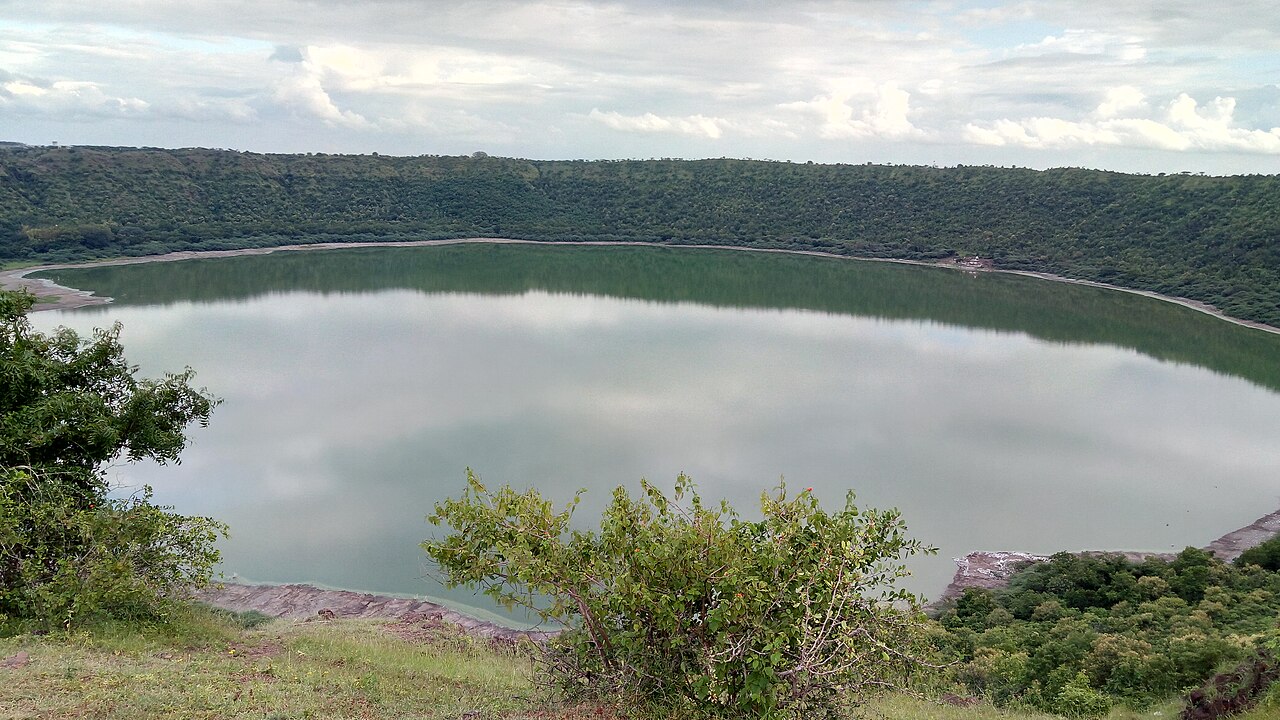
A scar on the Deccan Traps
Sometime during the Pleistocene Epoch, a meteorite traveling at hyper-velocity slammed into a 65-million-year-old flood basalt plain in what is now Maharashtra, India. The impact created the Lonar Crater, a near-circular depression with a mean diameter of 1.2 kilometers (3,900 ft) and a rim that rises about 20 meters (65 feet) above the surrounding plain. The crater floor sits roughly 137 meters (449 ft) below the rim. While age estimates vary, argon-argon dating suggests the impact occurred around 570,000 years ago.
For many years, its location within the Deccan Traps, a massive field of volcanic basalt—led geologists to believe it was a volcanic crater. The confirmation of its impact origin came with the discovery of specific shock-metamorphism features. The most definitive of these is maskelynite, a type of natural glass. Maskelynite formed when the mineral plagioclase is subjected to the extreme pressures of a high-velocity impact, a process that does not occur in volcanism. This glassy material, previously identified in lunar rock samples and meteorites, provided clear evidence of the crater's extraterrestrial origin. The presence of shatter cones and an ejecta blanket surrounding the crater further supports the impact theory. Lonar is one of only four known hyper-velocity impact craters in basaltic rock on Earth.
An alkaline, color-shifting oasis
The crater holds a shallow lake, typically less than 6 meters deep, with no outlets. This enclosed basin has resulted in water that is both highly saline and exceptionally alkaline. The pH of the lake water consistently measures between 9.5 and 10.5, creating an extreme environment. This unique chemistry supports a specialized ecosystem of microorganisms known as extremophiles, which thrive in conditions hostile to most other life. The lake hosts diverse communities of bacteria, including Proteobacteria, Actinobacteria, and Firmicutes, some of which perform biological nitrogen fixation.
In June 2020, the lake water famously and abruptly changed from its usual green hue to a bright pink. Scientific investigation concluded this was caused by a massive bloom of salt-loving microbes called Haloarchaea. These organisms produce a pink pigment, and their proliferation was likely triggered by increased water salinity due to lower water levels and higher temperatures during a dry period. As the monsoon season arrived and diluted the water, the lake gradually returned to its normal color. The lake's unusual mineralogy and microbiology make it a site for scientific research, showing conditions that might be found on Mars or the Moon.