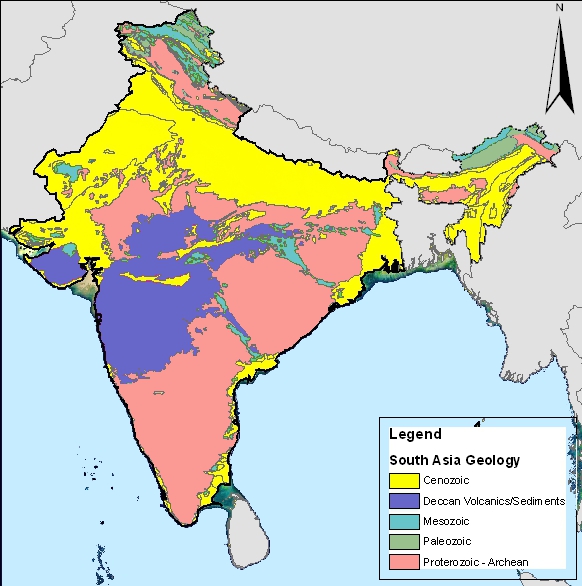
Eruptions lasting 500,000 years released enough CO2 and SO2 to cause mass extinction. The debate rages whether this or Chicxulub killed the dinosaurs.
CamArchGrad, Public domain, via Wikimedia Commons
The dinosaur's bad year
Around 66 million years ago, a series of volcanic eruptions began in west-central India that was larger than any in human history. This was the Deccan Traps, a large igneous province that erupted a staggering volume of basalt lava—estimates range from 1 to 1.1 million cubic kilometers. This molten rock spread out to cover an area of 500,000 square kilometers, with some geologists estimating the original coverage before erosion at 1.5 million square kilometers, about half the size of modern India. In places, the stacked layers of solidified flood basalt are more than 2 kilometers thick.
The main, most intense phase of these eruptions occurred over a period of roughly 750,000 years, an event that inconveniently straddles the Cretaceous-Paleogene (K-Pg) boundary. This is the precise geological moment when the non-avian dinosaurs, along with about 75% of Earth's plant and animal species, vanished from the fossil record. For decades, the main cause of this mass extinction has been the Chicxulub asteroid impact in present-day Mexico. High-precision dating, however, shows that the Deccan Traps were devastating the global environment at the exact same time, creating a major debates in paleontology.
A crime with two culprits
Scientists use high-precision dating techniques like uranium-lead (U-Pb) and argon-argon (40Ar/39Ar) on minerals like zircon found in ash layers between lava flows to construct a timeline of the eruptions. These methods have revealed that the main phase of Deccan volcanism began approximately 250,000 to 350,000 years before the Chicxulub impact. Some studies suggest the eruptions occurred in four massive pulses, each lasting about 100,000 years. One of these pulses started tens of thousands of years before the asteroid strike, releasing vast quantities of climate-altering gases.
The eruptions would have released large amounts of carbon dioxide, sulfur dioxide, and chlorine into the atmosphere. The sulfur dioxide could have created aerosols that blocked sunlight, causing a rapid "volcanic winter" and acid rain. Following this, the release of CO2 would have driven long-term greenhouse warming, raising global temperatures and acidifying the oceans. Geochemical analysis of fossil shells from this period shows evidence of both ocean warming and high concentrations of mercury, evidence of large-scale volcanic activity.
The debate now centers on whether the volcanoes were the primary killer, with the asteroid delivering a final blow, or if the asteroid was the main culprit, perhaps even triggering the most voluminous phase of the Deccan eruptions through its seismic shockwaves. Some models indicate the Deccan emissions alone were sufficient to cause the extinction, while others suggest the "impact winter" from the asteroid was the more important event. The coincidence of two global-scale catastrophes drives research and scientific argument.
💡Fun Facts
The term "traps" comes from the Swedish word "trappa," meaning stairs, which describes the step-like landscape created by the layers of lava flows.
Some individual lava flows from the Deccan eruptions are among the longest known on Earth, traveling up to 1,500 kilometers across India.
The famous Ajanta and Ellora cave temples in Maharashtra are carved directly out of the hard basalt rock of the Deccan Traps.
The volcanic hotspot that created the Deccan Traps is still active today, now located under Réunion Island in the Indian Ocean.
The geological formations are a natural landscape and are always accessible. Specific viewpoints or parks like those near Matheran or Mahabaleshwar have their own operating hours, typically sunrise to sunset.
Admission
Free to view the general landscape. Fees may apply for specific parks, viewpoints, or cave temple sites like Ajanta and Ellora.
Accessibility
The terrain is highly varied, from flat plateaus to steep, rugged hills and cliffs of the Western Ghats. Many viewpoints are accessible by car, but exploring the formations often requires hiking on uneven ground.