Geometric precision
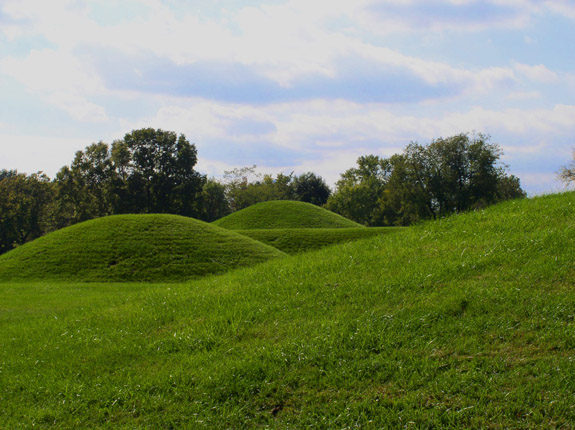
Between 100 BCE and 500 CE, the people of the Hopewell culture constructed hundreds of monumental earthworks across southern Ohio. These were not cities; evidence suggests they were ceremonial centers used for gatherings, trade, and funerals. The builders moved millions of cubic feet of earth, one basket at a time, to create precise geometric forms: perfect circles, squares, and octagons on an enormous scale. On September 19, 2023, eight of these sites were collectively inscribed as a UNESCO World Heritage Site.
The Newark Earthworks are the largest surviving complex, originally covering more than four square miles. Its main components are the Great Circle and the Octagon Earthworks. The Great Circle is a nearly perfect circle almost 1,200 feet (370 meters) in diameter, enclosing about 30 acres. Its earthen walls were once 8 to 14 feet high, with a 5-foot deep interior moat. The Octagon Earthworks consists of a 50-acre octagon connected to a 20-acre circle. Each of the Octagon's eight walls measures about 550 feet (170 m) long. The consistent use of specific dimensions across different sites, such as circles with a 1,054-foot diameter, suggests the Hopewell possessed a standard unit of measure.
The Hopewell culture also maintained a vast trade network, the Hopewell Interaction Sphere, that connected populations from the Great Lakes to the Gulf of Mexico. Materials found at Ohio sites include copper from near Lake Superior, mica from the Carolinas, obsidian from what is now Wyoming, and marine shells from the Florida coast. These exotic materials were crafted into complex objects and deposited within the earthworks during ceremonies.
An 18.6-year astronomical clock
The geometric precision of the Hopewell Earthworks extends to their alignment with celestial events. The Newark Octagon is a sophisticated astronomical observatory, engineered to track the complex cycle of the moon. The Moon does not rise and set at the same points on the horizon each night. Its rising and setting points move between northern and southern extremes over an 18.61-year cycle, a phenomenon known as the lunar standstill.
In 1982, researchers Ray Hively and Robert Horn demonstrated that the architecture of the Octagon Earthworks precisely marks the eight points of this lunar cycle. The main axis of the Octagon, viewed from the Observatory Mound, aligns with the northernmost rising of the moon, the major lunar standstill. Other sightlines created by the Octagon's gateways and walls correspond to the southernmost moonrise, northernmost moonset, and other moments in the cycle.
Tracking this 18.6-year period required systematic observation over many generations. The builders then had to translate this astronomical knowledge into a physical structure with remarkable accuracy. This achievement shows a deep understanding of geometry and a long-term cultural focus on celestial rhythms. The purpose was not agricultural, as the cycle has no practical use for planting. Instead, the earthworks created a stage for predictable, generation-spanning celestial events, and connected the community to the cosmos.