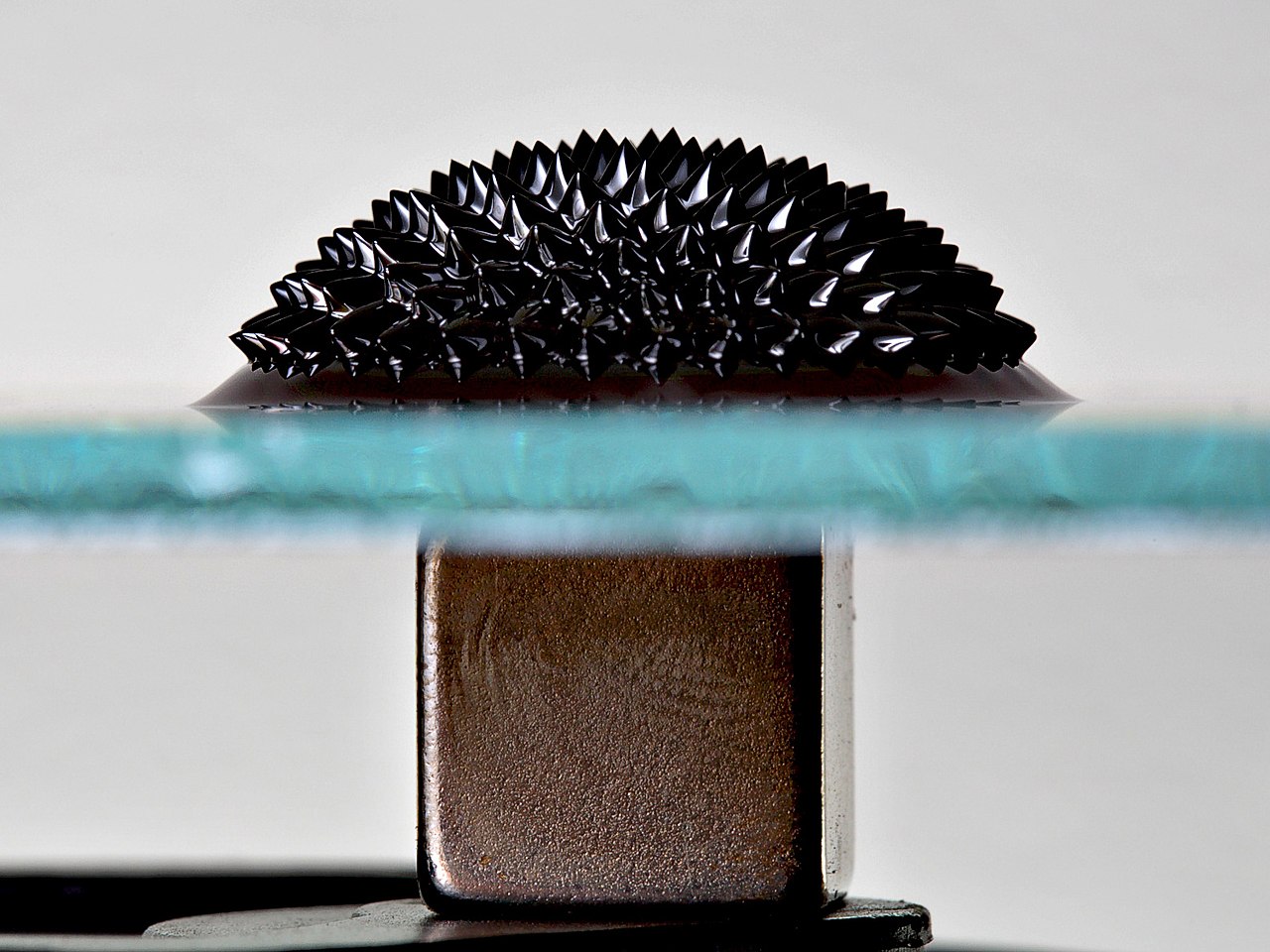
Magnetic particles in oil form spiky hedgehog patterns when exposed to magnets. The mathematics describing these shapes connects to black hole physics.
Gregory F. Maxwell <gmaxwell@gmail.com> PGP:0xB0413BFA, CC BY-SA 3.0, via Wikimedia Commons
A liquid that feels forces
A ferrofluid is a liquid that becomes strongly magnetized in the presence of a magnetic field. It is not a single substance, but a colloid—a stable suspension of tiny magnetic particles in a carrier fluid. A typical ferrofluid contains three ingredients: ferromagnetic nanoparticles, a surfactant, and a carrier liquid. The nanoparticles, often magnetite or hematite, are incredibly small, with a mean diameter of about 10 nanometers. Each of these particles is coated with a surfactant, a substance that stops them from clumping together due to magnetic and other forces. This coated-particle mixture is then suspended in a carrier liquid, such as oil or water. By volume, a standard ferrofluid is about 5% magnetic solids, 10% surfactant, and 85% carrier fluid.
This material was invented in 1963 by NASA scientist Stephen Papell. The original purpose was to create a liquid rocket fuel that could be drawn into a pump inlet in the weightless environment of space using a magnetic field. While this application was never fully realized, the research led to a new class of materials with unique properties. Ferrofluids are not typically ferromagnetic; they are superparamagnetic. This means they exhibit strong magnetic properties only when a magnetic field is present and do not retain magnetization once the field is removed.
The Rosensweig instability
When a pool of ferrofluid is subjected to a strong, uniform magnetic field applied perpendicular to its surface, a pattern emerges. The once-flat liquid surface erupts into a regular arrangement of peaks and valleys. This phenomenon is called the normal-field instability, or the Rosensweig instability, after researcher Ronald E. Rosensweig who extensively studied ferrohydrodynamics. The formation of these spikes is a balance between competing forces. The magnetic field pulls the fluid outward along its field lines, creating the peaks. This action is countered by gravity, which pulls the fluid down, and surface tension, which tries to minimize the surface area and keep it flat.
A critical magnetic field strength must be reached before the spikes can form. Below this threshold, surface tension and gravity dominate. Above it, the magnetic energy reduction from forming peaks outweighs the energy cost of increasing the surface area and fighting gravity. The resulting peaks, often called Rosensweig crests, arrange themselves in a stable hexagonal pattern when viewed from above. The height and spacing of the spikes are determined by the strength of the magnetic field and the physical properties of the specific ferrofluid, such as its magnetic susceptibility and surface tension.
The mathematics describing the Rosensweig instability—how the liquid surface deforms under magnetic, gravitational, and surface tension forces—is similar to astrophysics. Researchers have identified similarities between the equations governing ferrofluid surface dynamics and those describing the behavior of rotating black holes. Specifically, the patterns are analogous to instabilities that can occur at a black hole's event horizon. These fluid-based systems are "analogue" models, allowing scientists to study complex gravitational phenomena in a controlled laboratory setting by observing wave interactions in a vortex.
💡Fun Facts
Ferrofluids were originally invented at NASA to create a liquid rocket fuel that could be guided into a pump in a zero-gravity environment.
The distinctive spikes are named Rosensweig peaks after Ronald E. Rosensweig, an important figure in the development of ferrohydrodynamics, the study of magnetic fluid mechanics.
High-performance loudspeakers often use ferrofluid to cool the voice coil and damp unwanted vibrations, improving audio quality.
Each magnetic nanoparticle, about 10 nanometers wide, is coated with a surfactant to prevent the particles from sticking together.