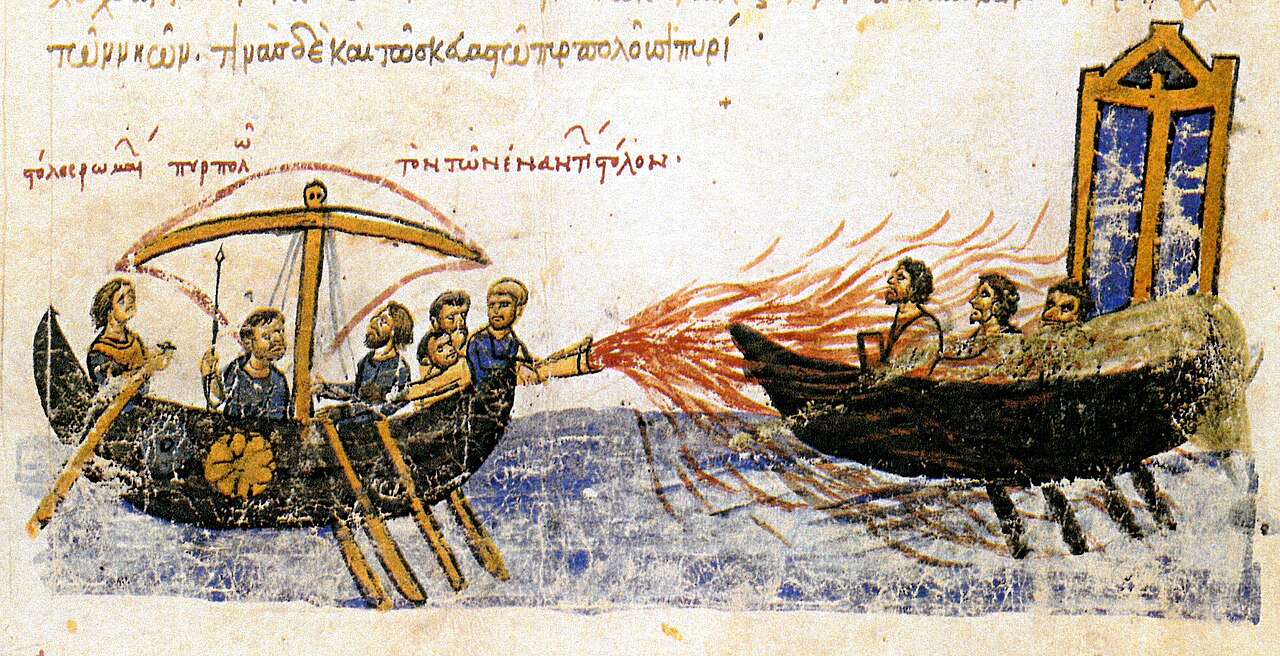
Byzantine "Greek Fire" destroyed enemy fleets by burning on water and resisting extinction. The formula was so secret it died with the empire. We still don't know exactly how they made it.
Unknown authorUnknown author, Public domain, via Wikimedia Commons
The Empire's Secret Fire
In the 7th century CE, the Byzantine Empire faced constant threats, particularly from Arab fleets attempting to conquer its capital, Constantinople. An architect and engineer named Kallinikos, a refugee from Syria, is credited with developing a new incendiary weapon around 672 CE that would alter the course of naval warfare. This substance, which the Byzantines called "sea fire" or "liquid fire," became one of the most effective and feared weapons of its time.
Its first major deployment occurred during the First Arab Siege of Constantinople (674–678 CE). The Byzantine navy used the weapon to devastating effect, destroying the attacking fleet and securing a victory for the empire's survival. Accounts describe a liquid that clung to ships and sailors, was accompanied by a loud roar and thick smoke, and, most unnervingly, could not be extinguished by water. In fact, sources suggest water only intensified the flames. This property made it a terrifying psychological weapon, causing panic among enemy crews who found that even the sea offered no escape. The formula was so important that Byzantine emperors passed it down to their successors as a state secret.
Reconstructing a Lost Formula
The exact chemical composition of Greek Fire remains unknown, as the secret formula was lost with the decline of the Byzantine Empire. Modern analysis, based on historical texts and chemical principles, suggests the primary ingredient was a petroleum-based substance, likely crude oil or naphtha, which was available from natural seeps around the Black Sea. This petroleum base would be mixed with other substances to create a sticky liquid comparable to modern napalm.
Leading theories propose a mixture that included pine resin as a thickener, allowing the substance to adhere to targets. Other probable ingredients were sulfur and quicklime (calcium oxide). The presence of quicklime could explain the weapon's most mysterious property. Quicklime reacts exothermically with water, generating intense heat. This reaction could have been sufficient to ignite the petroleum mixture, explaining why the fire seemed to intensify when doused with water. Another theory says the formula included calcium phosphide, which produces phosphine gas upon contact with water—a gas that ignites spontaneously in air.
The delivery system was as secret as the formula itself. The Byzantines developed a complex apparatus called a siphōn, a large bronze tube mounted on the prow of their warships, known as dromons. A system of pumps and heated, sealed cauldrons pressurized the liquid, which was then projected in a stream towards enemy ships and ignited at the nozzle. For land-based warfare and sieges, smaller, portable versions called cheirosiphōnes were developed, along with clay pots filled with the mixture that functioned as primitive grenades.
💡Fun Facts
The term "Greek Fire" was coined by Western European Crusaders; the Byzantines themselves used names like "sea fire," "Roman fire," or "liquid fire".
The secret of its manufacture was so compartmentalized that even when enemies captured ships with the siphons, they could not replicate the full weapon system.
The formula was allegedly known only to the emperor and the family of its inventor, Kallinikos, who passed the secret through generations.
The only substances said to extinguish the fire were sand, strong vinegar, or old urine, likely through a chemical reaction or by smothering the flames.