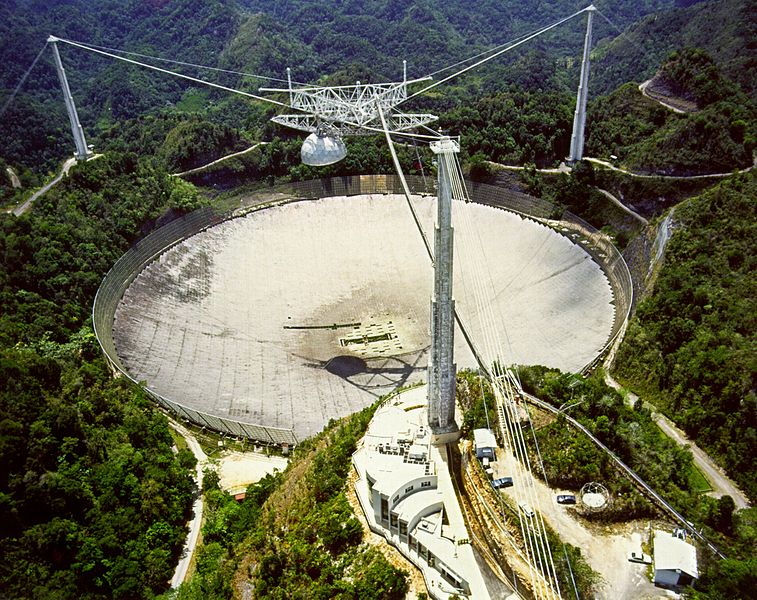
The question of why we've found no evidence of alien life despite high probability. Explanations range from the Great Filter to the Dark Forest hypothesis.
H. Schweiker/WIYN and NOAO/AURA/NSF, CC BY 4.0, via Wikimedia Commons
The great silence
The Fermi Paradox grapples with a deep contradiction: in a universe with billions of stars much older than our own, many with Earth-like planets, intelligent life should be common. Yet, the cosmos is conspicuously quiet. This silence is the physical evidence of the paradox. The Drake Equation, a framework created by astronomer Frank Drake in 1961, attempts to estimate the number of detectable civilizations in our galaxy. It multiplies several variables: the rate of star formation, the fraction of stars with planets, the number of habitable planets per system, and the fractions of those planets that develop life, intelligence, and detectable technology, along with the civilization's lifespan. Even conservative estimates can yield thousands of civilizations in the Milky Way.
So where is everybody? Explanations vary widely. The "Great Filter" hypothesis suggests that some step in the evolution of life to a galaxy-spanning civilization is exceptionally improbable, and we do not know if we have passed it or if it lies ahead. Other ideas propose that interstellar travel is simply too difficult or that advanced civilizations have no interest in colonization. More unsettling theories, like the Zoo Hypothesis, posit that aliens watch us from a distance, intentionally avoiding contact. The Dark Forest hypothesis offers a grimmer explanation: that civilizations stay silent for fear of being destroyed by more advanced competitors.
Arecibo's ear to the cosmos
For 57 years, the Arecibo Observatory was a monumental tool in the search for an answer. Built into a natural sinkhole, its 305-meter (1,000-foot) dish was the world's largest single-aperture telescope for over five decades. Its massive collecting area made it uniquely sensitive for the Search for Extraterrestrial Intelligence (SETI). Arecibo was the primary instrument for Project Phoenix, a privately funded continuation of NASA's SETI program that scanned over 700 nearby sun-like stars between 1995 and 2004. The observatory also provided the data for the popular distributed computing project, SETI@home.
On November 16, 1974, Arecibo did listen; it sent a message. To mark a major upgrade, scientists including Frank Drake and Carl Sagan broadcast a pictorial message toward Messier 13, a globular star cluster 25,000 light-years away. The transmission lasted less than three minutes and consisted of 1,679 binary digits. When arranged in a grid of 73 rows by 23 columns, the bits form a simple infographic depicting the numbers one to ten, the atomic numbers of important biological elements, the formula for DNA, a human stick figure, and a diagram of our solar system and the Arecibo telescope itself. The broadcast was a technological demonstration than a serious attempt at contact, as M13 will have moved by the time the message arrives. After decades of searching and one brief transmission, Arecibo's main instrument collapsed on December 1, 2020, leaving the silence.
💡Fun Facts
The number 1,679 was chosen for the Arecibo message because it is a semiprime (the product of two prime numbers, 23 and 73), making its arrangement into a two-dimensional grid less ambiguous for a recipient.
The Arecibo telescope was so large it could not be steered like a traditional dish. Instead, the 900-ton receiver platform was moved along tracks above the dish to track objects as the Earth rotated.
Data from Arecibo helped discover the first planets ever found outside our solar system, orbiting a pulsar in 1992.
The observatory's unique structure featured prominently in the James Bond film *GoldenEye* (1995) and the science fiction movie *Contact* (1997).
The main telescope is gone, but the Ángel Ramos Foundation Science and Visitor Center is now part of the new Arecibo C3 educational facility, anticipated to open in 2025. Check the official website for updates on public access.
Admission
To be announced.
Accessibility
The observatory is located in a mountainous, remote area. The visitor center itself is generally accessible.