An Unlikely Freezer
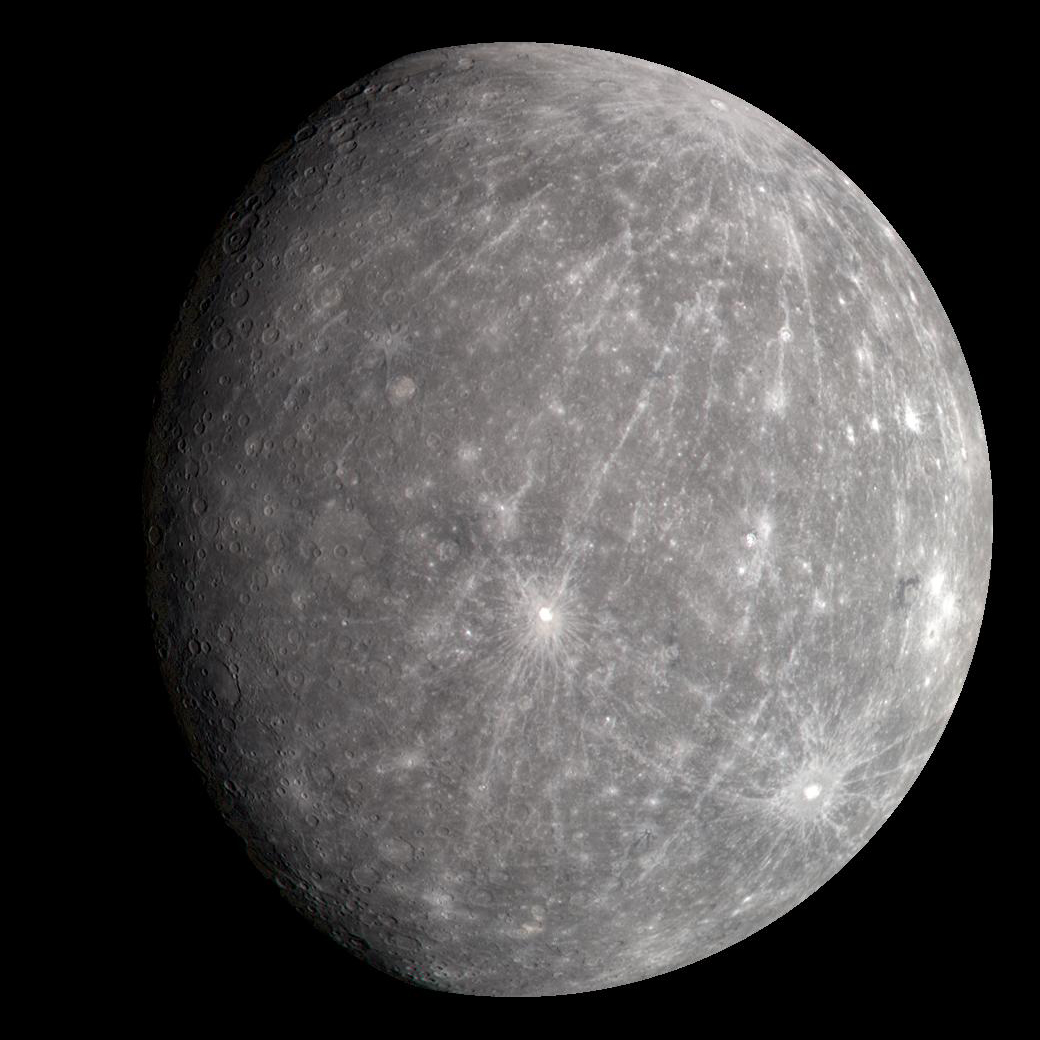
Mercury is a planet of extreme temperatures. Its sun-facing side can reach 430°C (800°F), hot enough to melt lead. Yet, against all odds, the planet harbors vast deposits of water ice. The explanation for this paradox lies in the planet's axial tilt. Mercury's axis is tilted by only a tiny amount, meaning the sun's rays arrive at the poles at a very shallow angle. The rims of deep polar craters create areas of permanent shadow that sunlight never reaches. In these perpetually dark regions, temperatures plummet to as low as -173°C (-280°F), creating cold traps where ice can remain stable.
The first hints of this ice came in the 1990s from radar observations at the Arecibo Observatory, which detected unusually bright patches at the poles. These radar-bright features corresponded to large impact craters mapped by the Mariner 10 spacecraft in the 1970s. Confirmation arrived decades later with NASA's MESSENGER (MErcury Surface, Space ENvironment, GEochemistry, and Ranging) probe, which orbited the planet from 2011 to 2015. MESSENGER's instruments mapped the shadowed regions and measured hydrogen concentrations, providing direct evidence for water ice in craters like Prokofiev and Kandinsky.
Cosmic Delivery and a Dark Blanket
Scientists estimate Mercury's polar regions hold between 100 billion and 1 trillion metric tons of water ice. If this ice were spread over an area the size of Washington, D.C., it would form a layer more than two miles thick. The origin of this water is being studied study. The two primary theories involve external delivery. One suggests that water-rich comets and asteroids have impacted Mercury over millions of years, depositing their volatile contents. Protons from the solar wind protons from the solar wind react with oxides in Mercury's surface minerals to form water, which then migrates to the polar cold traps.
The ice is not pure. MESSENGER's data revealed that most ice deposits are buried beneath a thin, dark layer. This material is likely a mix of complex organic compounds, also delivered by comets and asteroids. This dark blanket acts as an insulator, protecting the ice below from sublimation and preserving it over geological time. In the very coldest parts of the craters, pure water ice is exposed directly at the surface, but elsewhere it is hidden by this dark, organic-rich material. The European-Japanese BepiColombo mission, which will enter Mercury's orbit in 2026, is expected to provide more detailed data on the composition and origin of these polar deposits.