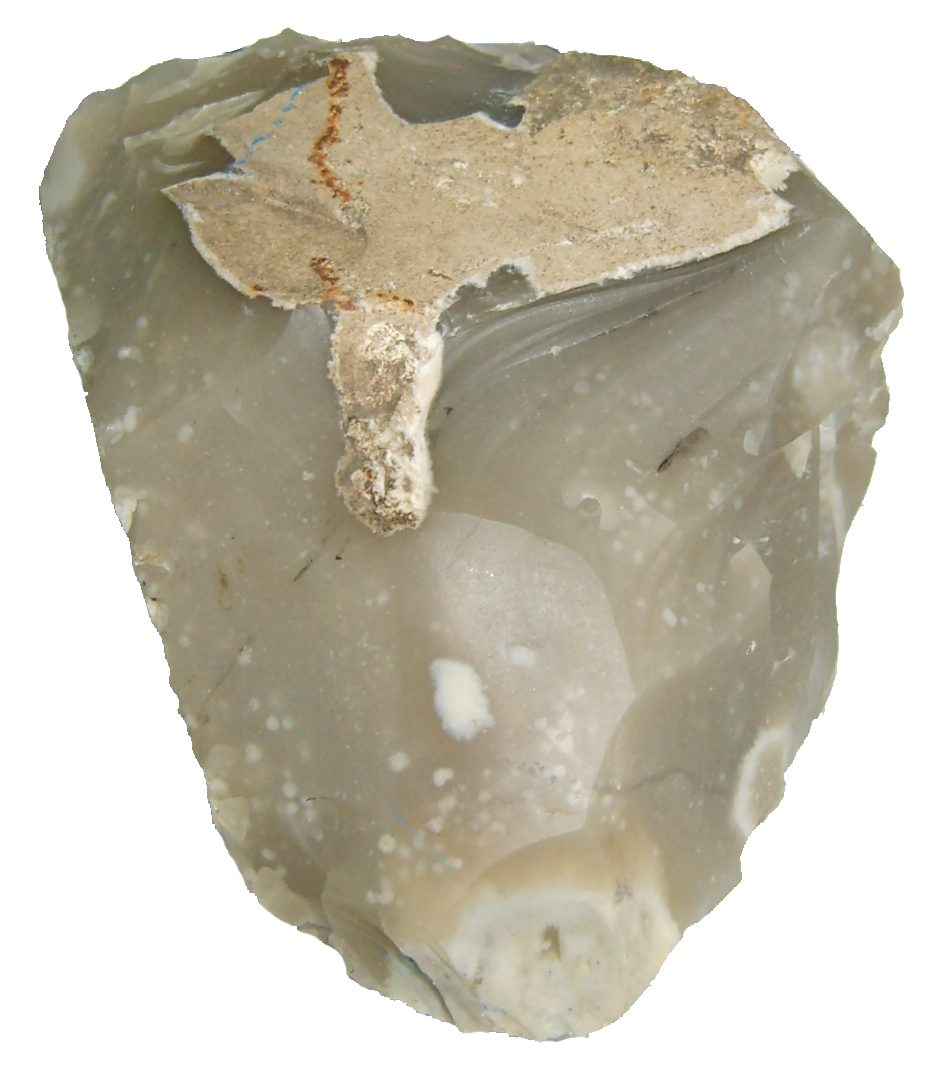
A site filled with rocks that look exactly like stone tools but were actually shaped by natural geological forces. It became a famous case study in how easy it is to fool yourself into seeing human craftsmanship where none exists, a cautionary tale for archaeologists.
Otis Crandell, CC BY-SA 3.0, via Wikimedia Commons
The dawn stones of Kent
In the rolling hills of Kent, the chalky soil is filled with flint, a hard, silica-rich rock. For centuries, these stones were just part of the area. But in the 1880s, a local grocer and amateur archaeologist from the village of Ightham named Benjamin Harrison began to see something more. In the wake of Darwin's theories, the scientific world was actively searching for evidence of early humans. Harrison believed he had found it. He collected thousands of flints from the high plateaus that showed what he considered to be clear signs of human workmanship: sharp edges and pointed ends that looked like "bulbs of percussion"—the tell-tale convex bulge left on a stone when it is struck deliberately.
He called them "eoliths," meaning "dawn stones," believing them to be the crude first attempts at tool-making by humans from the Pliocene epoch, millions of years in the past. His finds, first reported to the British Association for the Advancement of Science in 1885, gained support from respected geologists like Sir Joseph Prestwich. For a time, the eoliths of Kent were celebrated as proof of humanity's deep origins in Britain. The idea spread, and soon eoliths were being reported from sites all across Europe.
A geological illusion
Not everyone was convinced. The debate over the eoliths raged for nearly 50 years, a period known as the "eolith controversy." Skeptics pointed out that the shapes were too crude and varied to be convincing tools. Geologists like S. Hazzledine Warren argued that powerful natural forces could mimic human craftsmanship. The flint-bearing chalk plateaus of Kent were subject to immense geological pressures. Scientists demonstrated that the slow, heavy movement of soil, the grinding force of ancient glaciers, and even thermal expansion and contraction from freezing and thawing could fracture flint in ways that created sharp edges and percussion-like marks.
The French archaeologist Marcellin Boule published an early critique in 1905, arguing it was impossible to distinguish the objects from naturally damaged stones. The final scientific resolution came in the 1930s from the work of A. S. Barnes. He developed a method to statistically analyze the angle of flake scars on flint. He showed that flakes made by intentional human strikes consistently fall within a certain angular range. The flakes on the Kent eoliths, however, were completely random, consistent with the uncontrolled force of nature. The dawn stones were geofacts, not artifacts. The long debate forced the young science of archaeology to develop more rigorous, objective methods for identifying human-made tools, making the fields of Kent a critical lesson in scientific skepticism.
💡Fun Facts
The term "eolith" was officially coined in 1892 by archaeologist J. Allen Brown.
The belief in eoliths was so widespread that it helped gain acceptance for the infamous "Piltdown Man" fossil, which was later exposed as a hoax.
Benjamin Harrison's massive collection of eoliths was meticulously documented in a series of notebooks, many of which are now held by the Maidstone Museum.
Some early experiments to disprove the eolith theory involved tumbling flints in a cement mixer to show how natural abrasion could create tool-like shapes.
Always open. The "graveyard" is a conceptual term for the open fields and plateaus of the Kent Downs.
Admission
Free
Accessibility
The locations are in open countryside, involving walks over uneven and potentially muddy agricultural land and public footpaths. Sturdy footwear is recommended.