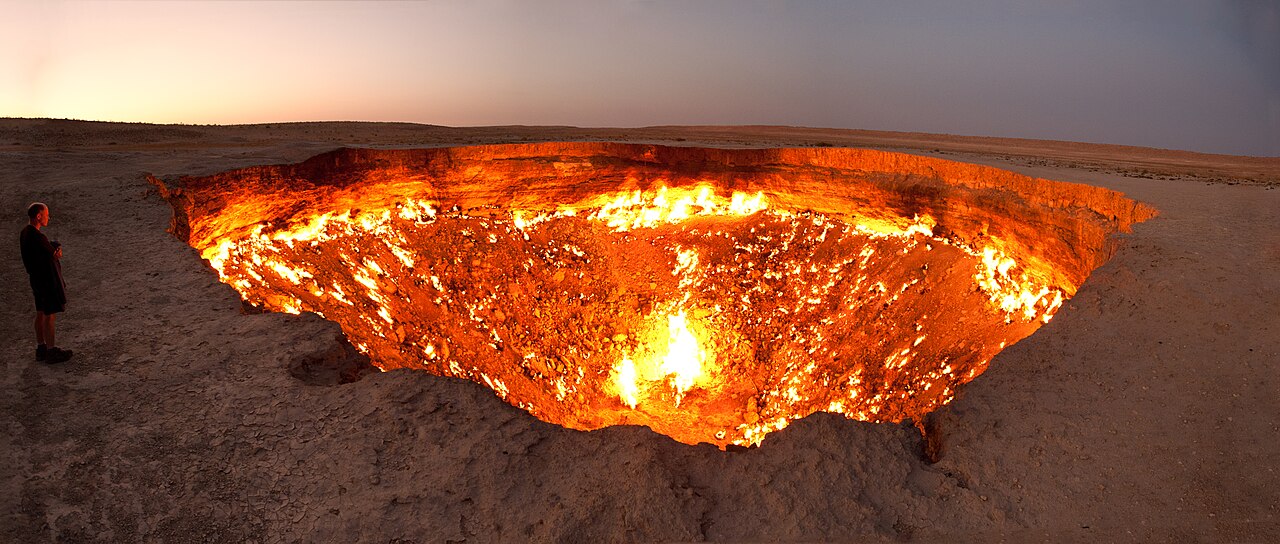
In 1971, Soviet engineers drilling for oil punched into a cavern filled with natural gas. Fearing toxic fumes, they set it on fire expecting it to burn out in weeks. Over 50 years later, the 70-meter-wide crater still blazes in the desert.
Tormod Sandtorv, CC BY-SA 2.0, via Wikimedia Commons
An Accidental Inferno
In 1971, a Soviet drilling operation in the Karakum Desert took an unexpected turn. The ground beneath the rig collapsed, swallowing the equipment into a massive subterranean cavern full of natural gas. The primary component of this gas was methane, a potent, dangerous substance. To prevent the uncontrolled release of poisonous fumes that could endanger the nearby village of Darvaza, the engineers made a fateful decision: they set the gas ablaze. The logic was that the fire would consume the leaking gas in a matter of weeks.
This calculation proved dramatically wrong. The cavern was part of one of the largest natural gas reserves on the planet, and the fire never went out. For more than half a century, the Darvaza Gas Crater—nicknamed "The Doorway to Hell"—has burned continuously. The crater measures approximately 70 meters (230 feet) in diameter and is about 30 meters (98 feet) deep. The sound of thousands of individual flames roaring at once has been compared to that of a jet engine.
A Unique Scientific Subject
The crater is a spectacle; it is a unique environment for scientific study. In November 2013, explorer George Kourounis became the first person to descend to the bottom of the crater. Protected by a custom-made Kevlar harness and an aluminized, heat-reflective suit with a self-contained breathing apparatus, he collected soil samples from the fiery floor.
The analysis of these samples produced a remarkable discovery. Scientists found several species of extremophile bacteria thriving in the hot, methane-rich environment. These microorganisms were not present in the soil of the surrounding desert, indicating they are part of a unique micro-ecosystem that has adapted to the crater's harsh conditions. This finding has implications for astrobiology, suggesting that life might exist in similarly extreme conditions on other planets.
The government of Turkmenistan has made several announcements about its intention to extinguish the fire, citing environmental damage and the waste of valuable gas resources. In 2022, the president ordered officials to devise a plan to finally put out the flames. More recent plans involve drilling a new well to divert the gas flow away from the crater. Despite these efforts, the Doorway to Hell continues to burn, a persistent reminder of an engineering misjudgment.
💡Fun Facts
The crater's official name, given by the government, is the "Shining of Karakum".
In 2013, explorer George Kourounis became the first person to set foot on the crater floor, finding heat-loving bacteria.
The fire burns very cleanly with no smoke, as the fuel is natural methane gas.
The President of Turkmenistan has ordered the fire to be extinguished on at least two separate occasions, in 2010 and again in 2022, but the crater remains alight.
The site is accessible 24/7, though viewing is most impressive after dark.
Admission
Access is free, but reaching the site requires hiring a guide with a 4x4 vehicle, which can be costly.
Accessibility
The crater is in a remote part of the Karakum Desert. The final leg of the journey is an off-road drive over sand, making it inaccessible for standard vehicles or wheelchairs.