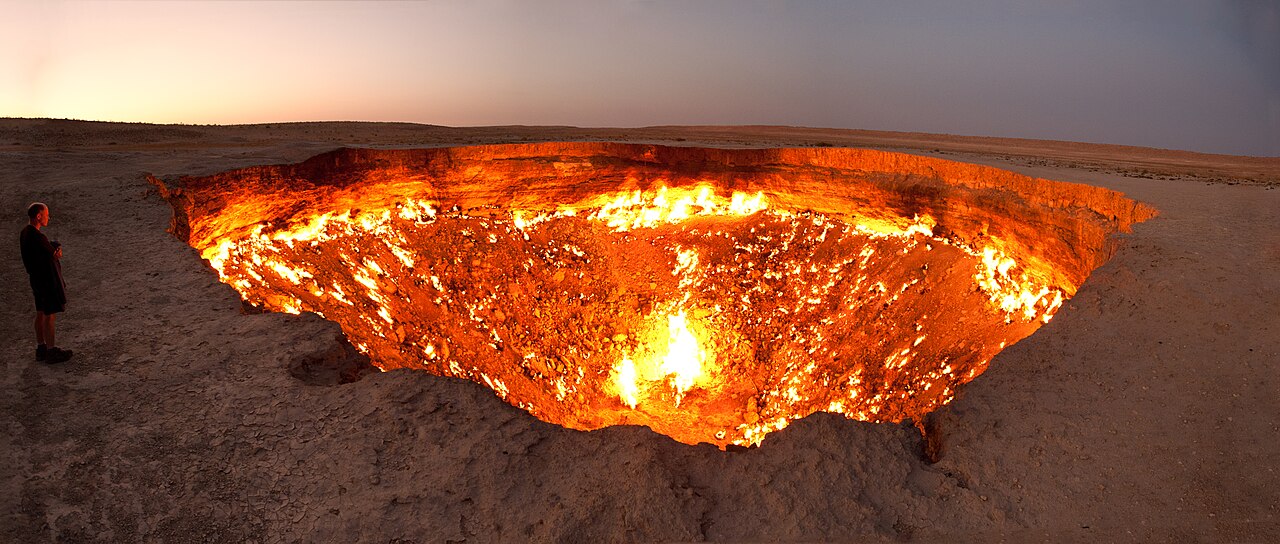
A fiery industrial accident in Turkmenistan's Karakum Desert, a pit 70 meters (230 feet) wide and 30 meters (98 feet) deep has been burning for over five decades.%%CITE_1%%%%CITE_2%%%%CITE_3%% This is the Darvaza gas crater, known as the "Door to Hell."%%CITE_2%%%%CITE_3%% Its origin is a persistent industrial accident. While records are sparse, the most accepted story is that in 1971, a Soviet drilling rig punctured a massive underground natural gas cavern.%%CITE_1%%%%CITE_2%%%%CITE_4%%%%CITE_5%% The ground collapsed, swallowing the rig and creating the crater. To prevent the spread of poisonous methane gas, geologists reportedly set it on fire, expecting it to burn out within weeks.%%CITE_2%%%%CITE_3%%%%CITE_5%% The gas reserves were far vaster than anticipated, and the fire has never stopped.%%CITE_3%%
The crater's official name is the "Shining of Karakum," but its fiery glow, visible from miles away, earned its more dramatic nickname. The sound from within is like a jet engine, as high-pressure gas fuels thousands of individual flames. While ambient temperatures inside can exceed 1,000°C (1,830°F), this extreme environment became a target for a major scientific question: could life exist here?
The Extremophile Microbiome Project
In November 2013, explorer George Kourounis became the first person to descend to the bottom of the crater. The expedition, sponsored by National Geographic, was part of the Extreme Microbiome Project. Kourounis rappelled into the inferno wearing a heat-reflective suit and a self-contained breathing apparatus. He had only 17 minutes on the crater floor to collect soil samples.
The goal was to search for extremophiles—organisms that thrive in physically or geochemically extreme conditions. Scientists were particularly interested in whether life could survive in this hot, methane-rich environment, as an analog for conditions on other planets.
Analysis of the soil samples revealed that DNA sequencing confirmed the presence of a sparse but active microbial ecosystem. These bacteria were thriving in the hot, anoxic conditions at the bottom of the crater. The microbes discovered within the crater were not found in the surrounding desert soil, indicating a unique ecosystem had adapted to the crater's specific environment. Some of these lifeforms metabolize methane directly, using chemosynthesis for energy instead of photosynthesis. The discovery of new bacterial life, previously unlisted in DNA databases, showed that life could persist in environments once thought to be completely inhospitable.