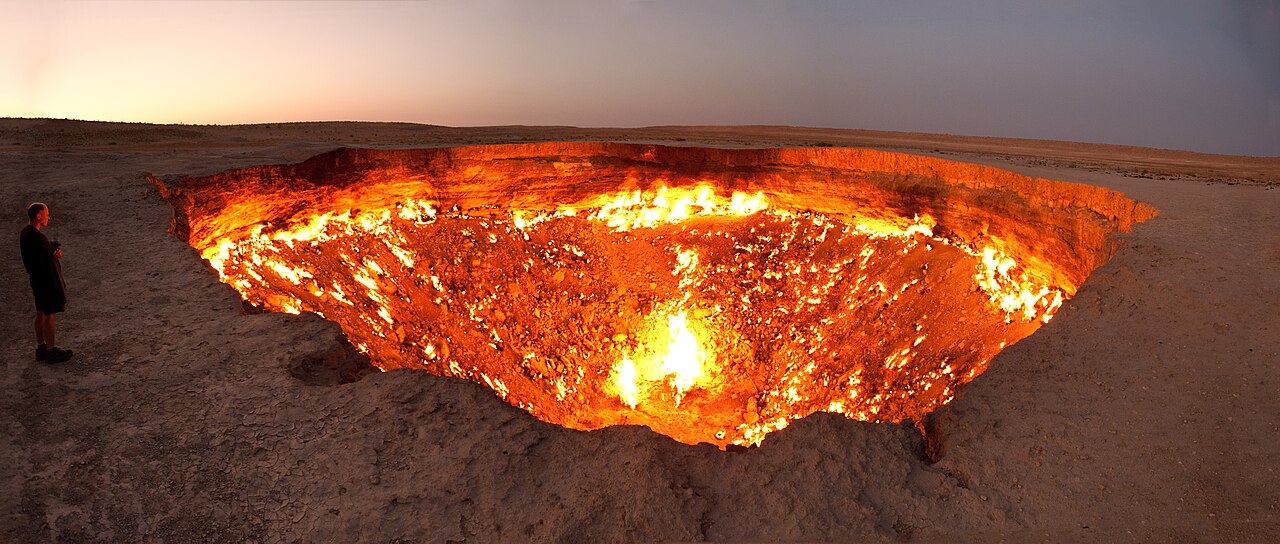
A fiery scientific frontier in Turkmenistan's Karakum Desert is the Darvaza gas crater, a fiery pit known locally as the "Shining of Karakum."%%CITE_1%% This blazing chasm, roughly 69 meters (225 feet) wide and 30 meters (99 feet) deep, has been burning continuously since 1971.%%CITE_1%%%%CITE_2%% The crater's origin is most commonly attributed to a Soviet-era gas exploration accident.%%CITE_3%%%%CITE_4%%%%CITE_5%% Geologists drilling for natural gas reportedly hit a cavern, causing the ground to collapse and release large quantities of methane.%%CITE_5%% To prevent the spread of the toxic gas, they set it alight, expecting it to burn out in weeks.%%CITE_6%%%%CITE_7%%%%CITE_8%% Decades later, the fire still rages, fed by the vast natural gas reserves of the Amu-Darya Basin.%%CITE_6%%
The crater's extreme environment, with temperatures reaching 1,000 degrees Celsius (1,832 degrees Fahrenheit), presents a unique laboratory for studying life's resilience. In November 2013, explorer George Kourounis became the first person to descend to the bottom. Sponsored by National Geographic, his mission was to collect soil samples for the Extreme Microbiome Project. Wearing a custom-made Kevlar harness and a heat-reflective aluminum suit, Kourounis spent about 17 minutes on the crater floor, gathering material for analysis.
Redefining the limits of life
The samples collected by Kourounis yielded a significant discovery: bacteria thriving in the scorching methane-rich environment at the crater's base. Analysis revealed that these microorganisms were not present in the soil outside the crater, indicating they are part of a unique micro-ecosystem. These organisms are classified as extremophiles—or more specifically, thermophiles—adapted to survive in conditions of extreme heat that would be lethal to most other life forms.
This discovery has implications for astrobiology. The ability of these microbes to survive in such a harsh, hydrocarbon-rich environment suggests that the "habitable zone" around distant stars might be wider than previously thought. Planets once dismissed as too hot to support life could potentially harbor similar extremophilic organisms. The Darvaza crater is an analogue for high-temperature environments on other worlds, pushing scientists to reconsider the conditions under which life might originate and persist elsewhere in the universe. The existence of these thermophiles demonstrates that life can occupy niches far more extreme than once imagined.