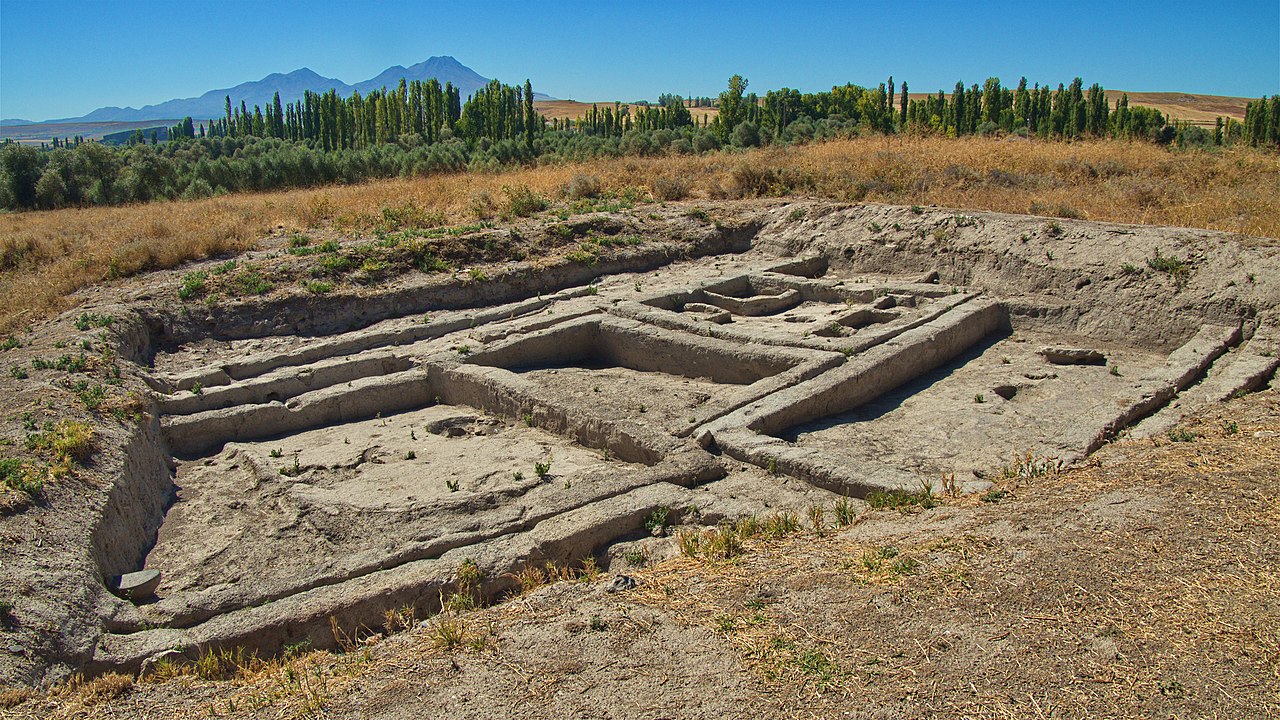
10,400-year-old obsidian knapping debris shows specialized tool production for trade. Use-wear analysis reveals they made 50% more tools than local needs, proving specialized craft production predated agriculture by 1,000 years.
Joe Wallace, CC BY-SA 2.0, via Wikimedia Commons
An industrial revolution before farming
Aşıklı Höyük is a settlement mound in Cappadocia, Turkey, that documents approximately 1,000 years of continuous occupation. Radiocarbon dating places its settlement between 8200 and 7400 BCE, during the Aceramic Neolithic period, also known as the Pre-Pottery Neolithic. This community of hunter-gatherers was one of the first in Central Anatolia to adopt a sedentary lifestyle, constructing distinctive mud-brick buildings clustered together without streets. Access to these rectangular structures was through openings in the flat roofs.
Within this early village, archaeologists have identified dedicated workshop areas containing vast quantities of obsidian debitage—the waste material from tool making. The sheer volume of this debris points to production on a scale that far exceeded the community's own requirements. The settlement sits just 25-30 kilometers from the Cappadocian obsidian sources of Göllü Dağ and Nenezi Dağ, giving its artisans direct access to high-quality volcanic glass. This proximity allowed the people of Aşıklı Höyük to become expert craftspeople, producing obsidian tools for themselves and for exchange with distant communities.
Scientific analysis of stone tools
Scientific investigation of the stone tools reveals the workshop's sophistication. Use-wear analysis, which examines the microscopic polishes and striations on a tool's edge, shows what materials the tools were used to cut. These studies indicate that tools from Aşıklı Höyük were used for a variety of tasks, including hide working, butchery, and processing plants. The analysis confirms that a significant portion of the tools produced were never used locally. This surplus production indicates organized, specialized labor intended for trade.
The obsidian from Cappadocian sources has been found at prehistoric sites in Cyprus, Iraq, and the Levant, demonstrating the extensive trade networks that existed 10,000 years ago. The industrial-level production at Aşıklı Höyük shows that complex economic behaviors like specialized craft production and trade were established parts of society long before the full adoption of agriculture. The residents were managing wild sheep and goats in the early stages of domestication, but their economy was not yet based on farming. This workshop shows a complex society innovating with industrial-scale production a millennium before the agricultural revolution took hold in the region.
💡Fun Facts
A skull belonging to a woman aged 25-30 shows evidence of the earliest known brain surgery (trepanation). She appears to have lived for a short time after the procedure.
Buildings at Aşıklı Höyük did not have ground-level doors; entry and exit were through the roof.
The residents were among the first to manage and herd sheep and goats, a critical step toward animal domestication.
Artisans at the site created one of the world's earliest known obsidian bracelets, which was shaped and polished with a surprisingly complex technique that researchers are still studying.