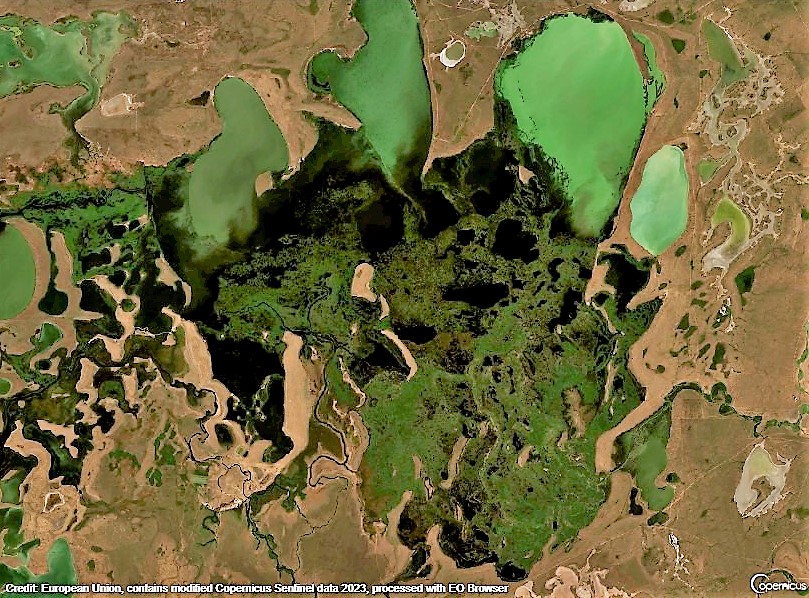
A Tale of Two Lakes in the Kazakh steppe, part of the Saryarka UNESCO World Heritage site, lies a deep hydrogeological puzzle.%%CITE_1%%%%CITE_2%%%%CITE_3%% The Tengiz-Korgalzhyn lake system is a vast wetland, but its two main bodies of water have different chemical compositions.%%CITE_4%% Lake Korgalzhyn is a freshwater ecosystem, with a salinity of about 0.2 to 0.5 grams per liter, sustained by the constant inflow of the Nura River.%%CITE_5%%%%CITE_6%% Immediately adjacent, the enormous Lake Tengiz is a hypersaline, terminal basin.%%CITE_4%% With no outlet, its waters can reach a salinity of 300 g/L, a concentration significantly higher than that of the Dead Sea.
This extreme difference occurs in lakes that are part of the same interconnected system. Water from the Korgalzhyn lakes can even flow into Tengiz during spring floods. For years, the question was how two adjacent water bodies, seemingly sharing a source, could develop such radically different chemistries. The answer is a combination of topography, hydrology, and the relentless power of the sun in an arid landscape.
Evaporation's Isotopic Fingerprint
Scientific investigation using stable isotopes of water—specifically deuterium and oxygen-18—confirmed that both the freshwater and hypersaline lakes are fed by the same regional groundwater aquifer. The salinity gradient is not from different water sources, but rather what happens to the water once it reaches the surface. The entire Tengiz-Korgalzhyn Depression is an endorheic basin, meaning water flows in but has no exit to the sea.
The main factor is evaporation. Lake Tengiz is exceptionally shallow for its size, with an average depth of just 2.5 meters and a maximum depth of about 6.7 meters, spread over a surface area of nearly 1,600 square kilometers. This creates a massive surface-area-to-volume ratio. In the hot, dry summers, evaporation rates are intense. As water molecules escape into the atmosphere, dissolved salts and minerals are left behind. Over millennia, this process has concentrated the salts in Tengiz to extreme levels. The Korgalzhyn lakes, continuously flushed by the fresh water of the Nura River, avoid this fate. The result is a natural laboratory showing how physical geography can create vastly different ecosystems side-by-side.