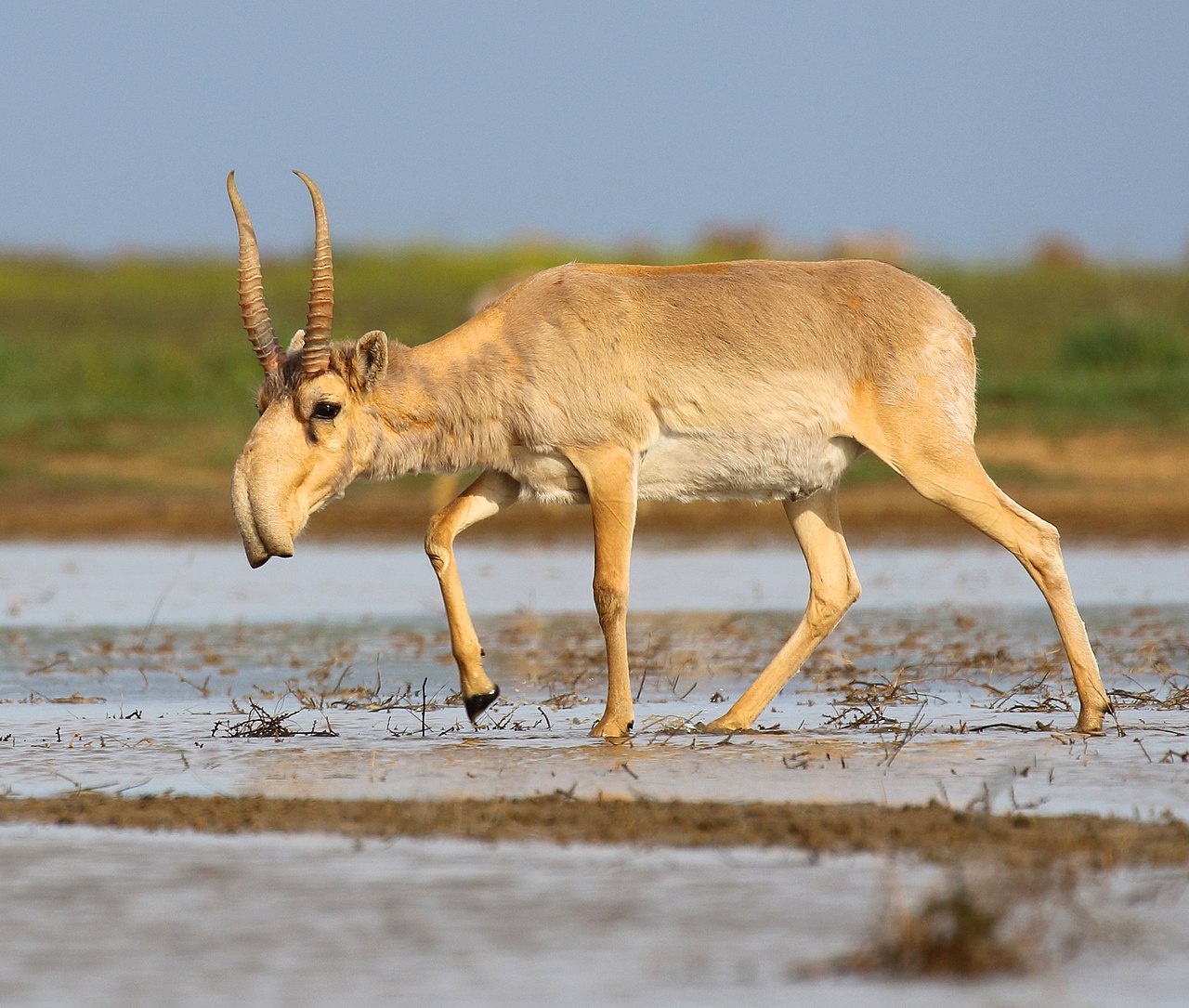
In 2015, over 200,000 saiga antelope. 60% of the global population. Died within 3 weeks from hemorrhagic septicemia. Climate conditions activated normally benign bacteria into lethal pathogens, showing ecosystem fragility.
Andrey Giljov, CC BY-SA 4.0, via Wikimedia Commons
A Sudden, Silent Catastrophe
In May 2015, the Betpak-Dala steppe of central Kazakhstan became the site of a shocking biological event. Over the course of just three weeks, entire herds of the saiga antelope (Saiga tatarica tatarica) perished. More than 200,000 of these critically endangered animals died, representing over 60% of their entire global population at the time. The event was staggering in its speed and scale, with a 100% mortality rate in the affected herds. The die-off was concentrated during the annual calving period, meaning the victims were overwhelmingly females and their newborn calves, littering the landscape in vast numbers.
Initial investigations were baffling. The animals died from hemorrhagic septicemia, a form of blood poisoning that causes massive internal bleeding. The culprit was identified as the bacterium Pasteurella multocida serotype B. This discovery only deepened the mystery, as P. multocida is a common bacterium that lives harmlessly in the tonsils and respiratory tracts of healthy saigas. For it to suddenly become a lethal pathogen on such an enormous scale was unprecedented.
A Climate-Driven Killer
A multi-disciplinary team of scientists eventually pieced together the sequence of events. The trigger was not a new virus or environmental toxin, but the weather. In the ten days leading up to the mass die-off, the region experienced unusually high humidity—over 80%—and warmer than average air temperatures. Researchers concluded that these specific climatic conditions crossed a physiological threshold for the saigas. The warm, moist air allowed the normally benign Pasteurella bacteria to proliferate and invade the animals' bloodstreams, triggering the fatal hemorrhagic septicemia.
While mass mortality events had been recorded in saigas before, including in the 1980s and 2010, the 2015 event was unparalleled in its speed and scope. It demonstrated how a sudden shift in environmental conditions could turn a harmless microbe into a devastating killer, especially for a species that gathers in immense aggregations for calving. The event shows the interactions between climate, pathogens, and wildlife populations.
The saiga is an Ice Age survivor, having once roamed alongside woolly mammoths. Its most notable feature is its large, flexible nose, which warms frigid winter air and filters out dust in the summer. This unique adaptation helps it survive the extreme continental climate of the steppes. Following the 2015 catastrophe, intensive conservation efforts and the species' high reproductive rate—females often give birth to twins—have led to a remarkable population recovery. By 2023, the population had rebounded so significantly that the species' IUCN status was upgraded from Critically Endangered to Near Threatened.
💡Fun Facts
The saiga's bulbous nose is an evolutionary tool that warms inhaled air in winter and filters dust in summer.
Saigas are ancient mammals that survived the last Ice Age, once sharing the plains with saber-toothed cats and woolly mammoths.
Female saigas can become pregnant in their first year of life and frequently give birth to twins, allowing populations to rebound quickly after declines.
The 2015 die-off was so rapid that it had a 100% fatality rate for all affected herds.
The Betpak-Dala steppe is a vast, unfenced wilderness accessible at all times, weather and road conditions permitting.
Admission
Free. Access is the primary challenge.
Accessibility
The terrain is remote, semi-arid desert with few to no paved roads. Travel requires a suitable 4x4 vehicle, extensive planning, and often a local guide. There are no facilities or services within the region.