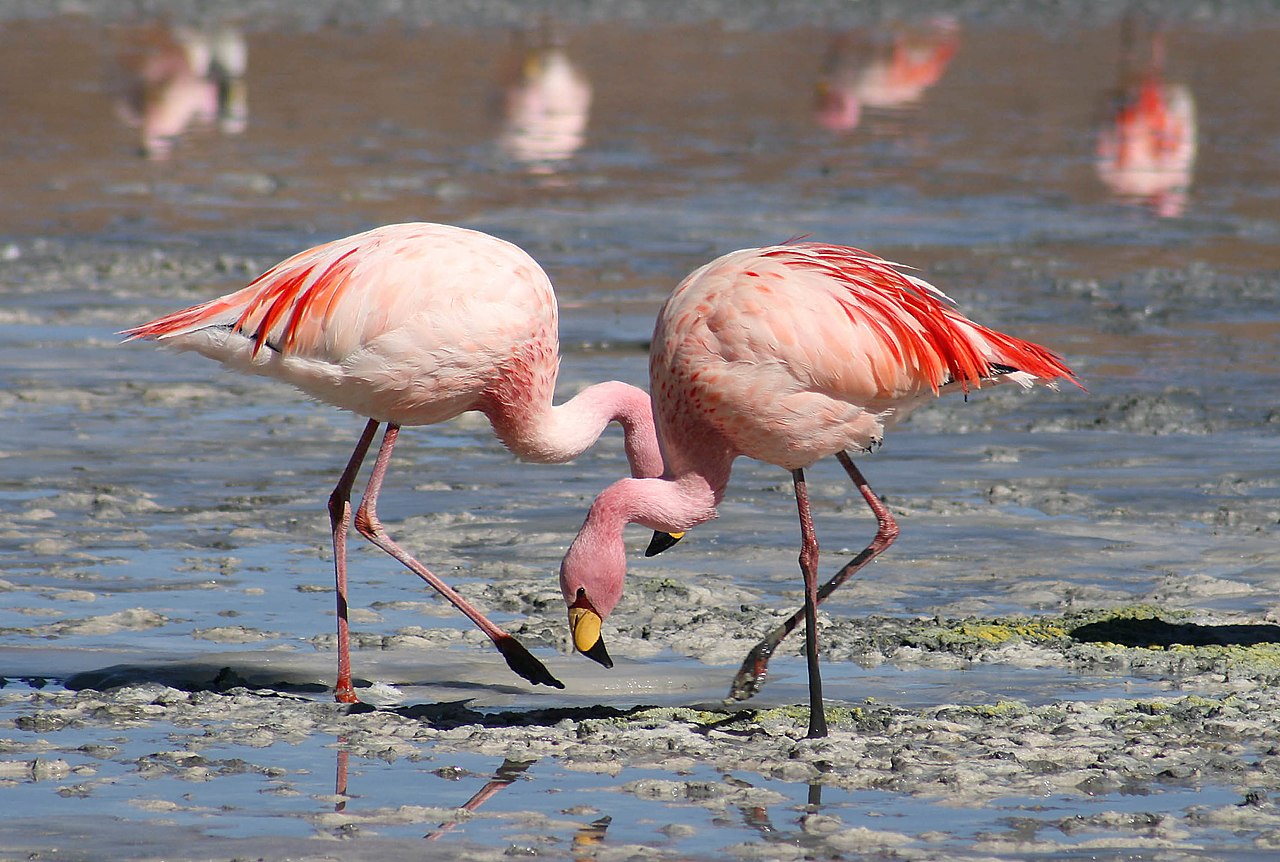
The world's northernmost pink flock
In the vast, treeless steppe of northern Kazakhstan, the Korgalzhyn State Nature Reserve presents a striking anomaly. This massive wetland, part of the Saryarka UNESCO World Heritage Site, is an important stopover for millions of migratory birds. The most celebrated visitors are the Greater Flamingos (Phoenicopterus roseus). The Tengiz-Korgalzhyn lake system hosts the world's northernmost breeding colony for these birds, with populations sometimes reaching 50,000 to 60,000 individuals. They arrive each April, transforming the shores of the salt lakes into a bright pink display.
These birds, however, do not have their coloration. Flamingo chicks hatch with dull grey plumage. Their transformation is entirely a result of their diet, a process that begins at a microscopic level within the salty waters of lakes like Tengiz. The name Tengiz translates to "sea," a fitting description for the lake which can have a salt content ranging from 22 to 127 grams per liter. It is in this hypersaline environment that the chemical foundation for the flamingo's color is built.
A diet-derived color. The bright pink and reddish hues of flamingo feathers are derived from pigments called carotenoids.%%CITE_8%%%%CITE_9%% These organic pigments are common in specific types of microscopic algae, such as blue-green algae and diatoms, that thrive in the reserve's salt lakes.%%CITE_5%%%%CITE_9%%%%CITE_10%% These organisms produce carotenoids, particularly beta-carotene (the same pigment found in carrots), as a protective mechanism against the intense solar radiation on the open steppe.
The flamingos do not always consume the algae directly. They primarily feed on an intermediary organism: the brine shrimp Artemia salina. These tiny crustaceans graze on the carotenoid-rich algae, concentrating the pigments within their bodies. The flamingos, with their highly specialized beaks, filter-feed on these brine shrimp and other small invertebrates.
Inside the flamingo's digestive system, enzymes in the liver break down the ingested carotenoids into their pigment components, including canthaxanthin and astaxanthin. These pigments are then absorbed by fats and distributed throughout the bird's body, where they are deposited in the growing feathers, as well as the skin on their legs and face. The intensity of a flamingo's color directly correlates with the amount of carotenoids in its diet; a well-fed, healthy flamingo is a brightly colored one.