The Mathematician's Arsenal
Between 214 and 212 BC, the might of the Roman Republic descended upon the city of Syracuse. A fleet of 60 quinqueremes, large warships powered by five banks of oars, attempted to breach the city's defenses under the command of General Marcus Claudius Marcellus. What should have been a swift victory turned into a protracted, three-year siege. The city's defense was masterminded by one person: the 73-year-old mathematician and engineer, Archimedes.
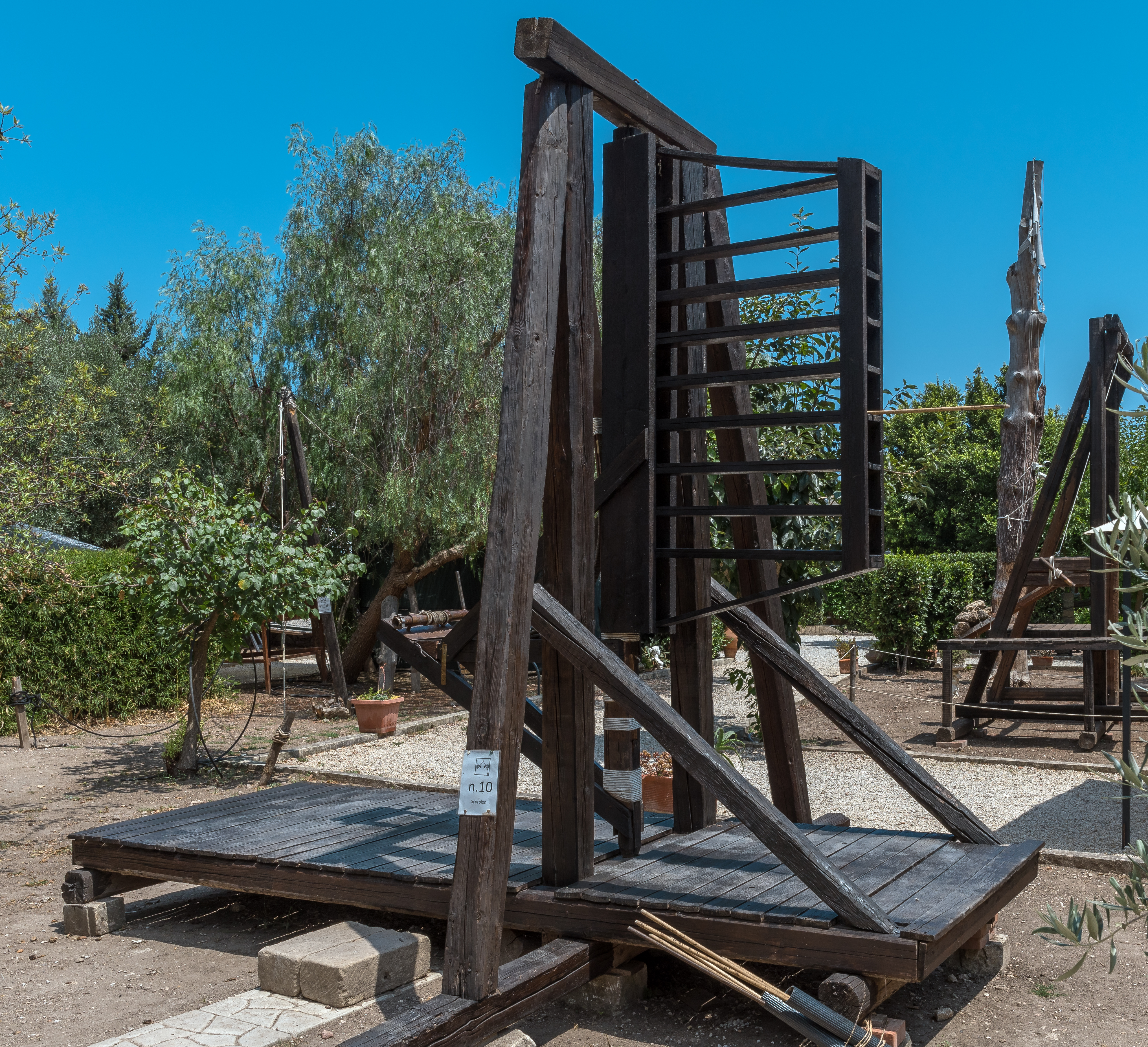
This outdoor museum brings Archimedes' defensive ingenuity to life with full-scale, functional replicas of his war machines. These are not static displays; they are built from wood and wrought iron by local craftsmen, showing mechanical principles that stalled an empire. The park shows a variety of catapults, crossbows, and stone-throwers that Archimedes designed to be effective at different ranges. Long-range machines targeted the fleet on approach, while others launched projectiles from narrow openings in the city walls at soldiers attempting to scale them.
One formidable reconstructions is the manus ferrea, or "Iron Hand," famously known as the Claw of Archimedes. Ancient historians like Polybius and Livy described this crane-like weapon, which was mounted on the city walls. The replica shows how a massive lever with a grappling hook could seize the prow of an approaching ship, lift it partially from the water, and then abruptly release it. This action would capsize the vessel or smash it against the rocks, creating chaos in the Roman fleet. The design relied on Archimedes' deep understanding of levers and mechanical advantage, principles he had outlined in his theoretical work.
A Legendary Heat Ray
The most debated of Archimedes' inventions is the "heat ray" or "burning mirrors." Later historical accounts, written centuries after the siege, claim that Archimedes used an array of polished bronze shields or mirrors to focus sunlight onto the wooden Roman ships, causing them to ignite. The first explicit mention of this device comes from Anthemius of Tralles, an architect who lived in the 6th century AD, more than 700 years after the event. The earliest detailed histories of the siege by Polybius, Livy, and Plutarch make no mention of burning mirrors.
The museum features reconstructions that allow visitors to engage with the physics of this legend. The physics works: a parabolic reflector can concentrate sunlight to a single focal point, generating intense heat. Modern experiments have tested the feasibility of this weapon with mixed results. A 1973 experiment by Greek engineer Ioannis Sakkas used 70 copper-coated mirrors held by sailors to ignite a plywood boat at a distance of about 50 meters. In 2005, a team from MIT successfully set a patch of a wooden boat on fire from 30 meters away using 127 square-foot mirror tiles, but it required ten minutes of focused sunlight under clear skies on a stationary target. Many historians and scientists argue that while theoretically possible, the weapon would be impractical in the chaos of battle against moving ships. It's suggested the mirrors may have been more effective at blinding or disorienting enemy sailors rather than incinerating their vessels.