A structure held by compression
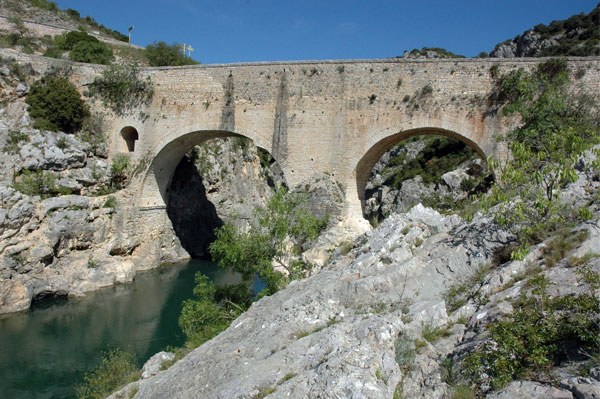
The Pont du Diable, or Devil's Bridge, is a Romanesque arch bridge made of local limestone that has spanned the Hérault River since its construction between 1028 and 1031. It was commissioned by the Benedictine abbeys of nearby Aniane and Gellone to connect their territories and provide safe passage for pilgrims. The entire 65-meter-long structure is a practical application of physics, relying on compressive forces for its stability. An arch bridge's strength comes directly from its semicircular shape.
The downward force from the bridge's own weight, and anything crossing it, is channeled along the curve of the arches to the abutments on the riverbanks. The wedge-shaped stones of the arch, called voussoirs, are squeezed tightly together. This immense compression makes mortar structurally unnecessary; the geometry of the precisely cut stones is what locks the bridge into a rigid, stable form. This technique shows an advanced understanding of static equilibrium, where all forces are balanced within the structure. The bridge has two main arches and two smaller, secondary openings designed to relieve hydrostatic pressure during the river's frequent and powerful floods. This design has allowed it to stand for nearly a millennium.
A millennium of service
The bridge was an important piece of infrastructure on the Arles route of the Way of St. James, the pilgrimage to Santiago de Compostela in Spain. In recognition of this historical role, it was inscribed as a UNESCO World Heritage site in 1998. For centuries, it withstood the elements and traffic with only minor repairs. Around 1770, the structure was widened to accommodate more traffic by adding a second, similar bridge directly against the original.
The original medieval construction is remarkably intact. The durability of the design shows the engineering skill of its 11th-century builders, whose names are not recorded in historical documents. It was the primary river crossing until a new, modern bridge was constructed nearby in 1932. Today, the Pont du Diable is a pedestrian-only bridge and the centerpiece of the Grand Site de France of the Gorges de l'Hérault.