The Stone's Story
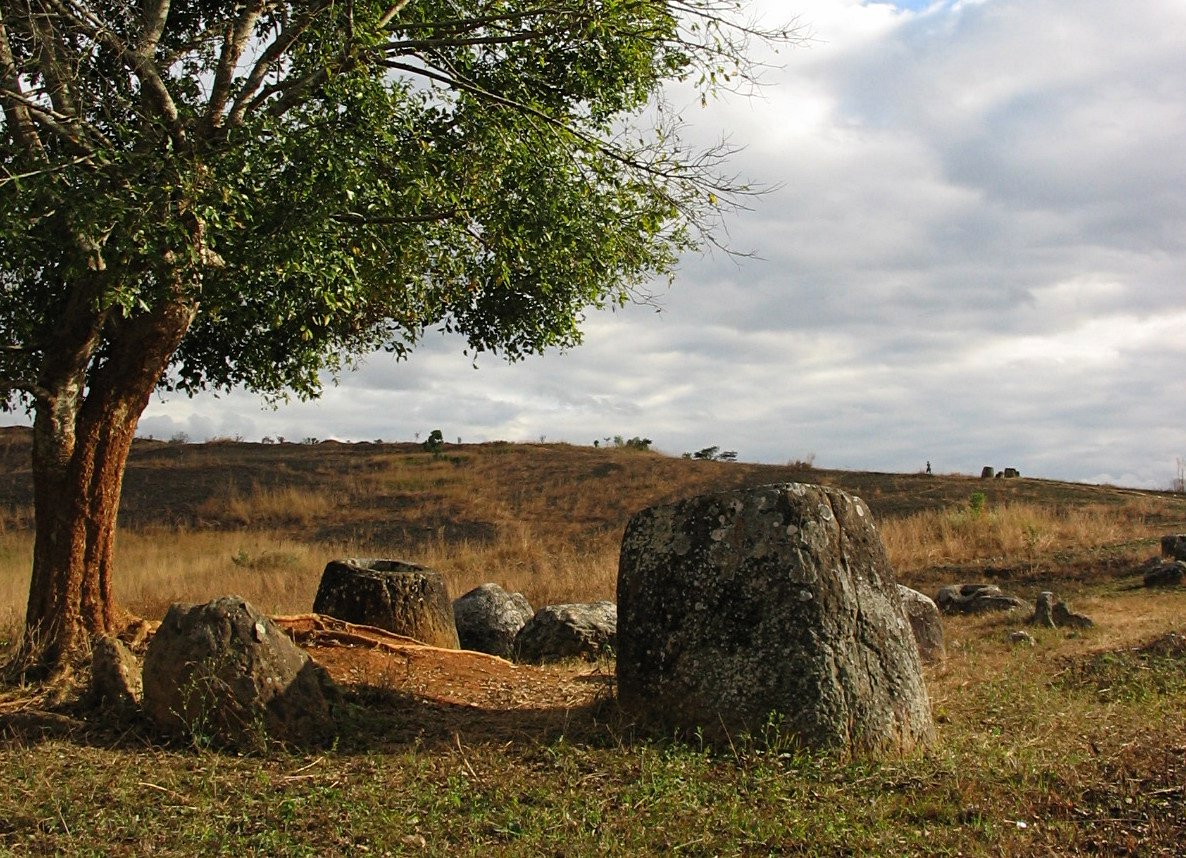
Site 1, also known as Thong Hai Hin, is the largest and most famous grouping on the Plain of Jars, with 334 megaliths scattered across a grassy plateau. These are not artifacts; each jar was hewn from a single, massive block of rock. The primary material used for the jars at Site 1 is a fine-to-medium-grained sandstone. Other rock types, like granite, conglomerate, and limestone, are found at different jar sites across the province, but sandstone dominates here.
Petrographic analysis—the microscopic study of rock composition and texture—is like a geological fingerprint. This technique reveals that the sandstone contains quartz, with significant amounts of potassium feldspar and other rock fragments. These minerals are held together by a clay matrix. This specific mineral signature is important for tracing the jars back to their exact origin. Advanced methods like detrital zircon geochronology have been used to match the age of mineral grains within the jars to the source rock with high precision. This analysis confirms that the immense jars at Site 1 were not carved from local stone but were transported from a specific quarry several kilometers away.
The Quarry Connection
The geological fingerprint of the jars at Site 1 points directly to the Phou Keng quarry, located about 8 to 10 kilometers away. At this quarry site, visitors can see the entire manufacturing process frozen in time. Dozens of unfinished jars lie abandoned, some only partially separated from the bedrock, showing how they were methodically carved from massive boulders.
The logistical challenge of this operation is significant. The jars vary in height from one to three meters, with the largest specimens weighing over 14 tons. The people who created them during the Iron Age (roughly 500 BCE to 500 CE) accomplished this feat without the aid of modern technology. How they moved these multi-ton megaliths across 10 kilometers of rolling terrain, including crossing two rivers and two streams, remains an unsolved archaeological question. Theories suggest complex systems of rollers, sledges, and a large, coordinated labor force were necessary. Dating of the sediment layers underneath the jars using Optically Stimulated Luminescence (OSL) suggests they were placed as early as 1240 to 660 BCE, pushing their origins back further than previously thought.