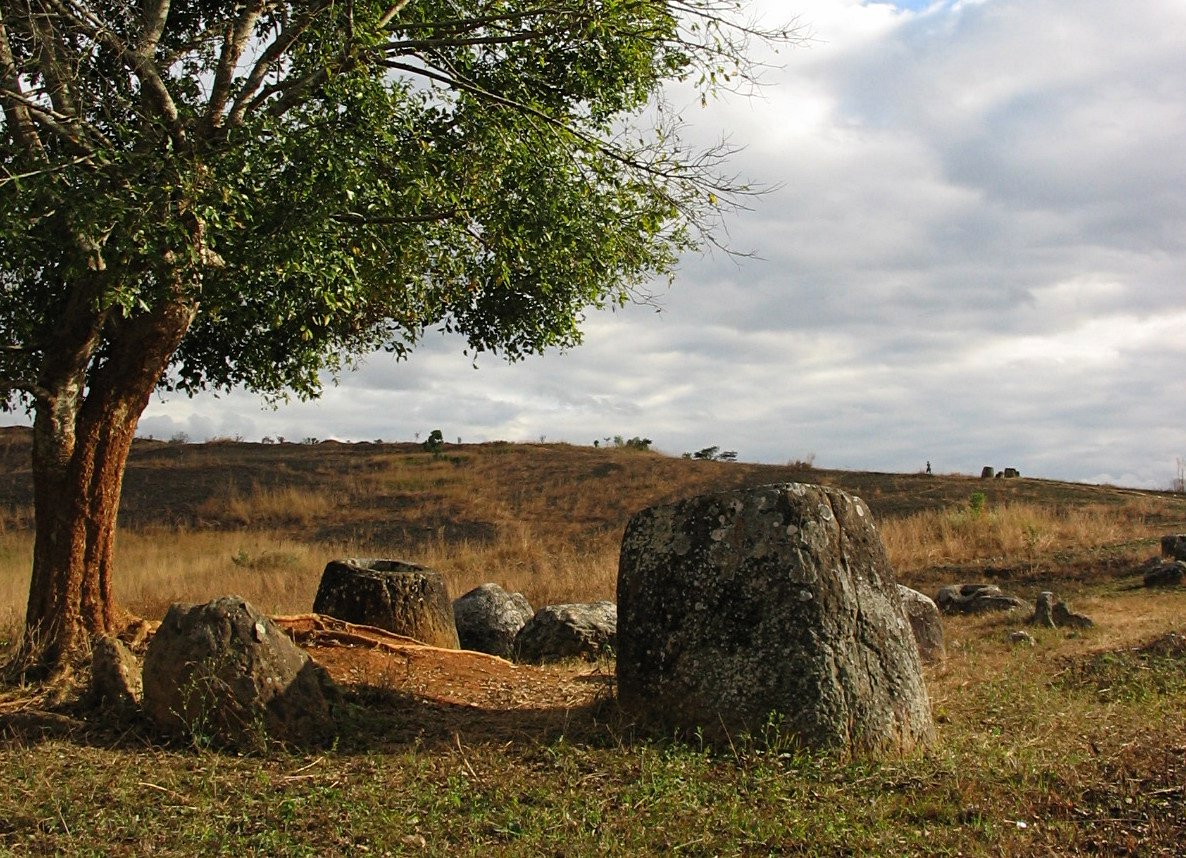
The Megalithic Puzzle
On the Xieng Khouang Plateau of central Laos, more than 2,100 megalithic stone jars are scattered across the plateau. These structures are found at over 90 different sites, in clusters ranging from a single jar to several hundred. The tubular jars, carved with their bottoms wider than their tops, can be up to three meters tall. Most are hewn from sandstone, but others are made from granite, conglomerate, and limestone. The largest, known as the "King Jar" at Site 1, weighs an estimated 14 tons.
Archaeological dating of the sites has produced a wide range of results. Research using optically stimulated luminescence suggests the jars were put in place as early as 1240 to 660 BCE. Other studies place the main period of activity during the Iron Age, from roughly 500 BCE to 500 CE. The civilization that created them remains largely unknown. Geochronological studies confirm that jars from Site 1 were transported from a quarry approximately 8 kilometers away, a significant undertaking for the multi-ton objects.
Funerary Functions
The leading theory, first proposed by French archaeologist Madeleine Colani in the 1930s, is that the jars were part of complex mortuary rituals. Excavations have unearthed human remains, both inside and buried around the jars. These discoveries support a multi-stage burial process. One cave at Site 1, with two man-made chimneys and evidence of burning, is was likely a crematorium. The human remains found inside jars often show signs of cremation, while skeletons buried nearby suggest unburnt secondary burials.
Archaeologists have found burial pits near the jars marked by large stone discs. These discs were once thought to be lids, but they do not fit the jar openings and were not found on top of them. Along with human bones, excavations have revealed grave goods including glass beads, iron and bronze tools, pottery fragments, and spindle whorls. Only one jar has any decoration: a carved human figure in bas-relief. The extensive presence of unexploded ordnance (UXO) from the Vietnam War has made many sites dangerous and limited the scope of archaeological research.