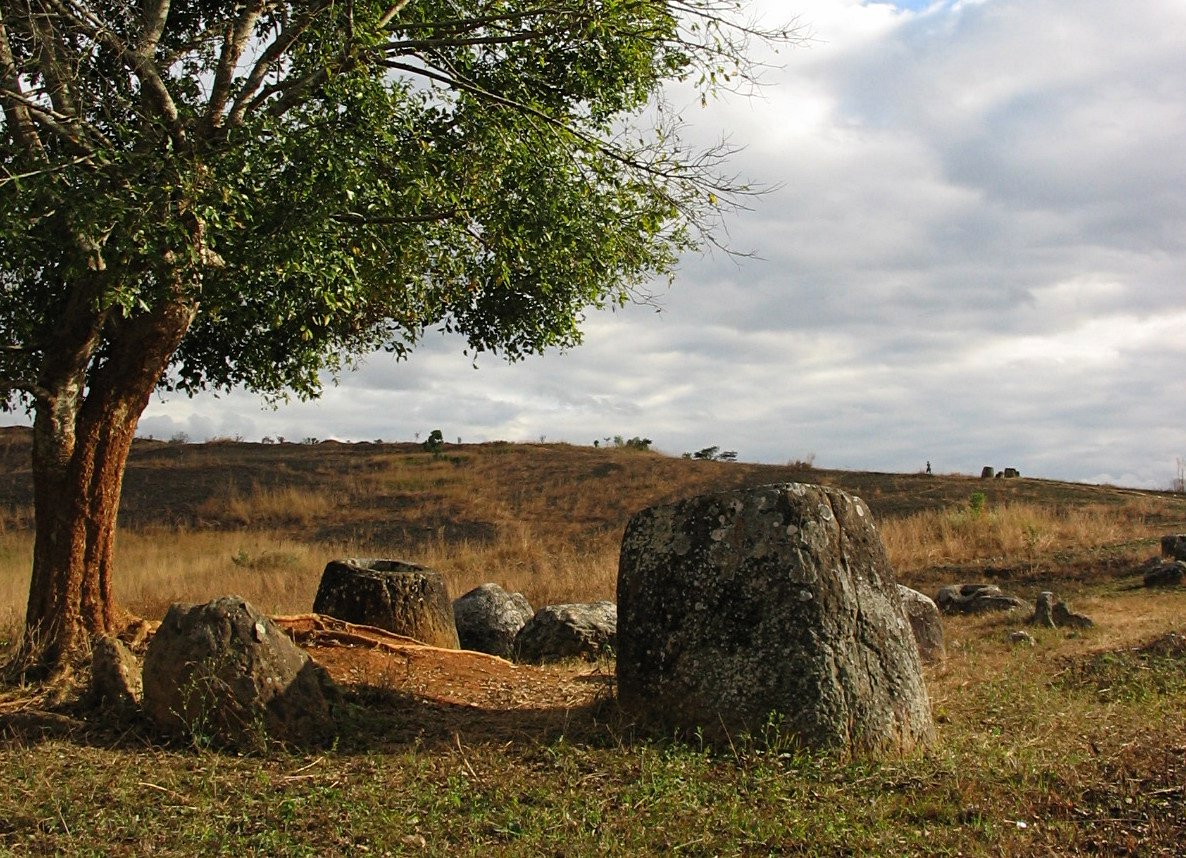
The hillside workshop
On the slopes of Phou Keng mountain, giant stone jars lie scattered among the trees. Some are finished, others are broken, and many remain half-carved, still attached to the bedrock from which they were hewn. This is the largest known quarry for the megalithic jars of Laos. These unfinished pieces record the manufacturing process, showing how Iron Age artisans used basic tools to shape multi-ton vessels from solid rock.
The primary material is a medium-grained sandstone, though jars at other sites are also made from granite, conglomerate, breccia, and limestone. The craftsmen would select a large boulder, chisel it into a rough cylindrical shape, hollow out the interior, and then add finishing touches like a rounded lip. The operation was large; more than 2,100 jars are spread across over 90 sites in the province, with some individual jars weighing up to 14 tons. Geochronological analysis confirms that jars found miles away at places like Site 1 originated from the specific sandstone at the Phou Keng quarry.
Reading the stone and soil
Scientific analysis has clarified when the jars were made and how they were used. Optically Stimulated Luminescence (OSL) dating of the sediment underneath the jars indicates they were placed in their locations between 1240 and 660 BCE. This establishes the sites to the regional Iron Age.
The function of the jars is related to funerary practices. Excavations around the jars have uncovered human remains, including bone fragments and teeth, consistent with secondary burials. In this practice, a body is left to decompose before the bones are collected for final interment. Grave goods such as glass beads and iron tools have also been found. While radiocarbon dating of the human remains shows mortuary activity occurred much later—between the 9th and 13th centuries CE—it suggests the sites held ritual importance for a very long time. The mystery is the identity of the people who initiated this massive undertaking and the specific beliefs that required such an enormous labor investment.