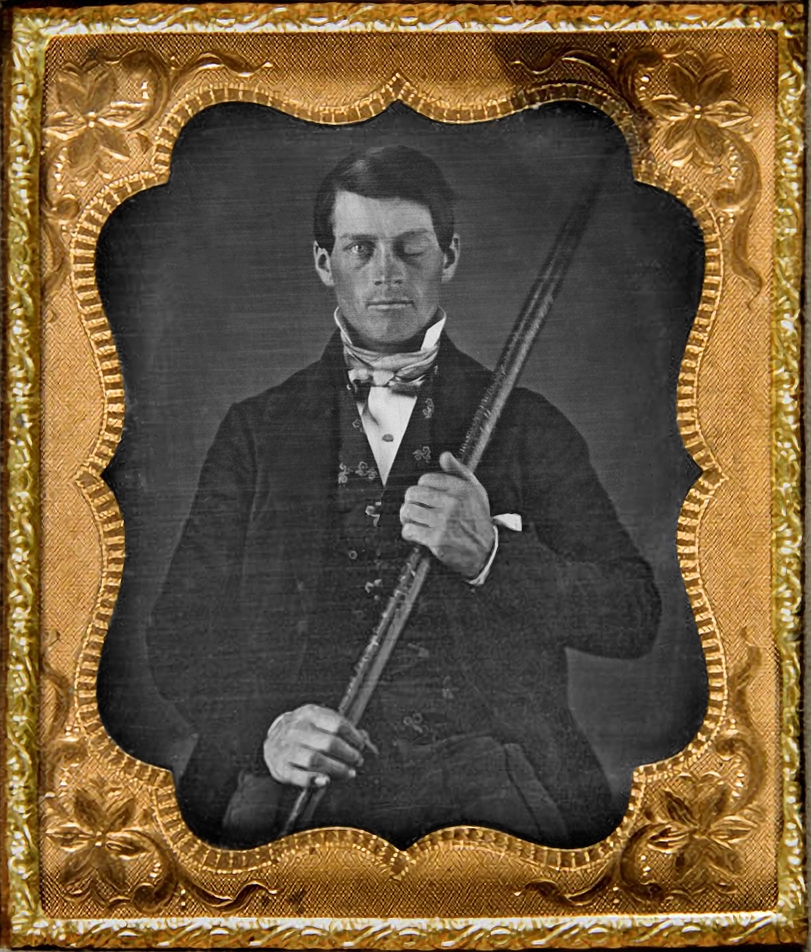
The railroad construction site in Vermont where Phineas Gage survived an iron rod blasting through his skull in 1848. He lived but became a different person, providing early evidence that personality and decision-making depend on specific brain regions.
Photograph by Jack and Beverly Wilgus of daguerreotype originally from their collection, and now in the Warren Anatomical Museum, Center for the History of Medicine, Francis A. Countway Library of Medicine, Harvard Medical School.Enlarged using Waifu2x and retouched by Joe Haythornthwaite (see notes on talk page)., CC BY-SA 3.0, via Wikimedia Commons
An explosive accident
On September 13, 1848, a 25-year-old railroad foreman named Phineas Gage was directing a crew blasting rock near Cavendish, Vermont. The men worked for the Rutland & Burlington Railroad, preparing a new rail bed. The job involved drilling holes in rock, adding blasting powder and a fuse, then covering it with sand or clay. Gage's specialized tool for this was a tamping iron: a solid iron rod measuring 43 inches long, 1.25 inches in diameter, and weighing 13.25 pounds.
Around 4:30 PM, Gage was distracted for a moment and began to tamp the powder directly, before his assistant had added the protective layer of sand. The iron rod struck the rock, creating a spark that ignited the powder. The resulting explosion launched the tamping iron like a missile. The pointed end entered Gage's head just below his left cheekbone, passed behind his left eye, tore through the front of his brain, and exited through the top of his skull. The iron rod landed some 80 feet away.
Astonishingly, Gage was not killed. He was thrown backward and had some brief convulsions, but was reportedly conscious and speaking within minutes. He was able to walk with some help and sat upright in an oxcart for the 1.2-kilometer trip back to his lodgings in town. The local physician, Dr. John Martyn Harlow, arrived to find a situation he later described as a case "calculated to excite our wonder."
The frontal lobe
Dr. Harlow's care saved Gage's life. Gage survived a severe infection and a period of being semi-comatose when a fungal abscess formed in the exposed brain tissue. Within about two months, he was physically recovered enough to return to his family's home in New Hampshire. He had no paralysis, and his memory and general intelligence were intact. But he was not the same man.
Before the accident, Gage was known as a capable and efficient foreman. After his recovery, his personality was altered. His employers could not give him his job back because his character had changed so dramatically. Dr. Harlow documented these changes, noting that Gage became "fitful, irreverent, indulging at times in the grossest profanity (which was not previously his custom)." He was now impatient, obstinate, and unable to follow through on future plans. His friends and acquaintances stated he was "no longer Gage."
The injury had destroyed a large portion of his brain's left frontal lobe. Modern analyses of his skull suggest specific damage to the orbitofrontal and ventromedial prefrontal cortex, areas involved in emotional regulation and decision-making. Gage's case provided the first direct evidence that specific brain functions are localized to specific regions. His skull and the tamping iron that passed through it are now on display at Harvard University's Warren Anatomical Museum. Gage lived for nearly 12 more years, eventually dying in California in 1860 from epileptic seizures related to his injury.
💡Fun Facts
Phineas Gage worked for a time as an attraction at P.T. Barnum's American Museum in New York City.
He later worked for seven years as a stagecoach driver in Chile, a job that required significant focus and planning, suggesting he regained some of his social and cognitive abilities over time.
The tamping iron was Gage's "constant companion" for a time after the accident, though he later temporarily donated it to Harvard's medical museum before asking for its return.
His body was exhumed seven years after his death at Dr. Harlow's request so his skull could be preserved for science.