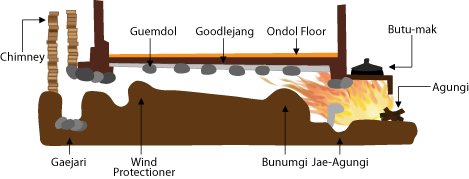
Korean underfloor heating used channeled smoke to warm stone floors, requiring precise airflow engineering. Modern ondol variants now use hot water, but the thermal mass principles remain unchanged since the Bronze Age.
Dzihi, CC BY 3.0, via Wikimedia Commons
A Subterranean Heat Engine
The traditional Korean ondol, literally meaning "warm stone," is a highly efficient underfloor heating system that is a large thermal battery. The system works by its separation of the fire from the living space, a design that provided smokeless indoor heat centuries before similar methods appeared in the West. The core components are the agungi (firebox), the gorae (a network of horizontal flues under the floor), and the gulttuk (chimney).
Heat generation begins in the agungi, a furnace typically located in an adjacent kitchen or on an outer wall. The hot smoke and gasses from the fire are not vented directly outside. They are channeled into the network of gorae passages. This design forces the hot exhaust to travel the entire length of the room before exiting through the chimney. As the gasses pass through the flues, heat is transferred via conduction to the thick stone slabs, called gudeuljang, that form the floor's foundation. These stones, along with layers of clay and mica, absorb and store a massive amount of thermal energy. The floor then radiates this stored heat gently and evenly into the room over many hours, a process using the principles of thermal mass. A fire lasting just a few hours could keep a room warm through a cold winter night.
An Ancient Engineering Marvel
Archaeological evidence traces the ondol's origins to primitive hearths used during the Bronze Age, around 1000 BCE. By the Three Kingdoms period (57 BCE - 668 CE), it had became a sophisticated system. The construction of an effective ondol required precise engineering. The flue network had to be carefully designed to balance two competing needs: it needed to be complex enough to maximize the time hot gasses spent under the floor transferring heat, but also clear enough to provide a sufficient draft to pull smoke through and out the chimney.
The floor itself was built with a slight incline, rising from the agungi towards the chimney, to facilitate the natural flow of smoke. The stone slabs (gudeuljang) were laid with care; thicker stones were placed closer to the intense heat of the firebox, while thinner stones were used further away to ensure even heat distribution. The entire structure was sealed with layers of clay and oiled mulberry paper (hanji) to prevent toxic carbon monoxide from leaking into the living quarters. When coal briquettes replaced firewood in the 20th century, poorly maintained ondol systems became a significant public health hazard due to gas poisoning. This eventually led to the development of modern hydronic ondol, which circulates hot water through pipes instead of smoke through flues, a system now standard in nearly all modern Korean homes.
💡Fun Facts
The same fire in the *agungi* was often used for both cooking and heating, making it a highly efficient dual-purpose system.
The warmest part of the floor, closest to the firebox, was called the *araetmok* and was traditionally reserved for elders or honored guests as a sign of respect.
American architect Frank Lloyd Wright reportedly encountered an ondol room in Japan and was so impressed that it inspired his pioneering use of radiant floor heating in the United States.
The smoke passing through the ondol flues had the secondary benefit of killing insects, mold, and fungi that might otherwise thrive in the wooden structures of traditional homes.
Weekdays 10:00-18:30; Weekends 10:00-19:00 (Hours may vary by season)
Admission
Adult admission is approximately ₩32,000 for an all-inclusive ticket
Accessibility
The Korean Folk Village is a large outdoor museum with many paved and unpaved paths. Some traditional houses have steps and are not fully wheelchair accessible.