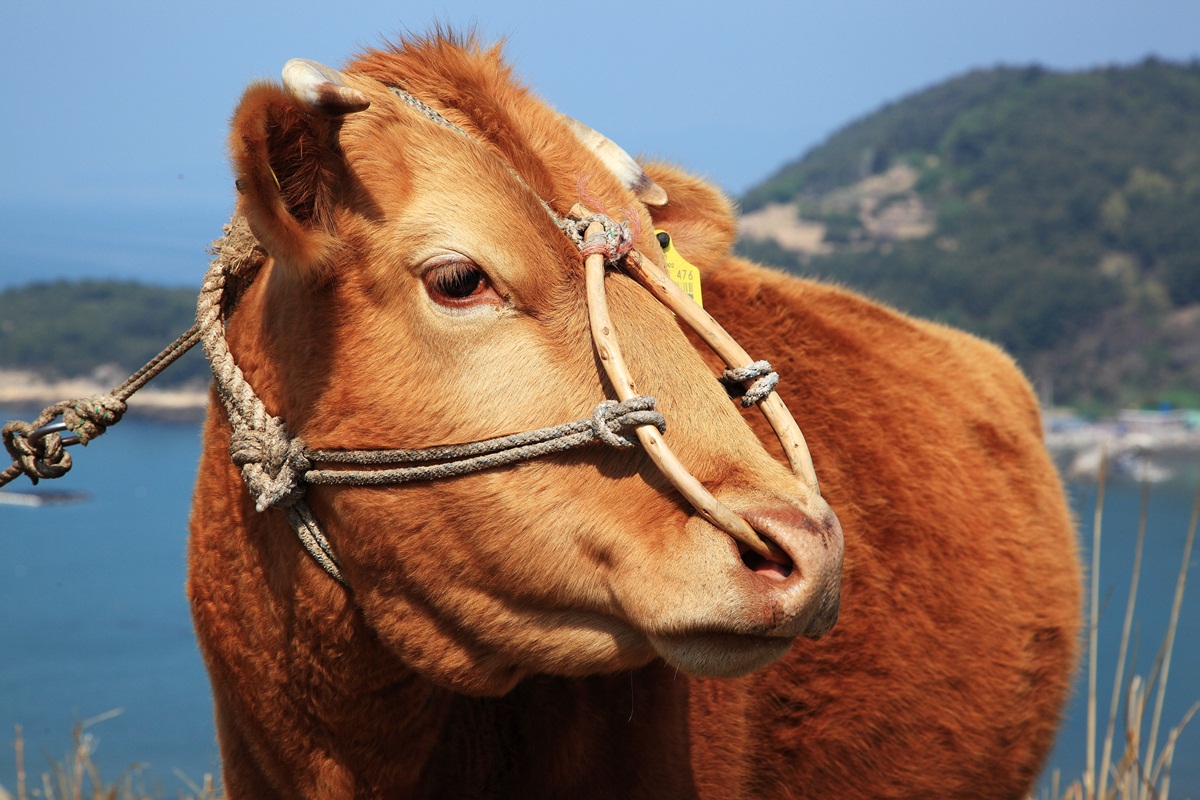
An ancient and distinct lineage
The genetic story of Hanwoo cattle (Bos taurus coreanae) begins thousands of years ago. While their exact origin is debated, evidence suggests they migrated to the Korean peninsula via northern China, sharing a common ancestor with Japanese Wagyu and Chinese Yanbian cattle. Over millennia of geographic separation and selective breeding, they developed a distinct genetic profile. For most of their history, which dates back at least 5,000 years, Hanwoo were primarily draft animals. Their small bodies and well-developed forelimbs were perfectly adapted to the mountainous Korean terrain. This long history of use for agriculture and transport, rather than meat, shaped their early evolution.
The modern Hanwoo comes from intense, systematic breeding that began in the 1960s with the rapid growth of the South Korean economy. This shifted the focus from draft characteristics to meat quality. The first official genetic breeding program was initiated by the Ministry of Agriculture and Forestry in 1979. Today, the Hanwoo Improvement Center, under the National Agricultural Cooperative Federation, manages the genetic improvement of the breed, producing roughly 2 million doses of semen annually from around 100 proven bulls. A beef traceability system, which assigns a 12-digit identification number to each animal, tracks its history from birth through sale, ensuring authenticity.
The genome of flavor
The defining characteristic of Hanwoo beef is its marbling—the fine threads of intramuscular fat (IMF) that give the meat its texture and flavor. This trait is highly heritable, with estimates around 0.49, making it a prime target for genetic selection. Researchers have identified numerous quantitative trait loci (QTLs)—sections of DNA—associated with marbling. Specific QTL regions have been found on chromosomes 2, 6, 12, 16, 17, 22, 24, and 29.
Specific genes affect the meat. Variations in the APM1 gene, for example, are strongly associated with higher marbling scores. The FABP4 gene is another gene whose expression is significantly higher in high-marbled Hanwoo. The genetic focus on marbling has resulted in a unique fatty acid profile. Hanwoo beef contains a significantly higher percentage of oleic acid, a monounsaturated fatty acid, compared to other breeds. One analysis found Hanwoo contained 52.86% oleic acid, compared to 49.11% in Angus beef. This high oleic acid content contributes to a lower melting point of the fat, improving the meat's flavor and tenderness. The concentration of glutamic acid, which contributes to an umami taste, is also higher in Hanwoo compared to some other Korean breeds like Jeju Black cattle.
This intensive genetic selection has achieved remarkable results. But it has also led to relatively low overall genetic diversity within the breed, particularly in rare color variants like the White Hanwoo, which is now managed by the National Institute of Animal Science to preserve its unique genetics.