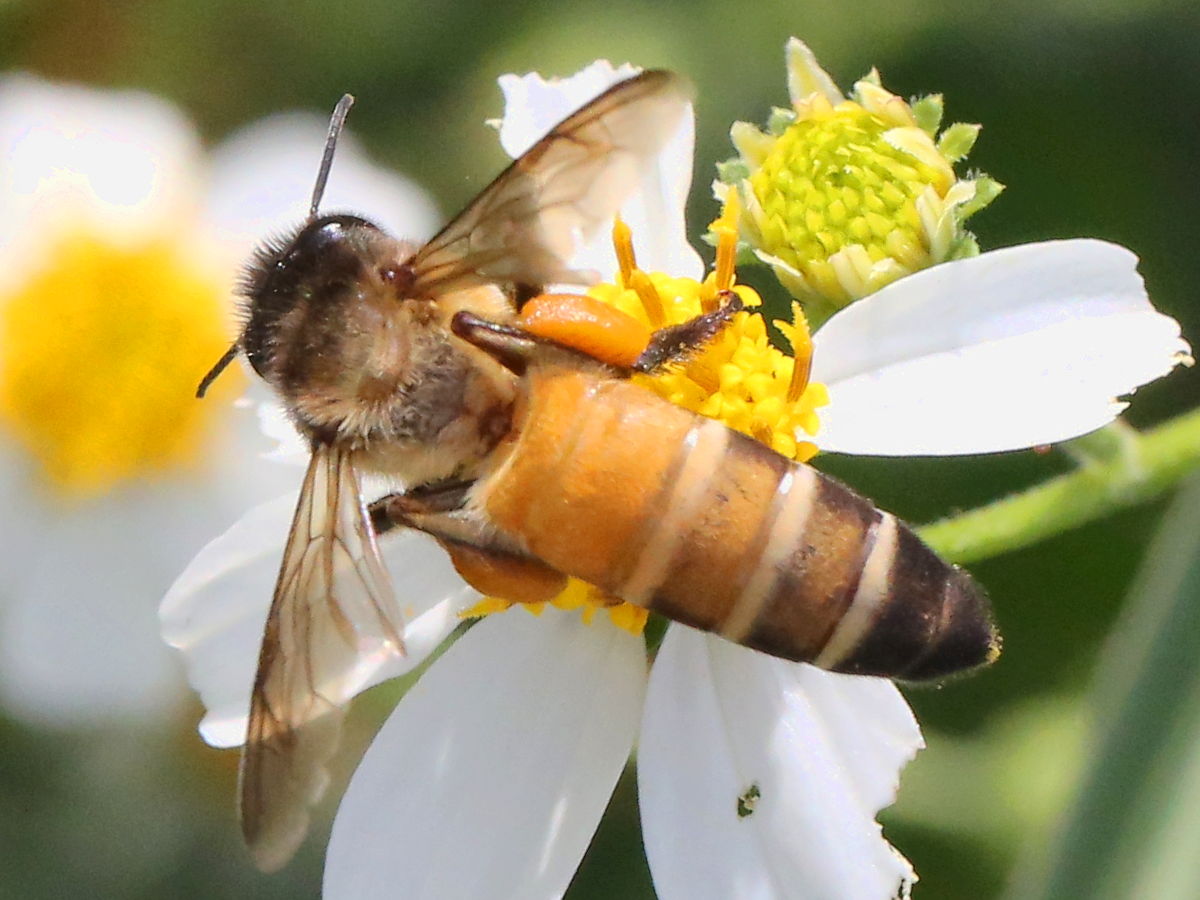
Giants of the forest canopy
The northern forests of Myanmar's Kachin State hold a remarkable concentration of bee species. This region, at the southern edge of the Himalayas, contains some of the largest intact forests in South Asia, is a habitat for immense biodiversity. Surveys in Myanmar have identified numerous bee species, with five native honey bee species documented: Apis cerana, Apis dorsata, Apis laboriosa, Apis florea, and Apis andreniformis.
The most noticeable of these is the giant honey bee, Apis dorsata. Individual worker bees can reach up to 3 cm in length, nearly twice the size of the common European honey bee. These bees construct massive, single-comb nests in exposed locations, often high on tree limbs or under cliff overhangs. A single comb can measure up to 1.5 meters long and 70 centimeters tall, forming a curtain of up to 100,000 worker bees several layers thick. This living shield protects the vulnerable brood from weather and predators. Apis dorsata is known for its aggressive defense, and its long sting can penetrate standard beekeeping clothing. Colonies sometimes aggregate, with up to 200 separate colonies nesting in a single tree.
A spectrum of pollinators
Besides giant honey bees, Kachin's forests support a wide array of other bee types. This includes several species of stingless bees from the Meliponini tribe. These bees, as their name suggests, have stingers that are too small to be used for defense. Instead, they defend their colonies by biting. Stingless bees are important pollinators for many tropical plants.
The diversity extends from the world's largest honey bee, the Himalayan giant honey bee (Apis laboriosa), also found in Myanmar, to tiny dwarf honey bees (Apis florea). This range of species enables the pollination of a vast number of Myanmar's 14,000+ vascular plant species, from agricultural crops like sunflowers and sesame to the wild flora of the mountain forests. Traditional honey hunting, a practice targeting the nests of wild Apis dorsata and Apis laboriosa, has been a part of local culture for centuries and is a source of honey for local consumption. The practice involves climbers using smoke to pacify the bees before cutting down the honeycomb.
Fossil evidence from Kachin State also shows the history of the region's bees. A 99-million-year-old bee, named Discoscapa apicula, was discovered preserved in a piece of Burmese amber from the Hukawng Valley. The fossil shows the bee carrying pollen, indicating that bees have been pollinating flowers in this part of the world since the mid-Cretaceous period.