Surviving the crush
At the bottom of the Mariana Trench, nearly 11,000 meters below the surface, the pressure is immense. The water column above exerts a force of 1,086 bars, or about 15,750 pounds per square inch (psi). This is 1,000 times the standard atmospheric pressure at sea level. Under this force, most biological molecules would be crushed. Proteins, the complex molecules that perform most of the work in cells, would have their complex three-dimensional shapes distorted, rendering them useless.
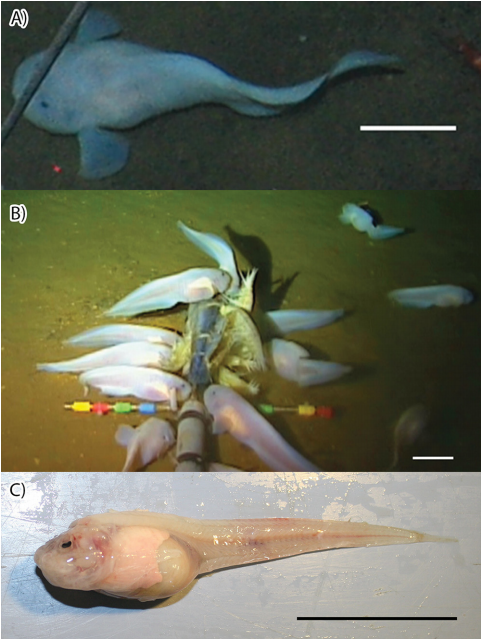
Yet, life persists. The Mariana snailfish (Pseudoliparis swirei), a translucent, tadpole-like fish lives at depths of 8,000 meters. Its survival depends on specialized adaptations to counteract the pressure. One of the most important is the presence of high concentrations of a molecule called trimethylamine N-oxide (TMAO) in its cells. TMAO is a piezolyte, a small organic molecule that counters the effects of pressure. It works by stabilizing proteins, preventing the water pressure from deforming them. The concentration of TMAO in marine animals' bodies increases almost linearly with the depth at which they live.
A body built for pressure
The adaptations of hadal zone (depths below 6,000 meters) creatures go beyond biochemistry. The Mariana snailfish has a body that is structurally prepared for the deep. Its skeleton is not fully ossified, meaning its bones are made of flexible cartilage, which resists fracturing under pressure. A specific gene mutation appears to halt the calcification process, keeping the skeleton pliable. The fish's skull is not a closed structure, which allows the pressure inside its head to equalize with the immense external pressure.
These fish also lack a swim bladder, the air-filled sac that many other fish use to control buoyancy. An air-filled space would be instantly crushed. Instead, the snailfish's body has a gelatinous consistency, which is nearly incompressible and provides buoyancy. Even the water itself behaves differently here. At the bottom of the trench, the intense pressure increases the density of water by about 4.96%. The temperature is also low, hovering at a near-freezing 1 to 4 degrees Celsius (34 to 39°F). These conditions have forced the evolution of a unique biology, shows how life adapts to one of the most inhospitable environments on Earth.