Life under 1,100 atmospheres
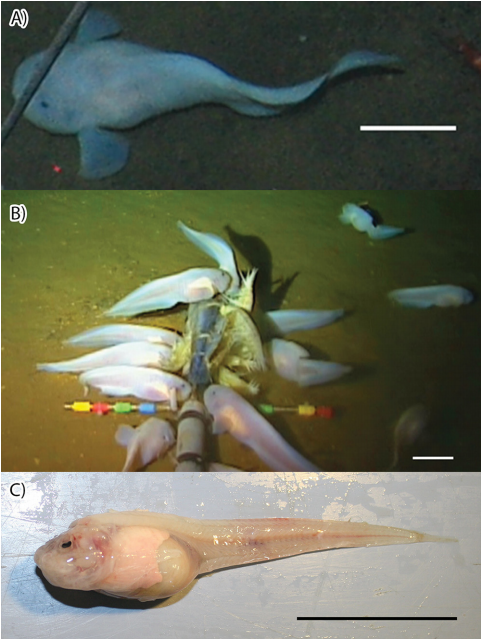
The Mariana snailfish (Pseudoliparis swirei) lives in the hadal zone of the Mariana Trench, a region deeper than Mount Everest is tall. At depths of 6,198 to 8,178 meters, the hydrostatic pressure is immense—more than 1,100 times greater than at the surface, equivalent to an elephant standing on your thumb. To survive, the fish has a suite of remarkable adaptations. Its body is small and pinkish-translucent, with no scales. The skin is so clear that its liver is visible.
Important to its survival is a molecule called trimethylamine N-oxide (TMAO). This organic compound permeates the fish's cells and counteracts the effects of extreme pressure on proteins, preventing them from being distorted and rendered non-functional. The concentration of TMAO in marine animals increases with depth, and the Mariana snailfish has the highest levels ever recorded in a fish. This chemical stabilization is so effective that scientists believe the 8,200-meter mark may represent a biochemical limit for fish, beyond which they cannot accumulate enough TMAO to survive. Other adaptations include a skeleton that is not fully ossified, meaning its bones are more cartilaginous and flexible. The skull bones are not completely fused, which helps to equalize the immense pressure. Unlike many fish, it has no swim bladder, a gas-filled sac that would be crushed at these depths.
A top predator in the abyss
Despite its fragile appearance, Pseudoliparis swirei is an apex predator in its habitat. It feeds on dense swarms of small crustaceans, particularly amphipods, which it sucks into its mouth. In this deep-sea environment, there are few larger predators, allowing the snailfish to thrive. Scientists have observed large aggregations of these fish attracted to baited cameras, indicating a healthy and active population.
The species was first collected by a research team in 2014 and formally described in 2017. Its scientific name, Pseudoliparis swirei, honors Herbert Swire, an officer on the HMS Challenger expedition of the 1870s which first discovered the Mariana Trench. The fish grows to a length of about 28.8 cm (11.3 inches). Its tadpole-like body is gelatinous, a feature that helps with buoyancy in the absence of a swim bladder. Female snailfish produce unusually large eggs, some measuring up to 9.4 mm in diameter, which are among the largest for any fish species. Genetic analysis reveals that the fish has evolved specific mutations related to its high-pressure environment, including changes to genes that regulate protein stability.