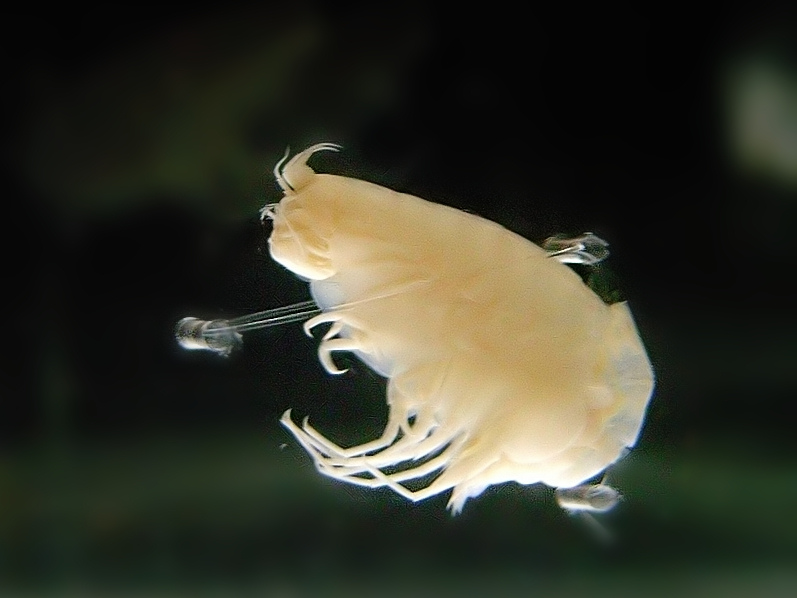
The deepest ecosystem on Earth at 11,000 meters hosts amphipods adapted to pressures exceeding 1,000 atmospheres. Their cells use specialized proteins and lipids that remain fluid under crushing pressure.
Daiju Azuma, CC BY-SA 2.5
Survival at the bottom
In the Challenger Deep of the Mariana Trench, nearly 11,000 meters below the surface, the pressure is immense. At 1,086 bars, or over 15,750 pounds per square inch, it is more than 1,000 times the pressure at sea level. In this dark, near-freezing environment, a small crustacean thrives: the amphipod Hirondellea gigas. Growing up to three centimeters long, this animal has developed a set of adaptations to survive where most life cannot.
One of its most significant challenges is maintaining its exoskeleton. At extreme depths, high pressure causes calcium carbonate—the material used by most crustaceans for their shells—to dissolve. H. gigas overcomes this by creating its own metallic shield. It extracts aluminum ions from the deep-sea sediment it consumes. Inside its gut, sugar-based chemicals process the aluminum, which is then secreted to form a protective gel of aluminum hydroxide over its body. This gel acts as a barrier, preventing the dissolution of its calcium carbonate exoskeleton in the high-pressure water.
Internally, the amphipod's cells are protected by molecules called piezolytes. One of these is trimethylamine N-oxide (TMAO), a compound that stabilizes proteins and prevents them from being distorted or forced into non-functional clumps by the external pressure. This allows the animal's metabolic processes to function normally.
An unconventional diet and a plastic namesake
Food is scarce in the hadal zone, the ocean's deepest region. Hirondellea gigas is an opportunistic scavenger, feeding on whatever organic matter drifts down from the waters above. This includes animal carcasses and other detritus, but a surprisingly significant part of its diet is wood. Plant debris and entire trees washed into the ocean eventually sink, providing a food source. H. gigas possesses a unique set of digestive enzymes, including a novel cellulase, that allows it to efficiently break down the tough cellulose in wood and convert it into sugars for energy. These enzymes have been shown to work even more effectively under the high-pressure conditions of the trench.
The remote nature of the Mariana Trench does not isolate it from human impact. In 2014, researchers from Newcastle University discovered a new species of amphipod living at depths between 6,000 and 7,000 meters. Inside the gut of one of the specimens, they found a microfiber of polyethylene terephthalate (PET), a common plastic used in bottles and clothing. To show the extent of plastic pollution, the scientists officially named the new species Eurythenes plasticus. This discovery shows that human-made materials have contaminated even newly-discovered species in one of the most remote habitats on Earth.
💡Fun Facts
The pressure at the bottom of the Mariana Trench is equivalent to about 100 adult elephants standing on your head.
The amphipod *Hirondellea gigas* was found to possess a unique cellulase enzyme capable of digesting wood, a rare ability in deep-sea crustaceans.
A species of amphipod from the trench, *Eurythenes plasticus*, was named after scientists found PET plastic fibers in its stomach before it was even formally described.
To gather specimens, researchers use baited traps on unmanned landers, which can attract swarms of hundreds of amphipods within hours.