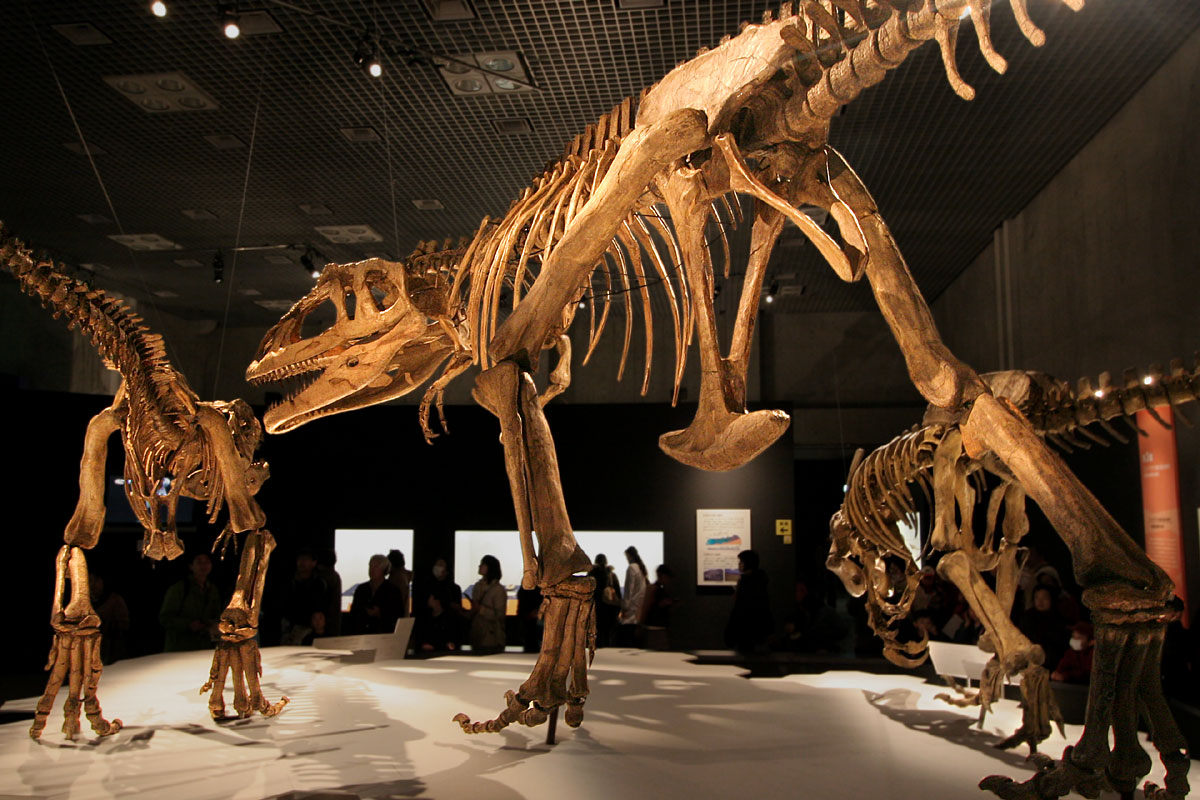
A mass death site containing at least nine individuals suggests these giant predators hunted in groups. Pack hunting by 12-meter carnivores would have threatened even the largest sauropods.
Kabacchi, CC BY 2.0, via Wikimedia Commons
A Prehistoric Crime Scene
In a remote part of Patagonia, a layer of rock holds the remains of a predator posse. Between 1997 and 2001, paleontologists from the Argentinian-Canadian Dinosaur Project excavated a bone bed containing hundreds of fossils. Unusually, all the identifiable dinosaur bones belonged to a single species of giant carnivore. The site, located in the Huincul Formation, held the skeletons of at least seven, and perhaps as many as nine, individuals of a newly discovered species: Mapusaurus roseae.
The jumble of bones came from animals of different ages, from juveniles to large adults. This mix shows that Mapusaurus was a social animal that lived in groups. The entire group seems to have perished together in a single event, although the cause—a flood, drought, or other catastrophe—is not yet known. The rock layers date to the Late Cretaceous Period, between 97 and 93.5 million years ago. The paleontologists who first described the find in 2006, Rodolfo Coria and Philip Currie, realized they had found a record of a prehistoric predator pack.
The Earth Lizard
Mapusaurus roseae was a carcharodontosaurid, or "shark-toothed lizard." This group of theropods is closely related to Giganotosaurus, another Patagonian giant. The name Mapusaurus comes from the Mapuche word for "Earth," and roseae honors both the rose-colored rocks of the dig site and Rose Letwin, who sponsored the expeditions. This predator was immense, with the largest individuals reaching an estimated length of 12.2 meters (40 feet) and weighing over three metric tons. Its skull was long and deep, but proportionally lighter than that of T. rex, and had narrow, blade-like teeth perfect for slicing flesh.
The environment Mapusaurus inhabited was a floodplain with seasonal streams, and it was filled with some of the largest animals ever to walk the Earth. Its neighbors included the titanosaur Argentinosaurus huinculensis, a sauropod that may have reached 100 tons. A single Mapusaurus could not kill a healthy adult Argentinosaurus. The bone bed discovery suggests a formidable hunting strategy: a coordinated pack attack. By working together, a group of Mapusaurus could collectively harass, wound, and eventually bring down prey many times the size of an individual hunter.
💡Fun Facts
The name *Mapusaurus* is derived from the word for "Earth" in the language of the local Mapuche people.
*Mapusaurus* belongs to the family Carcharodontosauridae, a name that means "shark-toothed lizards," referring to their serrated, blade-like teeth.
Despite their similar sizes, the skull of *Mapusaurus* was narrower and lighter in construction compared to that of its cousin *Giganotosaurus*.
The fossils are curated at the Museo Carmen Funes in Plaza Huincul, Argentina.