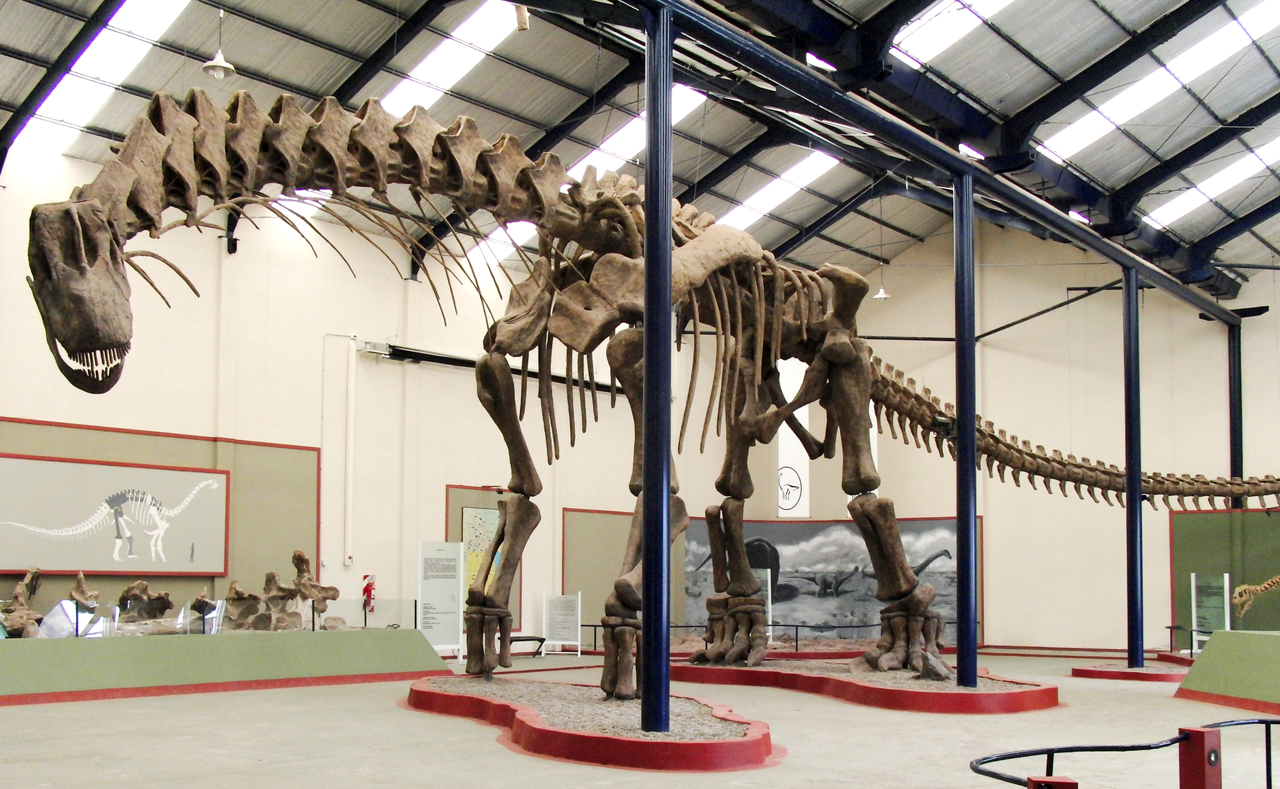
An Accidental Giant
In 1987, a local rancher named Guillermo Heredia was on his farm, "Las Overas," about 8 kilometers east of Plaza Huincul, when he noticed something unusual. Protruding from the ground were enormous objects he initially mistook for petrified logs. He reported the find to the local Museo Municipal Carmen Funes. In 1989, a formal excavation led by paleontologist José F. Bonaparte confirmed Heredia's "logs" were the bones of a colossal dinosaur.
The team unearthed a series of gigantic back vertebrae, parts of the sacrum (the fused vertebrae of the hip region), a massive rib, and a lower leg bone (a fibula). The sheer scale of each piece was astounding. A single dorsal vertebra, for example, had a reconstructed height of 159 centimeters. Bonaparte and his colleague Rodolfo Coria formally named the creature Argentinosaurus huinculensis in 1993, meaning "Argentine lizard from Huincul," in honor of the country and the nearby town. All the recovered remains, designated as the holotype specimen MCF-PVPH 1, are housed at the museum.
Reconstructing a Colossus
Argentinosaurus is known from very incomplete remains, making a precise reconstruction difficult. Paleontologists must rely on these few, massive bones to extrapolate the animal's full dimensions. By comparing its vertebrae and a separately discovered 2.5-meter-long femur to more complete titanosaurs like Saltasaurus and Patagotitan, scientists can develop size and mass estimates.
These estimates place Argentinosaurus at a length of 30 to 35 meters (98 to 115 feet) and a weight of 65 to 80 metric tons. Some calculations have produced figures as high as 100 tons, though more recent studies converge around 75 tonnes. This places it among the largest and heaviest land animals known to science. The animal belongs to the Titanosauria, a group of sauropod dinosaurs that were the dominant large herbivores in the Southern Hemisphere during the Cretaceous.
The bones of Argentinosaurus were unearthed from the Huincul Formation, a layer of rock deposited between 97 and 93.5 million years ago during the Cenomanian age of the Late Cretaceous. At that time, Patagonia was a very different place, with a warmer, more humid climate and vast, braided river systems. This environment supported a diverse dinosaur fauna, including other sauropods like the rebbachisaurid Cathartesaura. It also supported fearsome predators. The giant carcharodontosaurid Mapusaurus has been found in the same formation and may have hunted Argentinosaurus, perhaps in packs, to bring down the colossal herbivores.