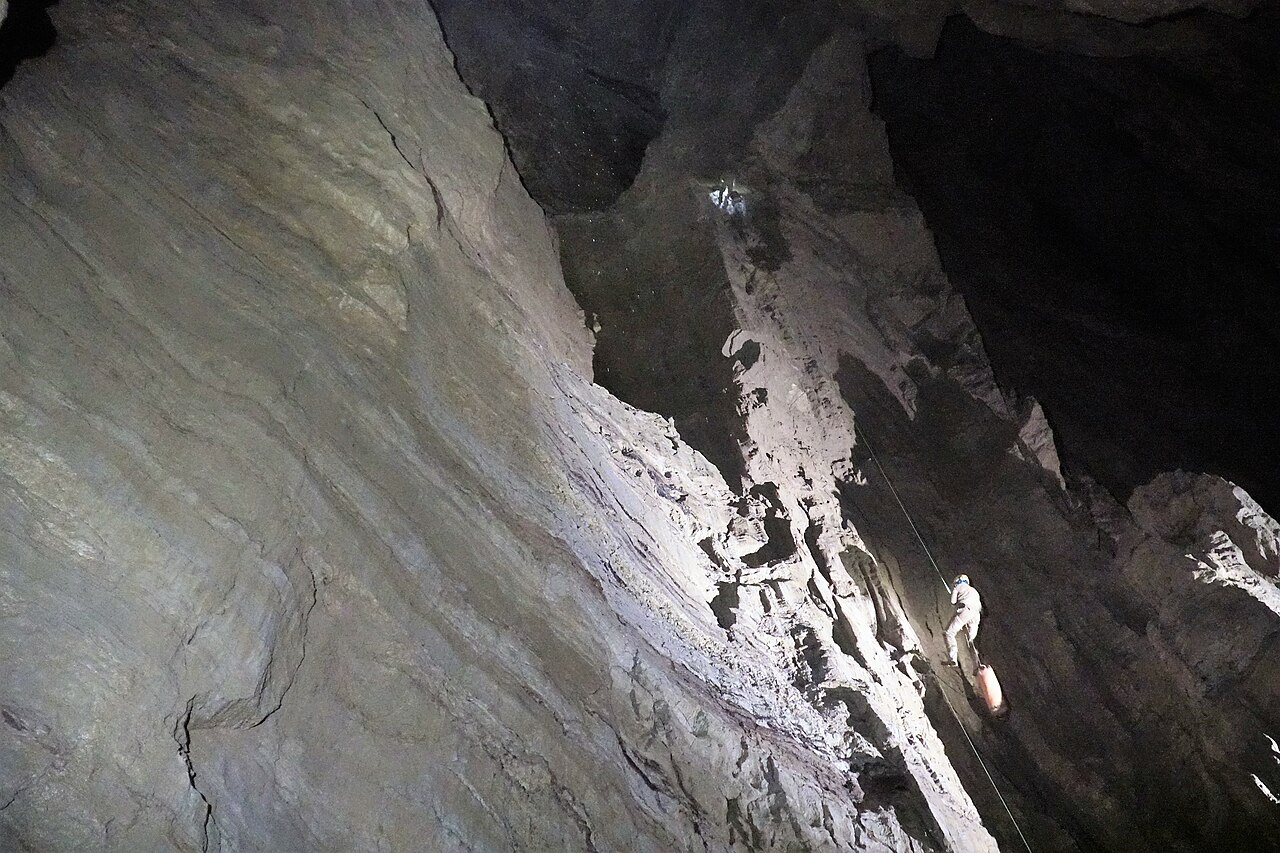
The second-deepest cave on Earth hosts ecosystems in zones of total darkness over 2,000 meters deep. Life here depends entirely on organic matter washing down from above.
Petr Lyubimov, CC BY-SA 4.0, via Wikimedia Commons
An ecosystem in perpetual night
Krubera Cave, in the Arabika Massif of the Western Caucasus mountains, is the second-deepest known cave on Earth. Ukrainian diver Gennady Samokhin set its current maximum depth record of 2,199 meters (7,215 feet) in 2012. For years it was considered the world's deepest, but it is now ranked second to the nearby Veryovkina Cave. Krubera is one of only two caves known to be deeper than 2,000 meters.
The cave is a network of deep pits and narrow passages carved through Upper Jurassic and Lower Cretaceous limestone. Beyond the entrance zone, no sunlight penetrates, creating a completely dark environment with near-total humidity and stable, cold temperatures between 2 and 4 degrees Celsius.
Life in these deep zones is completely dependent on allochthonous organic material—nutrients that wash down from the surface. Water percolating through the rock carries dissolved organic matter, fungi, and microbes, which form the base of the food web. This sparse nutrient supply supports a community of highly adapted organisms.
The inhabitants of the abyss
The deep zones of Krubera Cave host a unique biological community of more than 12 species of arthropods. Many of these are troglobites, animals that are physiologically adapted to life in permanent darkness. Typical adaptations include a lack of eyes, no pigmentation, and better non-visual senses. The cave's fauna includes species of pseudoscorpions, spiders, crustaceans, beetles, and dipterans.
During a 2010 expedition, researchers made a remarkable discovery. At a depth of 1,980 meters (6,500 feet), they found a species of springtail named Plutomurus ortobalaganensis. This arthropod holds the record for the deepest-living terrestrial animal ever found. It survives by feeding on fungi and decaying organic matter in the lightless, near-freezing environment.
Three other new species of springtail were also discovered during that expedition: Anurida stereoodorata, Deuteraphorura kruberaensis, and Schaefferia profundissima. These animals demonstrate that life can persist far deeper into the Earth's crust than previously thought, subsisting on the planet's most limited energy budgets.
💡Fun Facts
The cave is also known as Voronya Cave, which means "Crows' Cave" in Russian, named by explorers in the 1980s for the crows nesting in the entrance pit.
*Plutomurus ortobalaganensis*, the deepest known terrestrial animal, still has pigment, which may suggest it colonized the deep parts of the cave relatively recently in geologic time.
Expeditions to explore the cave's deepest reaches are major undertakings, requiring teams of dozens of people and over five tons of gear to establish a series of underground camps.
To reach the cave's record depth, explorer Gennadiy Samokhin had to dive through a sump—a passage completely submerged in water—at the very bottom of the cave.
Krubera Cave is not a tourist destination. It is accessible only during highly specialized and permitted speleological expeditions.
Admission
Not applicable. Exploration requires participation in a scientific or speleological expedition.
Accessibility
The cave is extremely difficult and dangerous, involving hundreds of meters of vertical rope descents, narrow passages, and underwater sections. Reaching the entrance requires a trek through a remote, high-altitude mountain range.