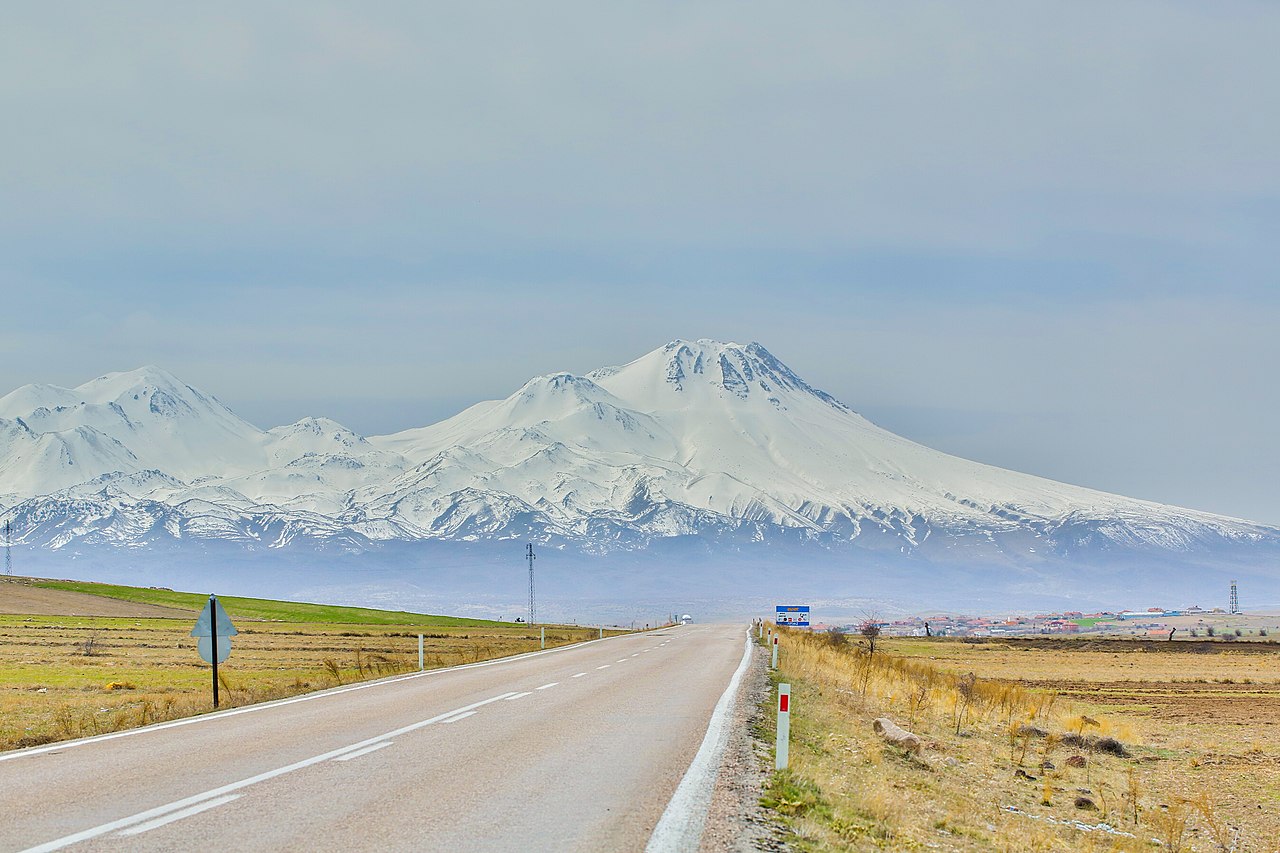
Volcanic ash layers from Cappadocia eruptions are time markers in lake sediments across Anatolia. Geochemical fingerprinting correlates ash layers between sites, creating a regional chronology precise to within decades.
prilfish, CC BY 2.0, via Wikimedia Commons
A Lakebed Time Capsule
The flat, expansive Konya Plain was not always the semi-arid breadbasket it is today. During the last glacial period, it held a vast, shallow lake. This ancient lake acted as a natural sediment trap, creating a high-resolution archive of regional environmental history. The story it tells is of water and sediment, but of fire. More than 130 kilometers to the northeast, the volcanoes of the Cappadocian Volcanic Province, including Mount Hasan (Hasan Dağı) and Mount Erciyes, were intermittently active.
During explosive eruptions, these volcanoes ejected enormous clouds of ash, or tephra, into the atmosphere. Winds carried this fine material across Anatolia, and it settled in a uniform layer on the surface of Lake Konya. The ash sank to the bottom, becoming interbedded with the regular lake silts and clays. Over thousands of years, a sequence of these ash layers built up, creating a natural barcode of volcanic events preserved in the lakebed. Each layer represents a single, geologically instantaneous event.
Fingerprinting Eruptions
The science of tephrochronology uses these ash layers for precise time markers. The premise is that every eruption has a unique geochemical "fingerprint," determined by the specific composition of its magma. Scientists take core samples from the former lakebed and isolate the microscopic shards of volcanic glass, known as cryptotephra, from distinct layers. Using techniques like electron microprobe analysis, they determine the concentration of major and trace elements. This chemical signature allows a tephra layer in the Konya Basin to be unambiguously matched to a specific, dated eruption from a volcano like Hasan Dağı.
These correlated layers, called isochrons, create a timeline that dates archaeological and paleoenvironmental records with great accuracy. For example, analysis of an eruption of Hasan Dağı provided a radiometric age of approximately 8,970 years ago. This date closely aligns with the age of a famous mural at the Neolithic site of Çatalhöyük, located on the Konya Plain, which is thought to depict an eruption of that very volcano. By studying the pollen and other organic matter trapped between dated tephra layers, researchers can reconstruct past climate and vegetation with a precision that would otherwise be impossible.
💡Fun Facts
The Neolithic settlement of Çatalhöyük, one of the world's first urban centers, is located in the Konya Plain and its chronology is partly anchored by these volcanic ash layers.
Obsidian, a volcanic glass from Cappadocian volcanoes, was a prized raw material for tools at Çatalhöyük, indicating long-distance exchange networks more than 9,000 years ago.
Tephrochronology can synchronize records across vast distances; Anatolian volcanic ash has been found in sediments as far away as the Black Sea and the Dead Sea.
The last major lake phase in the Konya Basin occurred between 23,000 and 17,000 years ago, during the Last Glacial Maximum.
The Konya Plain is a vast, flat agricultural region. Access is generally via paved and unpaved roads. The terrain is easy to traverse, but specific scientific coring sites are not marked or accessible to the public.
The Konya Volcanic TephrochronologyKonya Province, Turkey