The southern edge
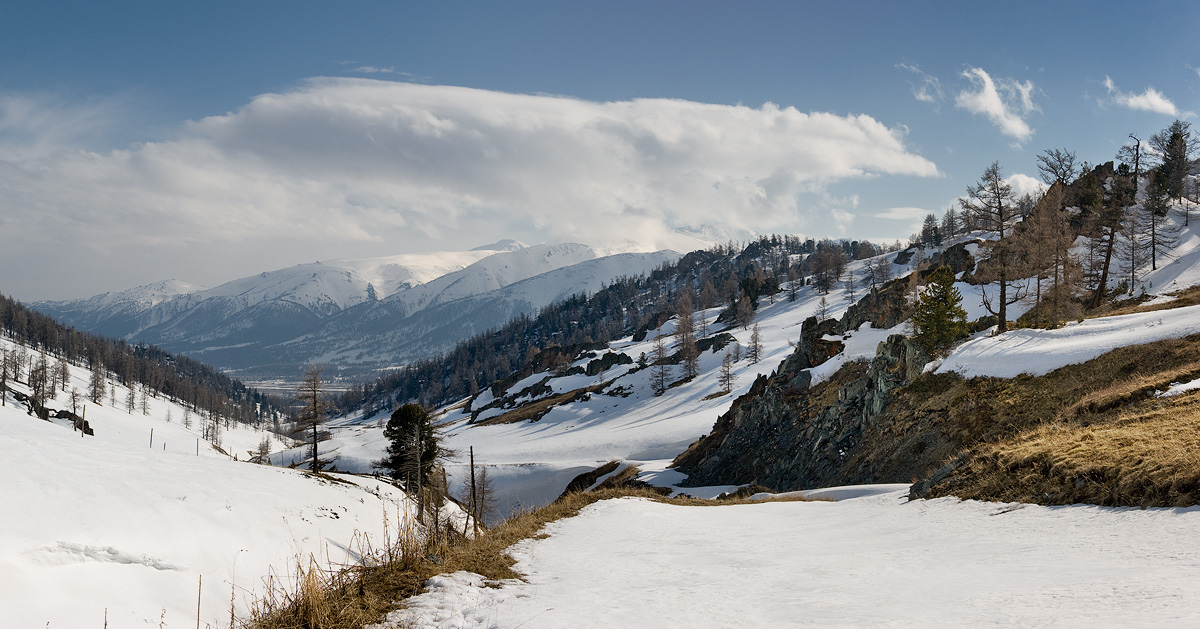
In the Southern Altai Mountains of East Kazakhstan lies the Katon-Karagay National Park, the largest in the country, covering over 643,000 hectares. Within this remote, glacier-carved landscape of steep valleys and high plateaus, a important climatic boundary exists. Here, the vast Eurasian permafrost—ground that remains frozen for at least two consecutive years—reaches its southernmost limits. This is not continuous, deep-frozen ground of the high Arctic, but a more delicate and unstable discontinuous permafrost, highly sensitive to changes in climate.
The permafrost in this region of the Altai is typically found at altitudes between 1,600 and 2,500 meters, where its thickness can reach up to 250 meters. It exists beneath an "active layer," the surface soil that thaws in the summer and refreezes in winter. This seasonal thaw allows for the growth of sub-alpine forests dominated by Siberian pine, larch, and birch, as well as extensive peatlands. These peatlands, saturated with water and composed of partially decayed plant matter, hold enormous quantities of organic carbon, locked away by the cold. The frozen ground acts as a natural freezer, halting the microbial decomposition that would otherwise release this carbon into the atmosphere.
A thawing carbon reservoir
The carbon stored in permafrost peatlands globally is immense, estimated at 185 billion metric tons. The soils of the entire northern permafrost region contain an estimated 1,460 to 1,600 billion metric tons of organic carbon, nearly double the amount currently in Earth's atmosphere. As global temperatures rise, these southern permafrost zones are particularly vulnerable.
Climate data indicates that Kazakhstan is warming faster than the global average. This warming directly threatens the stability of the permafrost in the Altai mountains. As the permafrost thaws, the previously frozen organic material in the peatlands becomes available for decomposition. This process can release vast amounts of carbon dioxide and methane—potent greenhouse gases—creating a feedback loop that accelerates climate change. Research in other boreal regions shows that when permafrost peatlands burn, the deeper thaw and slow vegetation recovery can turn the ecosystem into a net carbon source for years afterward. The stability of this fragile southern edge helps in understanding future climate dynamics.