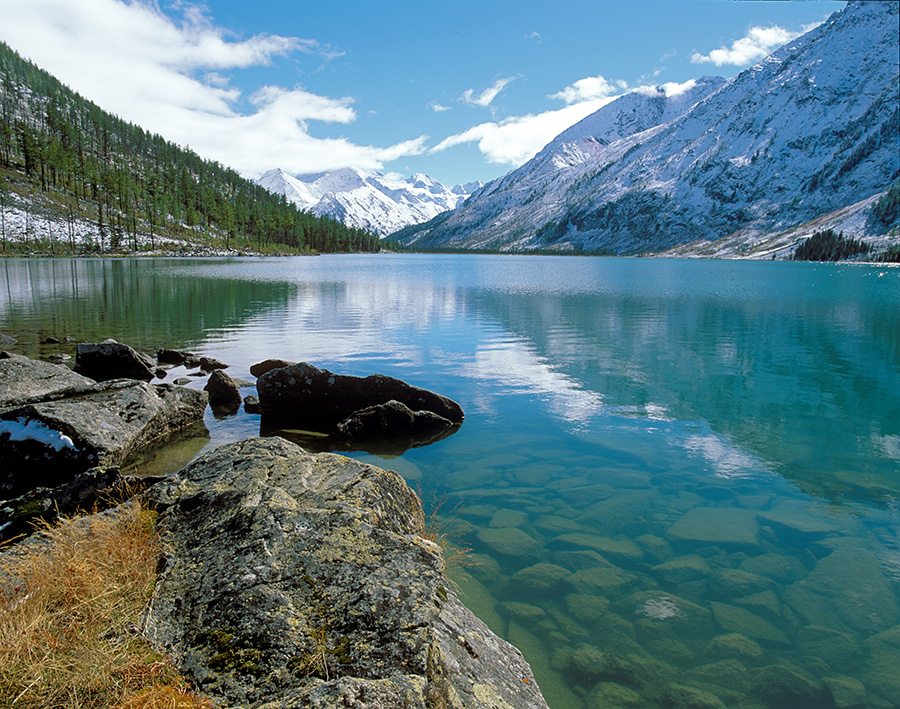
A UNESCO site where three vegetation zones (steppe, taiga, alpine) meet, creating exceptional biodiversity. The mountains hold glaciers, permafrost, and archaeological sites documenting 10,000 years of human habitation.
Игорь Шпиленок, CC BY-SA 3.0, via Wikimedia Commons
A convergence of ecosystems
The Altai Golden Mountains in southern Siberia represent one of the most complete sequences of altitudinal vegetation zones in all of central Siberia. This UNESCO World Heritage site encompasses several protected areas, including the Altaisky and Katunsky Nature Reserves and the Ukok Quiet Zone. Here, the dry Central Asian steppe collides with the dense Siberian taiga forest and rises into alpine meadows and glaciers. This convergence creates habitats for a wide array of species. The mountains host over 2,000 species of vascular plants, with more than 10% being endemic to the Altai region.
The landscape is dominated by Siberia's highest peak, Mount Belukha, which reaches 4,506 meters (14,783 feet). Its slopes and the surrounding Katun Range contain more than 386 glaciers, covering a total area that exceeds 150 square kilometers. These glaciers feed the Katun River, which is the primary source of the Ob River, one of Asia's longest river systems. The site also includes Lake Teletskoye, a vast body of fresh water with a maximum depth of 325 meters that holds over 40 cubic kilometers of water. The region's fauna has 72 mammal species, such as the Siberian ibex and the globally endangered snow leopard (Panthera uncia).
A landscape frozen in time
The Altai's permafrost acts as a preservative, turning the ground into a record. For millennia, the nomadic Pazyryk culture buried their high-status dead in deep log chambers beneath mounds of earth and stone called kurgans. Water would seep into these tombs, freeze solid, and remain that way for thousands of years, preserving organic materials well.
In 1993, archaeologists on the Ukok Plateau discovered the tomb of a 25-year-old woman from the 5th century BC, now famously known as the "Siberian Ice Maiden." She was buried with six saddled horses, wore Chinese silk, and had a tall, elaborate headdress. Most remarkably, her skin was covered in complex tattoos of creatures, such as deer with griffin beaks. These are among the most complex ancient tattoos ever found.
The human story in these mountains goes back much further. The region contains the Denisova Cave, a site occupied by different human groups for over 300,000 years. It was here in 2010 that genetic analysis of a single finger bone revealed a previously unknown group of archaic humans: the Denisovans. The cave's sediment layers show that Denisovans, Neanderthals, and early modern Homo sapiens all used this same location at different times, and genetic evidence even proves they interbred.
💡Fun Facts
The Denisova Cave is the only known site in the world where remains of Denisovans, Neanderthals, and modern humans have all been found.
The tattoos on the Pazyryk mummies were created with fine needles, possibly the same ones used for embroidery, and soot-based ink.
Mount Belukha has twin peaks; the Eastern peak stands at 4,506 meters and the Western peak reaches 4,440 meters.
Lake Teletskoye is the third deepest lake in Russia, after Lake Baikal and the Caspian Sea.
The general territory is always open, but access to the core nature reserves (zapovedniks) like Altaisky and Katunsky is strictly regulated and requires permits obtained in advance. Guided tours are often mandatory.
Admission
Fees are required for permits to enter the protected nature reserves.
Accessibility
The terrain is rugged and mountainous. Travel within the region is often by 4x4 vehicles, on horseback, or via multi-day trekking. It is not generally accessible for those with mobility issues.