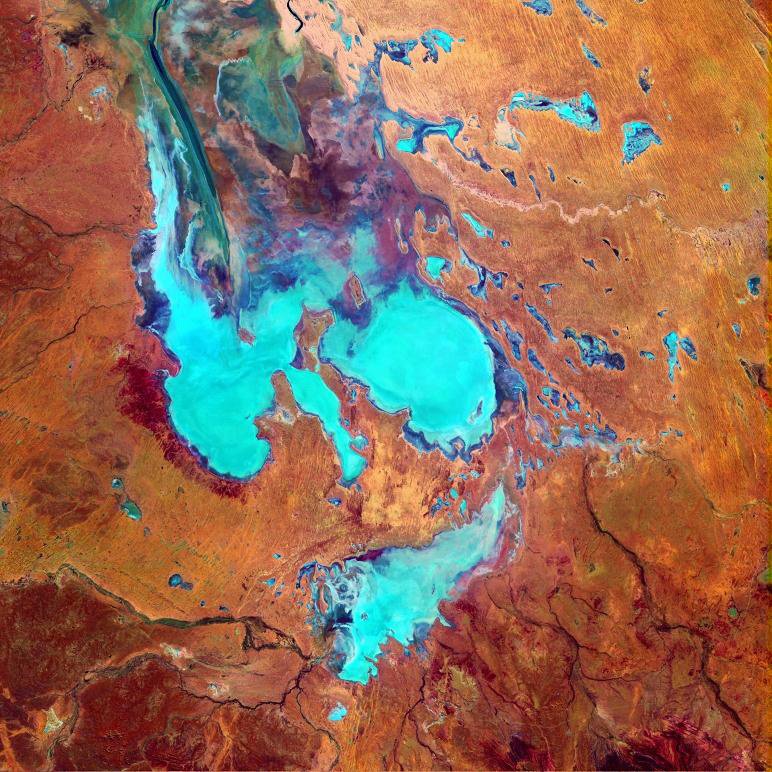
Bacteria surviving in salt concentrations that kill all other life. When rare floods dilute the lake, they bloom in pink and red, visible from space.
Goddard Space Flight Center’s Landsat Team and the Australian ground receiving station teams., Public domain, via Wikimedia Commons
Australia's Ephemeral Pink Sea
Kati Thanda-Lake Eyre is a place of extremes. Located at Australia's lowest point, about 15 meters below sea level, it is the continent's largest lake—when it contains water. Most of the time, it is a vast, dry salt pan. The lake is an endorheic basin, meaning water flows in but only leaves through evaporation. This process has created a hypersaline environment where salt concentrations can be ten times that of seawater, a condition hostile to most forms of life.
Yet, life persists. The pink and red colors that appear when the lake has water are not from minerals, but from a community of extremophilic microorganisms. These are life forms adapted to environments that are typically lethal. The main organisms are a green alga called Dunaliella salina and several species of salt-loving archaea and bacteria, including Halobacterium salinarum and Salinibacter ruber. D. salina can survive in salt concentrations up to 35%, a level that would destroy the cells of most other organisms.
To cope with the immense osmotic pressure, D. salina produces high concentrations of glycerol within its cell. When stressed by high salinity and intense sunlight, it also produces massive amounts of a pigment called beta-carotene, the same compound that gives carrots their orange color. This carotenoid acts as a protective shield against UV radiation, tinting the alga, and the water, a shade of orange-red.
A Colorful Biological Cascade
The archaea, such as Halobacterium salinarum, contribute their own distinct color. These single-celled organisms possess a protein called bacteriorhodopsin in their cell membranes, which can make up nearly 50% of the cell's surface area. This protein is purple and is a light-driven proton pump, capturing solar energy to produce ATP, the cell's energy currency. Other bacteria, like Salinibacter ruber, produce a pigment called bacterioruberin, which is also spread throughout the cell. The combined effect of these different pigmented microbes creates the lake's pink, red, and orange hues.
The bloom is a rare event. Minor floods, causing a one-and-a-half-meter depth, happen roughly every three years, but the lake has filled to capacity only three or four times in the last 160 years. When floodwaters from Queensland's channel country arrive, they dilute the salt crust, triggering a biological explosion. Dormant brine shrimp eggs hatch by the million, feeding on the algae. The population of Dunaliella salina blooms first, followed by the archaea and bacteria that feed on the byproducts of the algae. This entire bright ecosystem becomes so expansive that the lake's color change is visible to satellites orbiting 36,000 kilometers above the Earth.
💡Fun Facts
The lake sits at the lowest natural point in Australia, approximately 15 meters (49 ft) below sea level.
On the rare occasions it fills, Kati Thanda-Lake Eyre becomes Australia's largest lake, covering up to 9,500 square kilometers.
The lake has only filled to capacity three times between 1860 and 2025.
The protein bacteriorhodopsin, responsible for the purple-red color in some of the archaea, functions as a light-driven energy pump.
The park is accessible 24/7, but the Halligan Bay Public Access Route is closed annually from December 1st to March 15th due to extreme heat. It's best to avoid travel during the summer months (November-March) when temperatures can exceed 50°C.
Admission
A vehicle entry fee is required. A Desert Parks Pass or a day pass can be purchased.
Accessibility
Access requires a 4WD vehicle, and outback travel experience is essential. Visitors are not permitted to walk or drive on the lake bed. Viewing is from designated lookouts or via scenic flights. The terrain is remote and harsh.