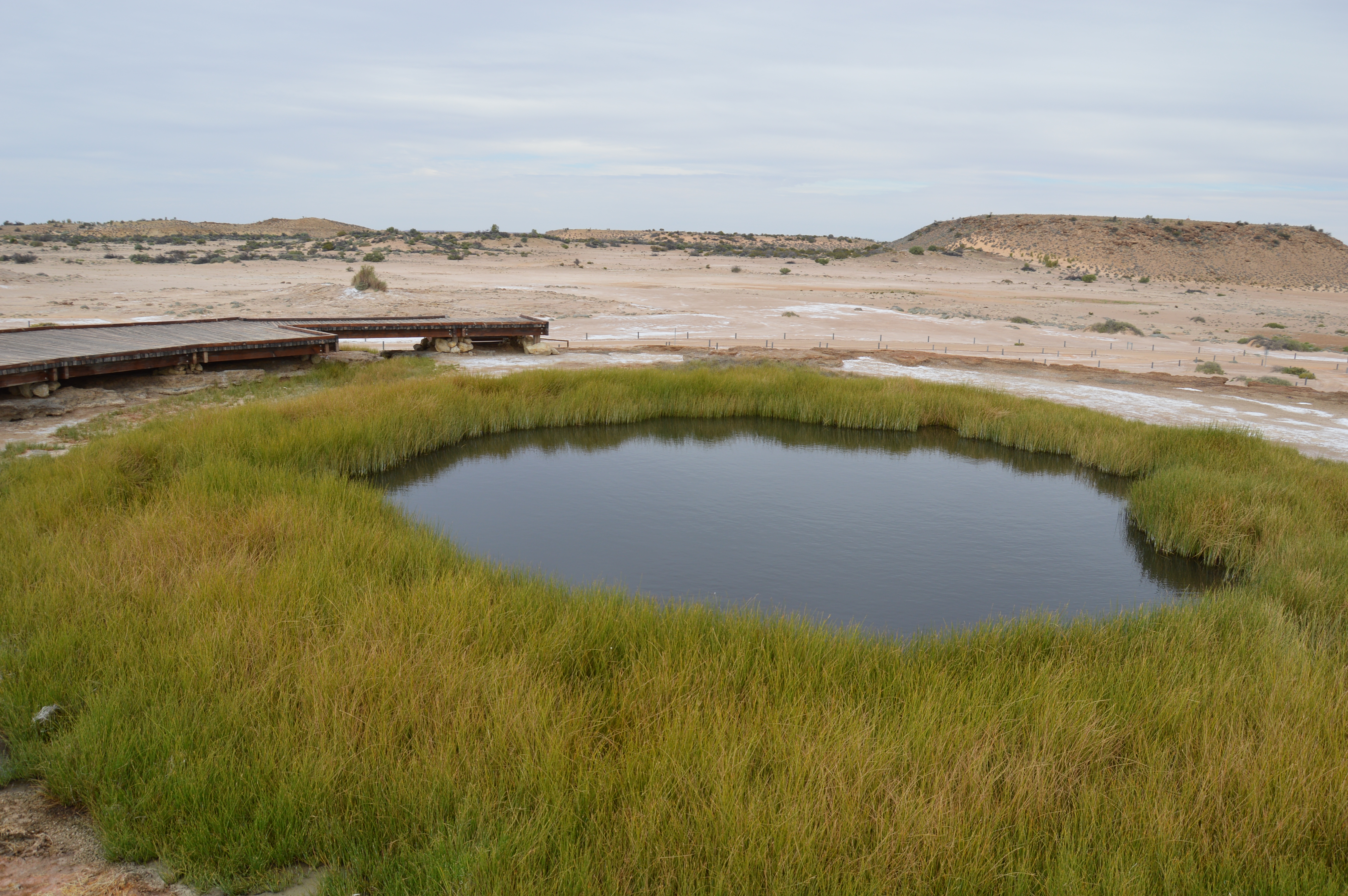
An underground ocean surfaces
Beneath 22% of Australia lies the Great Artesian Basin, the largest and deepest artesian system on Earth. It holds an estimated 64,900 cubic kilometres of groundwater, a volume that could fill Sydney Harbour 130,000 times. This water is held in porous sandstone layers laid down during the Triassic, Jurassic, and early Cretaceous periods, capped by a layer of impermeable marine sedimentary rock.
Rainfall enters the basin primarily along its eastern edge, near the Great Dividing Range. From there, it begins an incredibly slow movement westward, moving through the sandstone at a rate of only one to five meters per year. Isotope dating using carbon-14 and chlorine-36 reveals the immense age of this "fossil water." Water emerging from the springs in South Australia today may have fallen as rain nearly two million years ago.
The water is forced to the surface through natural faults or thin spots in the overlying rock, creating the mound springs. As this pressurized, mineral-rich water evaporates in the arid climate, it deposits sediments like calcium carbonate. Over thousands of years, these deposits build up into the characteristic mounds, some rising several meters high.
Isolated islands of life
Each mound spring is a small, wet area in an otherwise dry landscape. This isolation has created unique, island-like ecosystems. The constant flow and stable water temperature, which can range from 30 to 100 degrees Celsius depending on the spring's depth, provide a reliable habitat.
This stability has allowed for the evolution of numerous endemic species found nowhere else on the planet. Over 90 species are unique to the Great Artesian Basin springs, with more than half of those found in South Australia. The Dalhousie Springs complex alone has 16 endemic species.
These include several species of hydrobiid snails (genus Jardinella), which have adapted to the specific water chemistry of their home springs. There are also at least eight endemic fish species, such as the Dalhousie hardyhead (Craterocephalus dalhousiensis), the Dalhousie catfish (Neosiluris gloveri), and several types of desert gobies (Chlamydogobius). These small, specialized animal communities are entirely dependent on the continuous flow of ancient groundwater. For the Arabana people, the springs, known as Ngarrawa, are central to their culture and Dreaming stories, having served as important water sources and landmarks for millennia.