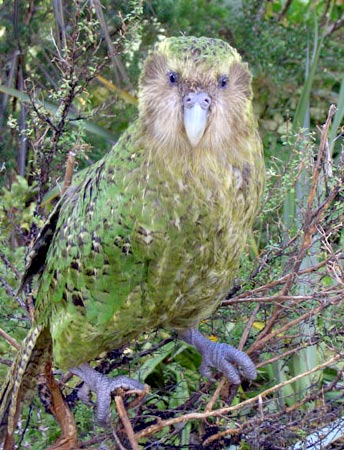
The world's only flightless parrot is also one of the rarest birds. Males excavate bowl-shaped depressions and emit booming calls that travel for miles. With only 250 individuals left, every bird is monitored and genetically managed.
Department of Conservation, CC BY 2.0, via Wikimedia Commons
The Subwoofer Serenade
The kākāpō (Strigops habroptilus), the world's heaviest parrot, has a mating system as unusual as its appearance. This is the only flightless parrot and the only parrot species to use a "lek" system for breeding. During the breeding season, males leave their solitary home ranges and can travel up to 5 kilometers to gather at specific arenas on ridges and hilltops. Here, each male establishes his own court, a track-and-bowl system he meticulously constructs and maintains.
Each court consists of one or more saucer-shaped bowls dug into the earth, often next to a rock face or bank to help reflect sound. These bowls can be up to 10 centimeters deep and are connected by a network of cleared tracks that can extend 50 meters along a ridge. From within his bowl, the male inflates a thoracic air sac and emits a series of deep, low-frequency "booms". These calls are below 100 Hz, verging on infrasound, and are powerful enough to travel for up to 5 kilometers on a still night. After a sequence of about 20 booms, the male emits a high-frequency, metallic "ching" sound, which may help females pinpoint his location. This performance is an endurance feat; males may boom for eight hours a night for three to four months.
A Cycle Tied to Fruit
The kākāpō breeding cycle does not happen every year. It is linked to the mast fruiting of specific native trees, primarily the rimu tree (Dacrydium cupressinum). These trees only produce a superabundance of fruit every two to five years. The vitamin D and calcium in rimu fruit are essential for egg production and the healthy growth of chicks. Females will travel long distances, bypassing some males, to select a mate based on his display. After mating, the female receives no further assistance from the male. She returns to her own territory to lay her clutch of one to four eggs in a ground-level nest and raises the chicks alone.
This infrequent breeding, combined with the devastating impact of introduced predators like stoats and cats, brought the species to the brink of extinction. By 1995, only about 50 birds remained. The Kākāpō Recovery Programme, established that year, has meticulously managed the entire population. Every individual is known, named, and monitored on predator-free island sanctuaries like Whenua Hou (Codfish Island) and Pukenui (Anchor Island). Conservation efforts include supplementary feeding, nest protection, and even artificial insemination to manage the species' low genetic diversity. These intensive efforts have slowly increased the population to over 200 individuals.
💡Fun Facts
The kākāpō is the world's heaviest parrot; males can weigh up to 4 kilograms (9 lbs).
True to their Māori name, which means "night parrot," kākāpō are nocturnal.
Individuals are thought to have a lifespan of 60 to 100 years, making them one of the longest-living birds.
When threatened, their primary defense is to freeze, relying on their moss-green plumage for camouflage. This strategy was effective against avian predators but fails against introduced mammals that hunt by scent.