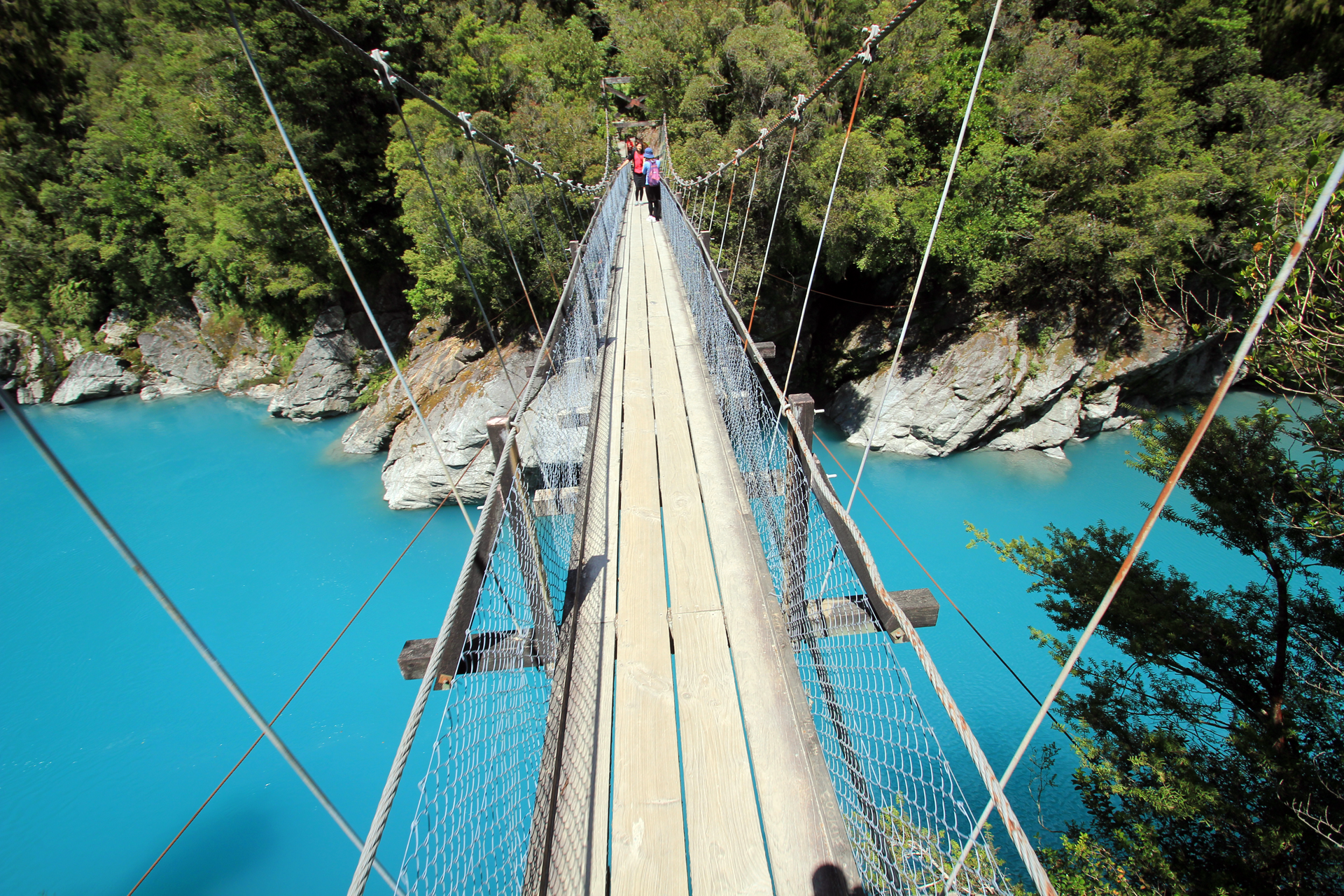
A river of powdered rock
The intense turquoise color of the Hokitika River is not a trick of the light, but the light itself. The water is saturated with 'glacial flour', a fine-grained silt created by the immense pressure of glaciers grinding against bedrock in the Southern Alps. This powder consists of minerals like quartz and feldspar, pulverized to particles between 2 and 65 microns. Because these particles are so small, they do not settle to the riverbed but remain suspended in the water column.
This suspension of fine sediment is the reason for the river's color. The water itself absorbs longer wavelengths of light—the reds, oranges, and yellows. The suspended rock flour, in turn, scatters the shorter blue and green wavelengths. This phenomenon, known as the Tyndall Effect, is what sends the turquoise hue back to an observer's eye. The shade of the water can change depending on conditions. A higher concentration of particles after significant glacial melt can make the water appear greener, while a lower concentration shifts the color toward a deeper blue. After heavy rainfall, however, the influx of other sediments overwhelms the glacial flour, and the river turns a murky grey-brown.
The geological engine
The Hokitika River is approximately 64 kilometers long, originating in the Southern Alps and flowing out to the Tasman Sea. The gorge itself is a specific section where the river carves through a narrow band of pale grey schist, with walls rising 15 to 20 meters above the water. The source of the rock flour is the mechanical grinding action of major nearby glaciers, such as the Franz Josef Glacier, which can move up to one meter a day.
The bedrock being ground down includes schist and greywacke, a type of hard, muddy sandstone that is ubiquitous in New Zealand. This constant erosion produces the fine particles that feed the river. The process is most intense during the warmer summer months when glacial melt is at its peak, continuously delivering fresh rock flour into the river system and maintaining the water's striking color. The entire process shows the link between the geology of the high alps and the physics of light in the lowlands.