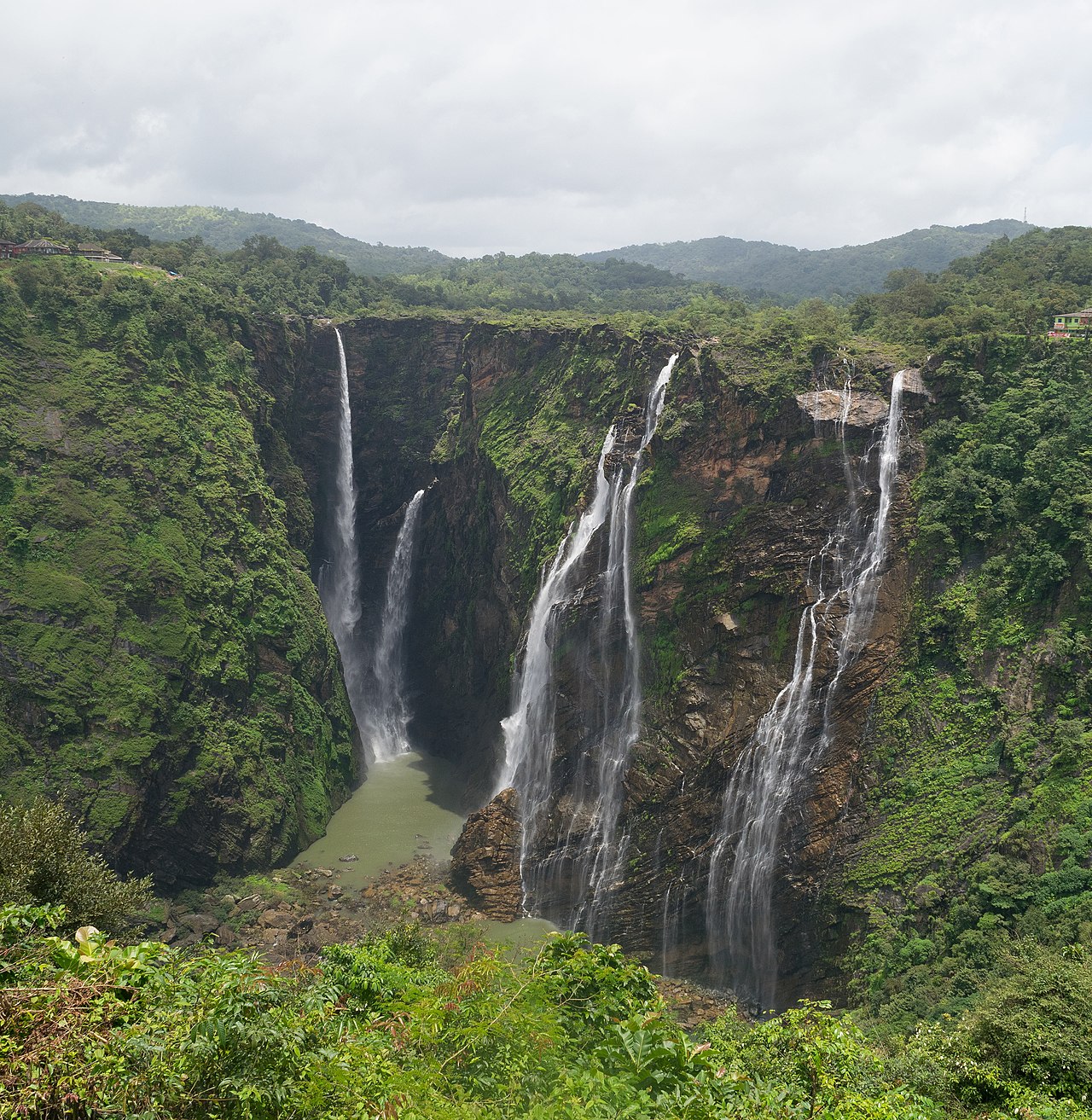
The Monsoon Engine
Jog Falls results of seasonal water physics, located in the Western Ghats of Karnataka. The falls are formed by the Sharavathi River, which originates in the Western Ghats and flows west towards the Arabian Sea. The river's course carves through a region that receives immense seasonal rainfall, with annual averages ranging from 1,700 mm to 6,000 mm. Around 95% of this precipitation occurs during the southwest monsoon between June and September.
This intense influx of water transforms the river. Before its modern regulation, the Sharavathi would swell and plunge 253 meters (830 feet) over a cliff of crystalline Peninsular gneiss. The drop is not a single sheet of water but is segmented into four distinct cascades, each with its own physical characteristics. The "Raja" is a sheer, unbroken plunge. The "Roarer" is named for the sound it produces as it rushes through a rocky recess at a 45-degree angle to the Raja. The "Rocket" shoots downwards in a series of jets, while the "Rani" glides down in a quiet, graceful sheet of water. During peak monsoon, the combined flow can be immense, with an average rate of 153 cubic meters per second. In the dry season, this torrent historically dwindled to a near-disappearance.
An Engineered Site
The natural, seasonal rhythm of Jog Falls was fundamentally altered in 1964 with the construction of the Linganamakki Dam, located about 9 kilometers upstream. This dam, measuring 2.4 kilometers in length, was built across the Sharavathi River primarily for hydroelectric power generation, creating a reservoir with a capacity of 4.3 billion cubic meters. The Sharavathi Hydroelectric Project has a generating capacity of over 1,000 MW, a significant portion of Karnataka's electricity.
This system now dictates the waterfall's behavior. For most of the year, the dam's gates are closed, and the river's water is diverted through a canal to the Talakalale Balancing Reservoir and then to the power-generating stations. This diversion starves the falls, often reducing them to a thin trickle, smaller than their natural state. The spectacle of the falls in their full power is now a managed event. When the Linganamakki reservoir nears its full capacity of 1,819 feet during a heavy monsoon, the dam's eleven sluice gates are opened to release excess water. These releases, which can discharge tens of thousands of cusecs (cubic feet per second), are what tourists now see as the "full" Jog Falls. The natural wonder has become a functional spillway for an industrial process, its flow scheduled by engineers rather than the seasons.