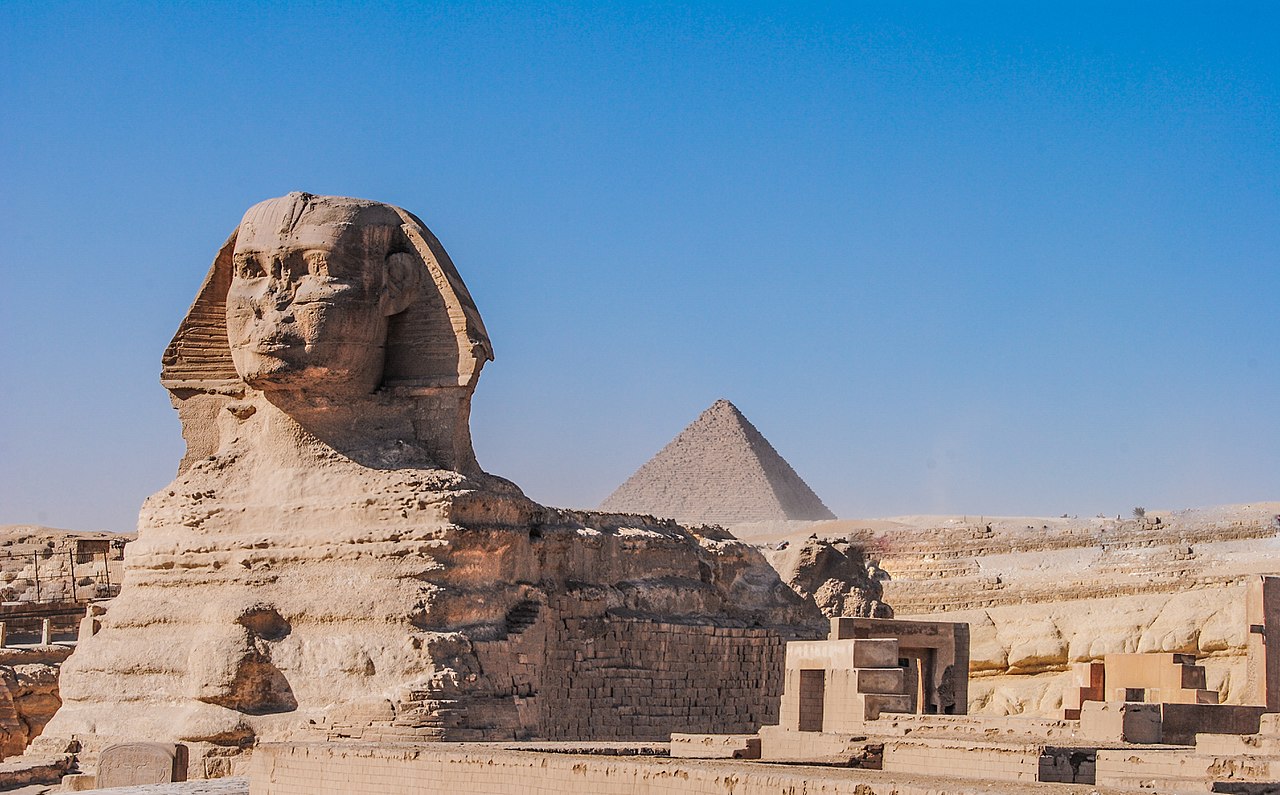
Vertical grooves suggest water erosion, not wind. Geologists debate whether rare desert floods or groundwater seepage caused the weathering that makes the body look older than the head.
Hesham Ebaid, CC0, via Wikimedia Commons
A Body Older Than Its Head
The Great Sphinx of Giza presents a geological puzzle that challenges its conventional origin story. Egyptologists attribute the monument to the Pharaoh Khafre, dating its construction to around 2500 BCE. The statue, the world's largest monolith, was not assembled but carved from a single, enormous outcrop of limestone from the Eocene-period Mokattam Formation. This bedrock is not uniform; it consists of different layers with varying hardness. The Sphinx's head is carved from a durable, dense limestone layer, which has kept it relatively well-preserved. In contrast, most of the body is sculpted from a softer, layered limestone that is highly susceptible to weathering.
The controversy lies in the type of weathering visible on the Sphinx's body and the walls of its enclosure. The surfaces show deep, vertical fissures and a rounded, undulating profile. Geologists widely recognize these features as signs of precipitation-induced erosion—the result of rainwater running down the stone for a very long time. This pattern differs from the sharp, horizontal layering typically caused by wind and sand erosion, which is visible on other Old Kingdom tombs and structures on the Giza plateau.
The Water Erosion Hypothesis
In the early 1990s, geologist Robert M. Schoch of Boston University, prompted by researcher John Anthony West, concluded that significant rainfall was the cause for the deep vertical weathering. The geological record shows that the Giza plateau has been hyper-arid for the last 5,000 years. For rainfall to be the primary cause of such extensive erosion, the Sphinx would have to be much older, dating to a period when North Africa had a wetter climate. This would push its origins back to at least 5,000 BCE, and possibly as far back as the end of the last Ice Age around 10,000 BCE. Seismic studies conducted by Schoch around the monument's base also indicated subsurface weathering patterns consistent with an older age.
This hypothesis is debated. Mainstream Egyptologists maintain that the Sphinx's context—its location and stylistic similarity to the adjacent temples—firmly places its construction in Khafre's reign. They propose alternative explanations for the weathering. One leading theory is haloclasty, where moisture wicking up from the ground or from atmospheric condensation carries salts into the porous limestone. As the water evaporates, the salt crystallizes and expands, flaking the rock apart. Others argue that the inherent poor quality of the body's limestone, combined with occasional heavy rains and Nile flooding over 4,500 years, is sufficient to explain the erosion. Some geoscientists suggest water seeped through natural fissures in the rock before the Sphinx was ever carved, meaning nature did the initial weathering, making the monument appear older than it is.
💡Fun Facts
The Sphinx's head is small with its body, leading to the theory that a later pharaoh had it re-carved from an originally larger lion's head.
The limestone bedrock from which the Sphinx is carved contains numerous marine fossils from the Tethys Sea, which covered the area approximately 50 million years ago.
The famous story of Napoleon's troops shooting off the Sphinx's nose is a myth; sketches of the Sphinx show it without a nose well before Napoleon's 1798 expedition.
The entire statue sits in a U-shaped enclosure, or ditch, several meters below the main level of the Giza plateau, created as workers quarried the limestone from around the central monolith.
The Giza Plateau is generally open from 7:00 AM to 4:00 PM, with some seasonal variations. Last entry is typically one hour before closing.
Admission
General entry to the Giza Plateau for foreign adults is approximately 700 EGP. Access to the interior of the pyramids requires separate, additional tickets. Prices are subject to change.
Accessibility
The main entrance near the Great Pyramid has more paved and wheelchair-friendly paths. The area around the Sphinx is sandier and less accessible. The terrain throughout the site can be uneven.