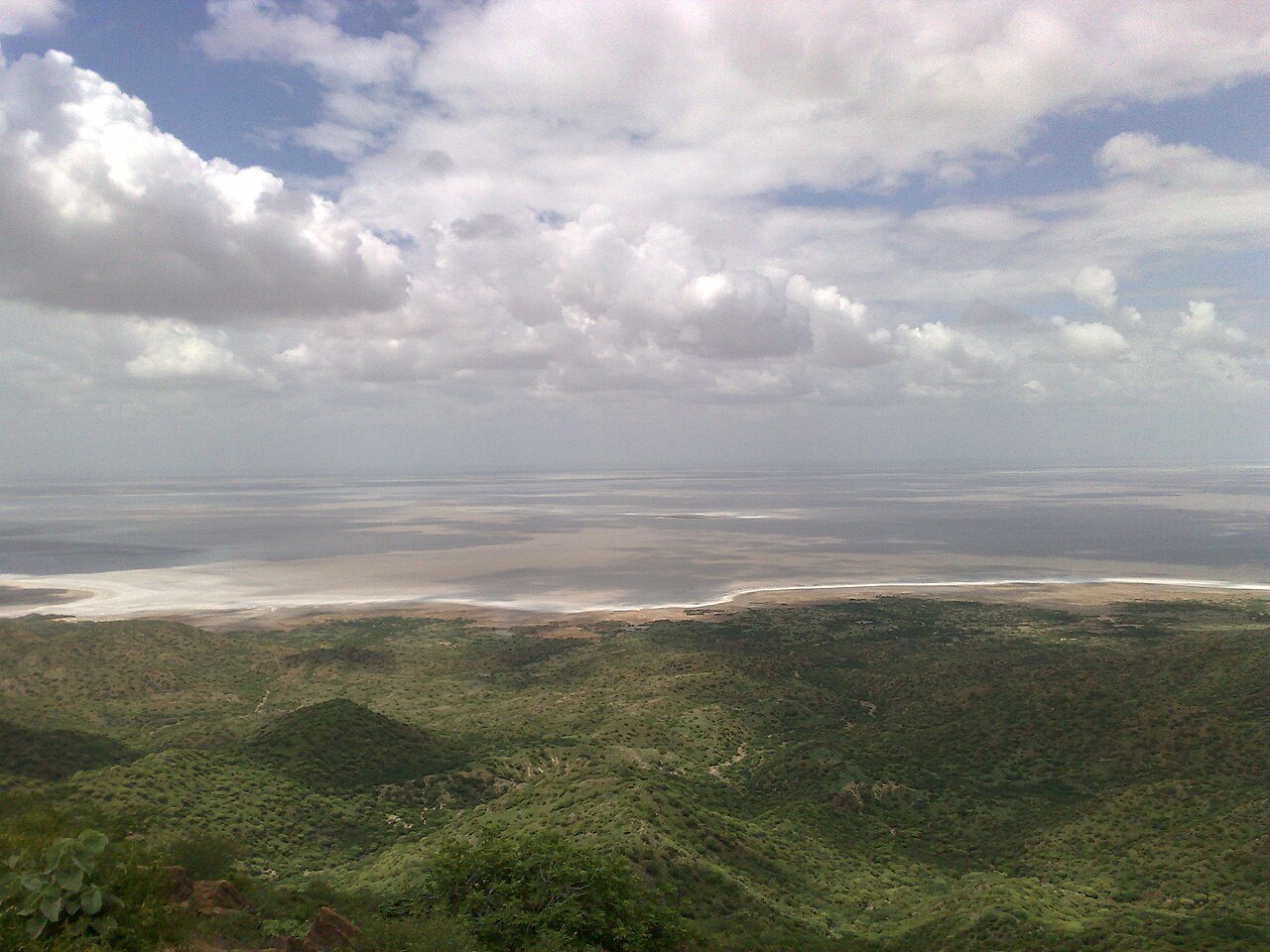
The only breeding ground for Greater Flamingos in India appears when monsoons flood this salt flat. Timing is erratic, and birds may wait years for conditions. An avian city that appears and vanishes with the rains.
Superfast1111, CC BY-SA 3.0, via Wikimedia Commons
An ephemeral metropolis for birds
For much of the year, the Great Rann of Kutch is a 26,000-square-kilometer salt-encrusted desert. Temperatures can reach 50°C (122°F) in the summer and drop below freezing in the winter. Then, the southwest monsoon arrives between June and September. A combination of rainwater and tidal surges from the Arabian Sea floods the flats to a depth of about 50 cm, transforming the landscape into a shallow, saline wetland.
This inundation triggers a bloom of life. The brackish water supports algae, brine shrimp, and other small organisms that are the primary food for flamingos. This temporary abundance attracts two species of flamingo: the Greater Flamingo (Phoenicopterus roseus) and the smaller, more numerous Lesser Flamingo (Phoeniconaias minor). The Rann of Kutch is the only known breeding site in Asia for both species. The area within the Kutch Desert Wildlife Sanctuary where the birds congregate is known as "Flamingo City," a name given for the immense colonies that form there. In 1945, ornithologist Dr. Sálim Ali estimated a population of half a million birds at the site. More recent surveys have observed congregations of around 100,000 Lesser Flamingos and 10,000 Greater Flamingos exhibiting courtship behavior.
To cope with the extreme salinity of their environment, flamingos have specialized supraorbital glands near their eyes. These glands function as a biological desalination system, filtering excess salt from their blood which is then excreted through their nostrils.
Architecture of a temporary city
Successful breeding is entirely dependent on the timing and extent of the monsoon flooding. If conditions are right, the birds begin constructing their nests. Using their beaks, both partners build a conical mound from the sticky mud of the salt flats. These nests stand one to two feet high, an elevation to protect the single egg from rising floodwaters. The female lays one egg, and both parents take turns incubating it for about 27 to 30 days.
After hatching, the grey-downed chicks leave the nest within four to eight days. They gather in immense groups called crèches, which can contain thousands of young birds supervised by a few adults. This allows the majority of the adult flamingos to forage for food, sometimes traveling up to 100 kilometers away, before returning to feed their specific chick. The parents feed the chicks a nutrient-rich "crop milk," a reddish secretion produced in their upper digestive tracts. The pink and reddish colors of adult flamingos come from beta-carotene pigments present in the algae and crustaceans they consume. Without this diet, the birds' feathers would be white or grey. As the long dry season returns and the water evaporates, the flamingos and their now-fledged young depart, leaving the salt flats to bake under the sun until the next monsoon.
💡Fun Facts
The first official confirmation of flamingo breeding in the Rann of Kutch was made by Maharao Khengarji of Kutch in the late 19th century.
Flamingo chicks are born with grey or white feathers and do not develop their characteristic pink plumage for about two years.
To feed, a flamingo holds its uniquely bent bill upside down in the water to filter out mud and silt, trapping shrimp and algae.
An abandoned, elevated 20-kilometer-long road built by the Border Security Force has become an ideal nesting site for tens of thousands of Lesser Flamingos.
The area is remote and access is often restricted, especially to the sensitive breeding colonies which are protected. General tourism to the White Rann is popular during the Rann Utsav festival (typically November to February).
Admission
Permits are generally required to enter the Rann of Kutch, available from Bhuj. Costs vary.
Accessibility
The terrain is a flat, expansive salt marsh, which can be wet or dry and cracked depending on the season. Travel is primarily by 4x4 vehicles. The breeding sites themselves are located in difficult, inaccessible terrain.