A ladder of life
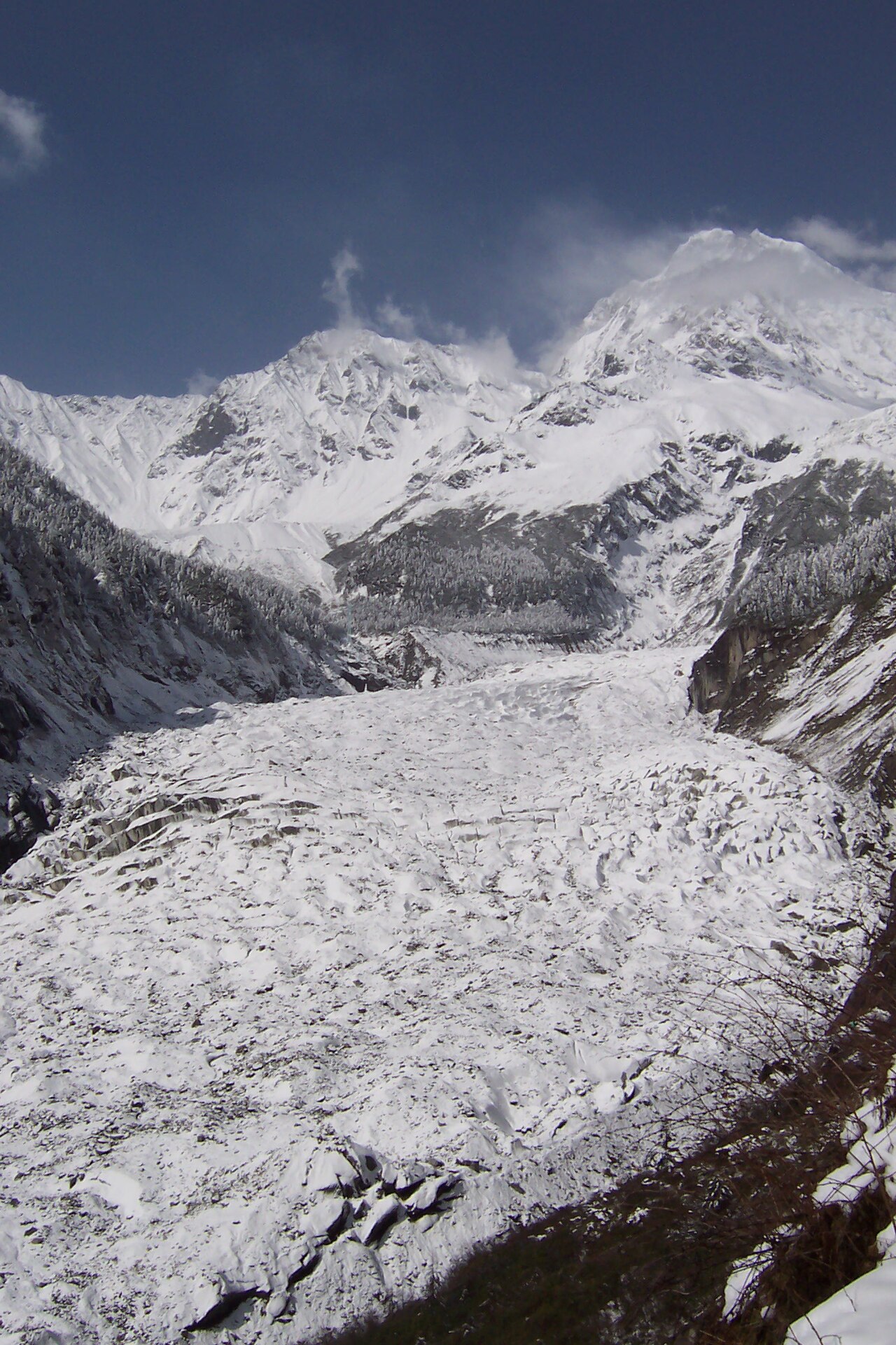
The Daxue Mountains, a major range in the Hengduan Mountain system, form a steep wall on the eastern edge of the Tibetan Plateau. The highest peak, Gongga Shan, rises to 7,556 meters (24,790 feet). This immense vertical drop—over 6,500 meters from the highest peak to the lowest valleys—creates one of the world's most pronounced examples of vertical zonation. Plant communities here are stacked in distinct bands, with the entire ecosystem changing dramatically with each rise in altitude.
The eastern slopes of the range display a complete range of vegetation belts.
- 1,100–2,200 m: Subtropical evergreen broad-leaved forests dominate the lower elevations. These forests contain species of Cinnamomum, Lithocarpus, and Cyclobalanopsis.
- 2,200–2,500 m: A coniferous and broad-leaved mixed forest appears, featuring trees like hemlock (Tsuga), maple (Acer), and birch (Betula).
- 2,500–3,600 m: This band is the subalpine coniferous forest. It is composed of fir (Abies fabri) and spruce (Picea).
- 3,600–4,600 m: Above the treeline, alpine shrubs and meadows take over. Hardy rhododendrons and willows (Salix) grow in dense thickets.
- Above 4,600 m: Vegetation becomes sparse, giving way to alpine scree and the permanent nival zone, or snow line.
This stratification creates a compressed sequence of different climates. A single day's hike can be like traveling through different latitudes, from subtropical to polar conditions.
The escalator to extinction
The clear, stacked ecosystems of the Daxue Mountains make them a natural laboratory for studying the effects of climate change. As global temperatures rise, these vegetation zones are forced to move upslope to find their ideal temperature range. Scientists use transect studies, repeated surveys of plant and animal life along specific elevation gradients, to measure this movement.
Research on Gongga Shan shows a clear upward trend. Over the past four decades, the upper limit of vegetation has advanced at an average rate of 17.43 meters per year. This is significantly faster than the upward shift of the snowline, which has moved at a rate of 3.9 meters per year. This phenomenon, where species from lower, warmer altitudes colonize higher elevations, is a direct response to a warming climate.
While some species can migrate, the mountain peak imposes a hard limit. As alpine species are pushed higher, the total available habitat area shrinks. This process is sometimes called an "escalator to extinction." Plants and animals adapted to the highest alpine conditions have nowhere left to go once the climate of their current zone becomes unsuitable. This habitat squeeze puts the unique biodiversity of the mountain's highest reaches at considerable risk.