The golden library claim
The story of a subterranean alien library begins with a Hungarian-Argentine explorer named János "Juan" Móricz. In 1969, Móricz claimed to have discovered a network of artificial tunnels deep within Cueva de los Tayos. He described a fantastic chamber containing a "metal library," books made of golden plates engraved with a lost history of humanity. Móricz's narrative was detailed, suggesting the library was the work of an ancient Magyar (Hungarian) society that had migrated to South America via the lost continent of Lemuria.
The story became globally known after it was featured in Erich von Däniken's 1973 book, The Gold of the Gods. Von Däniken, already famous for his "ancient astronaut" theories, sensationalized Móricz's account and linked the library to extraterrestrial beings. This publication turned the remote cave, long known to the indigenous Shuar people as a home for nocturnal oilbirds (Steatornis caripensis), into a place of international speculation. The Shuar have traditionally been the guardians of the cave, which they consider a sacred place. Despite the publicity, Móricz never revealed the library's exact location, and his credibility was frequently questioned.
The 1976 expedition
Spurred by von Däniken's book, a Scottish engineer named Stan Hall organized one of the largest cave expeditions in history. The 1976 Ecuadorian-British expedition was a massive undertaking, involving over 100 people. The team included scientists, cavers, and military personnel from both nations. To lend credibility to the scientific mission, Hall invited former astronaut Neil Armstrong to serve as the expedition's Honorary President.
The team spent over a month systematically exploring and mapping the cave system. Access to the main chambers requires a vertical descent of about 65 meters (213 feet) down a shaft. Inside, they found a vast limestone karst system, with passages and chambers formed by millions of years of water erosion. The expedition's scientists conducted detailed geological, zoological, and botanical surveys.
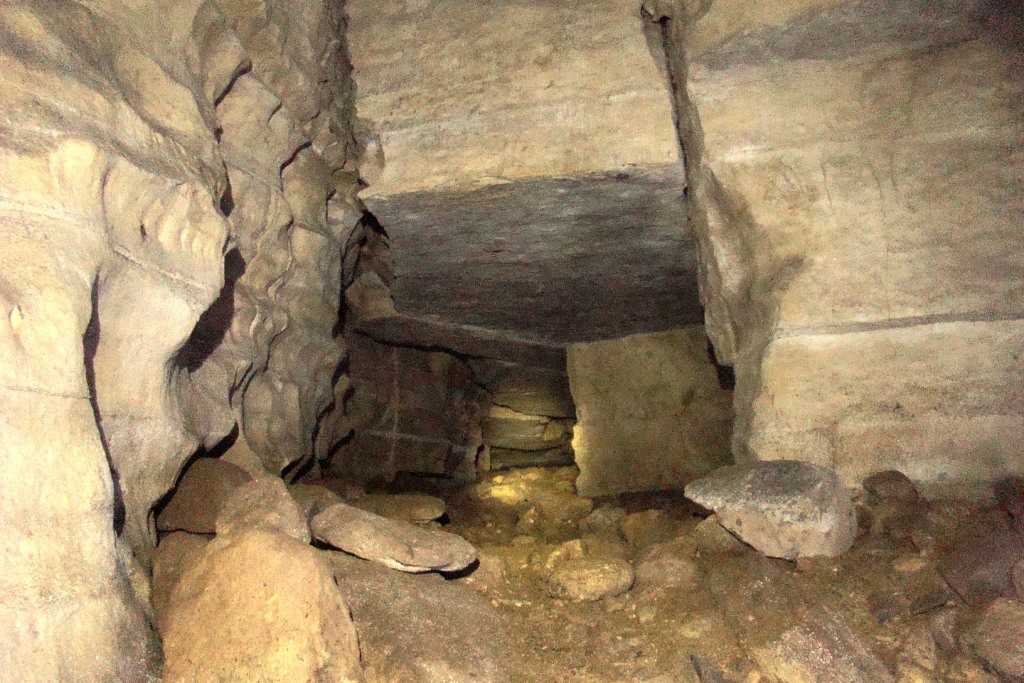
The archaeological findings were genuine but modest. They uncovered pottery and a burial site dating to around 1500 BCE, indicating long-term human use of the cave's entrance areas. The expedition found no evidence of a metal library, artificial tunnels, or extraterrestrial artifacts. The seemingly man-made straight walls and right-angled passages that had fueled speculation were identified as natural jointing and block-breakdown patterns, common in this type of limestone and shale formation.