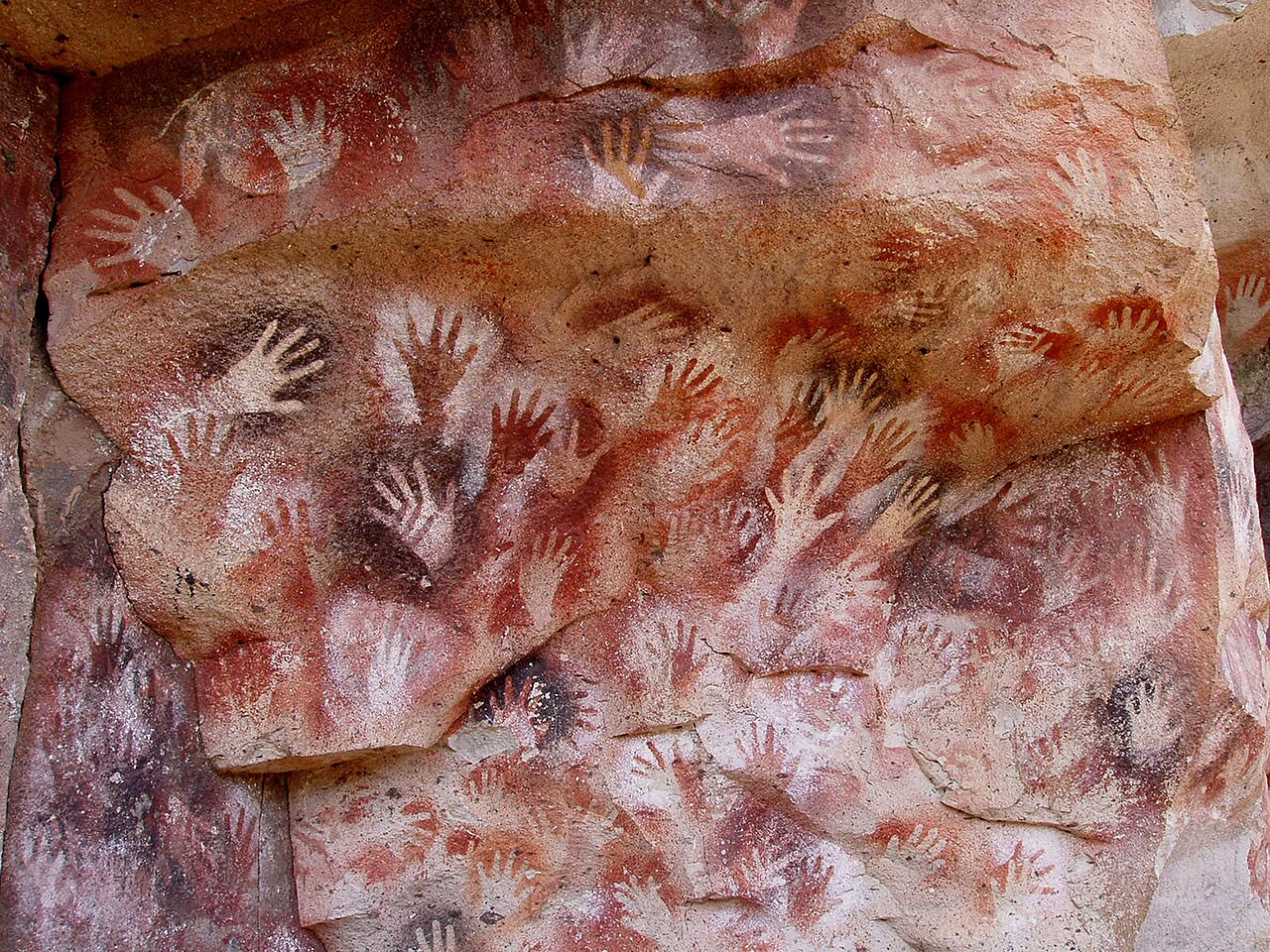
9,000-year-old hand stencils used mineral pigments whose iron oxide and manganese sources have been geochemically traced to specific outcrops kilometers away. Ancient paint supply chains.
Mariano, Public domain, via Wikimedia Commons
The Mineral Recipe
The art inside Cueva de las Manos is a direct record of early Holocene geology and chemistry. The bright colors applied to the rock walls were made from specific minerals, ground into fine powders. Scientific analysis using techniques like X-ray diffraction (XRD) and scanning electron microscopy has identified the precise composition of these ancient paints. The reds and purples come from iron oxides, specifically hematite (α-Fe₂O₃) and maghemite (γ-Fe₂O₃). Yellows were derived from natrojarosite and goethite (α-FeOOH).
Black pigments were sourced from manganese oxides, primarily pyrolusite (β-MnO₂) and other forms like hollandite. White was created using the clay mineral kaolin. In some cases, green earth pigments, identified as celadonite or glauconite, were also used. To improve the paint's consistency and adhesion to the rock's surface, the artists sometimes mixed in gypsum as a binder. The durability of these mineral-based paints, sheltered from the elements, has allowed them to persist for millennia.
Geochemical Fingerprinting
Analysis of the paint is not limited to identifying the minerals. Modern archaeometric studies can trace the pigments back to their points of origin. Researchers use methods like portable X-ray fluorescence (pXRF) to determine the unique elemental signature of the paint samples. This signature includes the primary elements (like iron or manganese) but also trace elements present in the specific geological deposit.
By comparing the elemental fingerprints of the cave pigments to those of mineral outcrops in the surrounding Patagonian landscape, scientists can map the artists' supply routes. This work shows that some pigments, like green earth, were locally sourced, while others were transported from kilometers away. The presence of obsidian flakes, not native to the immediate area, further indicates that the people who created this art were part of wider networks of travel and resource collection. This geochemical evidence transforms the artwork from static images into a dynamic record of movement, geological knowledge and resource management by hunter-gatherer societies that began occupying the site as early as 10,000 years ago.
💡Fun Facts
The stencils were created by spraying liquid pigment through hollowed-out bird bones.
The vast majority of the more than 800 handprints are of the left hand, suggesting the artists were predominantly right-handed.
One of the hand stencils appears to have six fingers.
Besides hands, the art depicts dynamic hunting scenes with guanacos (a native camelid), rheas (a flightless bird), and geometric shapes.