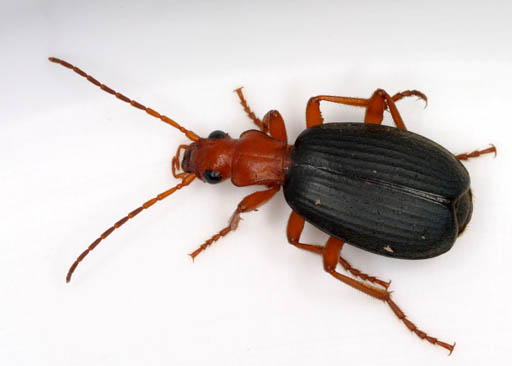
A biological pressure cooker
Found on every continent except Antarctica, bombardier beetles are ground beetles (family Carabidae) with a uniquely explosive defense mechanism. When threatened, these insects can produce a violent chemical reaction in their abdomen, ejecting a scalding, noxious spray with an audible "pop". This remarkable ability stems from a specialized gland system with two compartments.
The first is a compressible reservoir that stores a stable aqueous solution of two primary chemicals: hydroquinones and hydrogen peroxide. The second, a thick-walled reaction chamber, is lined with secretory cells that produce a mix of enzymes, mainly catalases and peroxidases. Under threat, the beetle contracts muscles around the reservoir, forcing the chemical precursors through a valve into the reaction chamber. This initiates a violent, exothermic reaction. The enzymes instantly break down the hydrogen peroxide into oxygen and water, and oxidize the hydroquinones into irritating p-quinones.
High-speed pulse jet
The chemical reaction raises the mixture's temperature to 100°C, boiling a portion of it and creating the pressure needed to expel the spray. The entire process is not a single continuous stream but a rapid series of pulses, with some species capable of firing between 300 and 1000 pulses per second. This pulsed mechanism is controlled by a passive feedback loop; the pressure from the initial explosion forces the inlet valve to close, momentarily cutting off the reactants. This allows the chamber to briefly cool before the next pulse, preventing the beetle from being harmed by its own weapon.
The ejected spray is a potent deterrent against predators like ants, spiders, frogs, and birds. The African bombardier beetle (Stenaptinus insignis) is an exceptional marksman. It can rotate the tip of its abdomen like a turret to aim its spray in almost any direction, even targeting specific limbs of an attacking ant or locations on its own back. The beetle has enough reactants for about 20 discharges before its glands are depleted. Some beetles have even been observed using their defense after being swallowed by a toad, forcing the amphibian to vomit them back up, alive and coated in mucus.