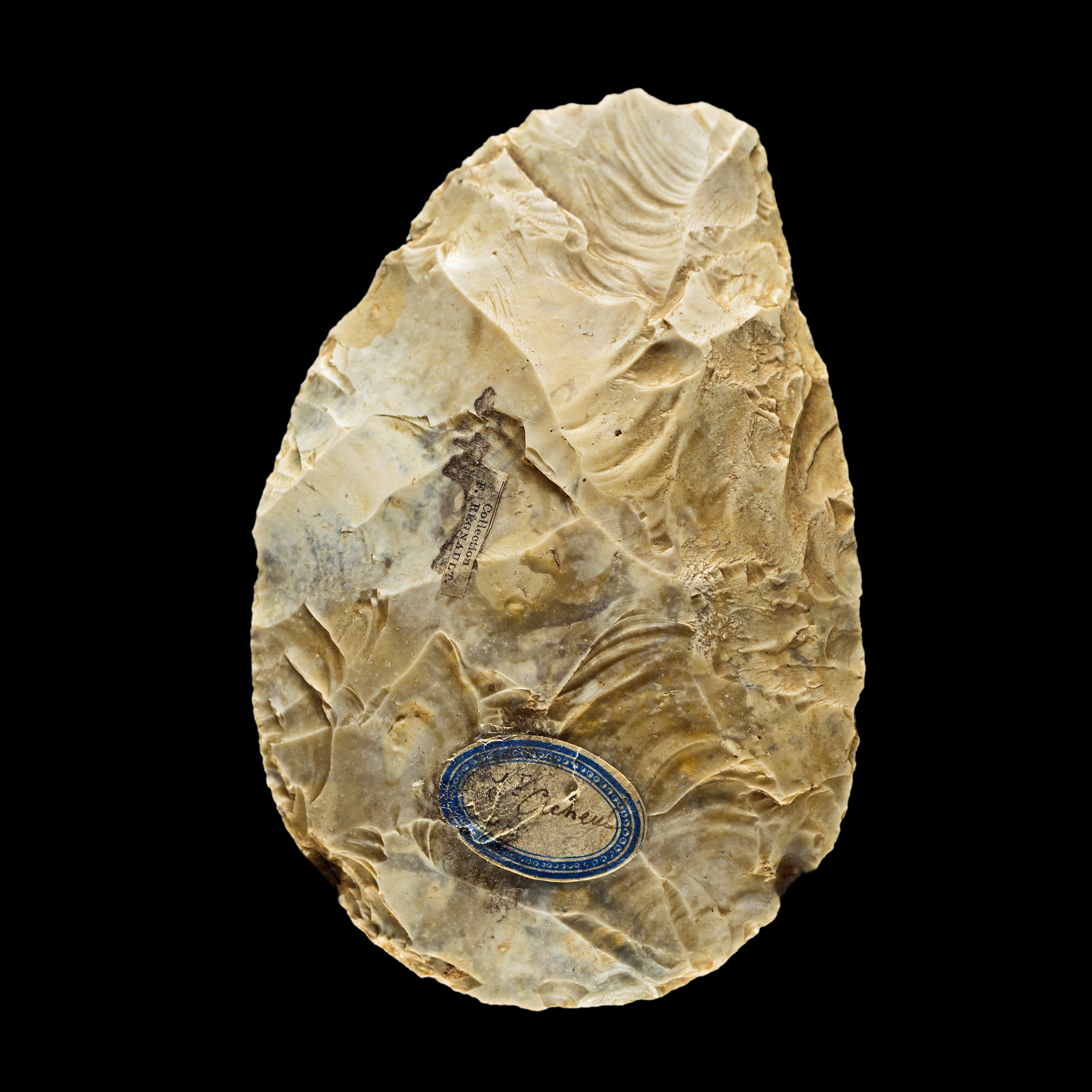
A tool of surprising endurance
The Acheulean handaxe is one of the longest-used tools in human history, emerging around 1.76 million years ago and persisting for well over a million years. This technology, named after the site of Saint-Acheul in France, is characterized by its distinctive oval or pear shape. These tools were manufactured by hominins like Homo erectus and Homo heidelbergensis. The Olorgesailie basin in Kenya is an important site for understanding this period, containing one of the largest accumulations of these handaxes ever discovered.
Excavations at Olorgesailie, which began in 1942, have revealed thousands of tools dating from 1.2 million to 490,000 years ago. The hominins here used up to 14 different types of local volcanic rock to craft their tools. One quarry site, dated to about 990,000 years old, shows where early humans struck huge flakes from volcanic outcrops. The only hominin fossil found at the site, a partial braincase from around 900,000 years ago, is believed to be Homo erectus. Its discovery 1.5 km from a dense deposit of handaxes from the same geological layer links this species to the tools.
The symmetry puzzle
The most persistent question about Acheulean handaxes is why they are so symmetrical. Many show a degree of craftsmanship that goes beyond what is needed for butchering animals or digging for tubers. This has led to several non-functional explanations. One prominent idea is the "sexy handaxe theory," proposed by Marek Kohn and Steven Mithen in 1999. They suggested that a well-made, symmetrical handaxe served as a reliable signal of fitness to potential mates. The ability to create such an object demonstrated good genes and resourcefulness—much like a peacock's tail.
This theory points to finds of oversized, pristine handaxes that show no signs of use, suggesting they were not purely utilitarian. Other researchers argue that symmetry could simply be a byproduct of an efficient manufacturing process for creating a long-lasting edge. Another hypothesis is that the act of creating a symmetrical object was cognitively rewarding for the maker. The process of imposing order and form on a stone may reflect the development of more complex spatial thinking and social learning in early humans. The debate continues, but the handaxes at Olorgesailie remain evidence of a long-vanished mind, showing early human cognition and perhaps even a sense of beauty.