The isotopic fingerprint
On the remote, 1.2-square-kilometer Akilia Island in southwestern Greenland, geologists found rocks that change our understanding of when life began. These rocks are part of the Akilia supracrustal belt, one of the oldest known rock formations on Earth. In 1996, a team of scientists announced a startling finding: tiny grains of graphite (a form of carbon) trapped inside apatite crystals within these rocks had a peculiar chemical signature. The graphite was dated to be at least 3.8 billion years old.
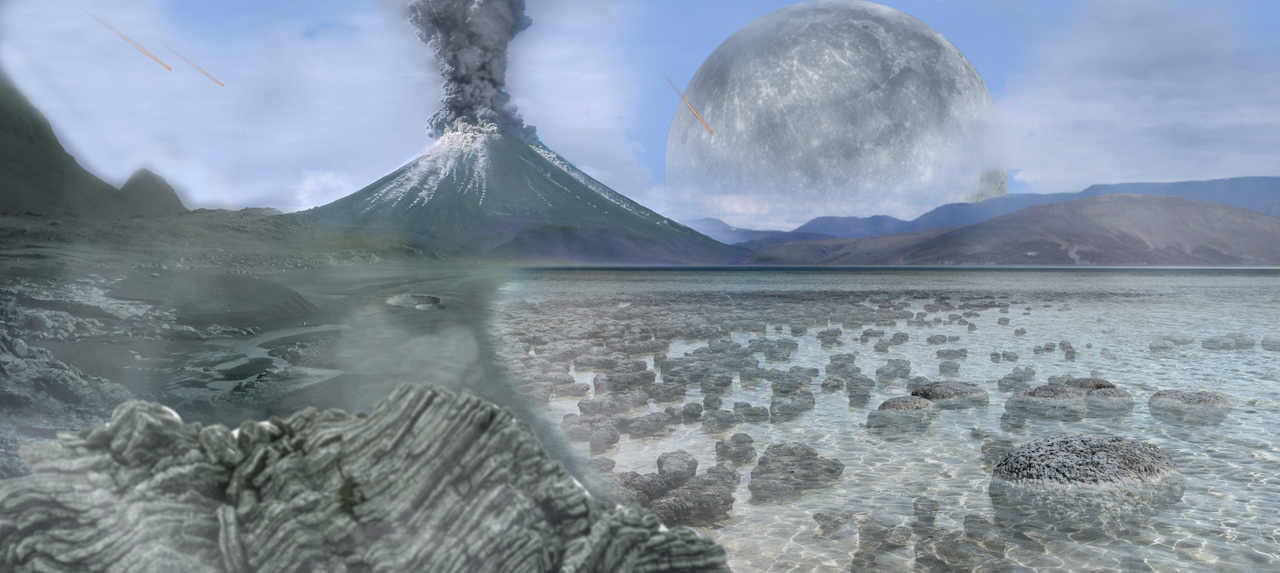
The evidence hinges on carbon isotopes. Carbon has two stable isotopes: the lighter carbon-12 (¹²C) and the heavier carbon-13 (¹³C). Biological processes, like photosynthesis, have a preference for the lighter ¹²C isotope. This metabolic preference means that carbon processed by living organisms becomes enriched in ¹²C, leaving an isotopic record. When scientists measured the ratio of these isotopes in the Akilia graphite, they found it was significantly depleted in ¹³C, a state described as "isotopically light." The specific values, or δ¹³C, were as low as -49‰ (parts per thousand), well within the range expected for biological processes and far different from typical non-biological carbon. If this interpretation is correct, it pushes the origin of life back to the Eoarchean, a time when Earth was just recovering from a period of intense asteroid bombardment.
A continuing debate
The claim for 3.8-billion-year-old life on Akilia is the subject of scientific debate. The primary challenge concerns the history of the rocks themselves. These ancient formations have been subjected to immense heat and pressure over billions of years, a process called metamorphism. Some studies suggest the rocks are not sedimentary—formed in an ancient ocean—but are instead highly altered igneous rocks. If the rocks were not laid down as sediment in water, it becomes much harder to argue they trapped signs of ancient marine organisms.
Critics also argue that the metamorphism itself could have altered the carbon isotope ratios. Abiotic, high-temperature chemical reactions, such as Fischer-Tropsch synthesis, can produce isotopically light carbon that mimics a biological signature. Other researchers have re-examined the specific rock samples and have been unable to find any graphite inclusions within the apatite crystals at all, questioning the original observations. Proponents of the biogenic origin have countered with further studies on the rock's geochemistry, arguing that features like oxygen isotope ratios support a sedimentary origin in a hydrothermal setting. The debate continues, with each new study adding to the geological history of Akilia Island.