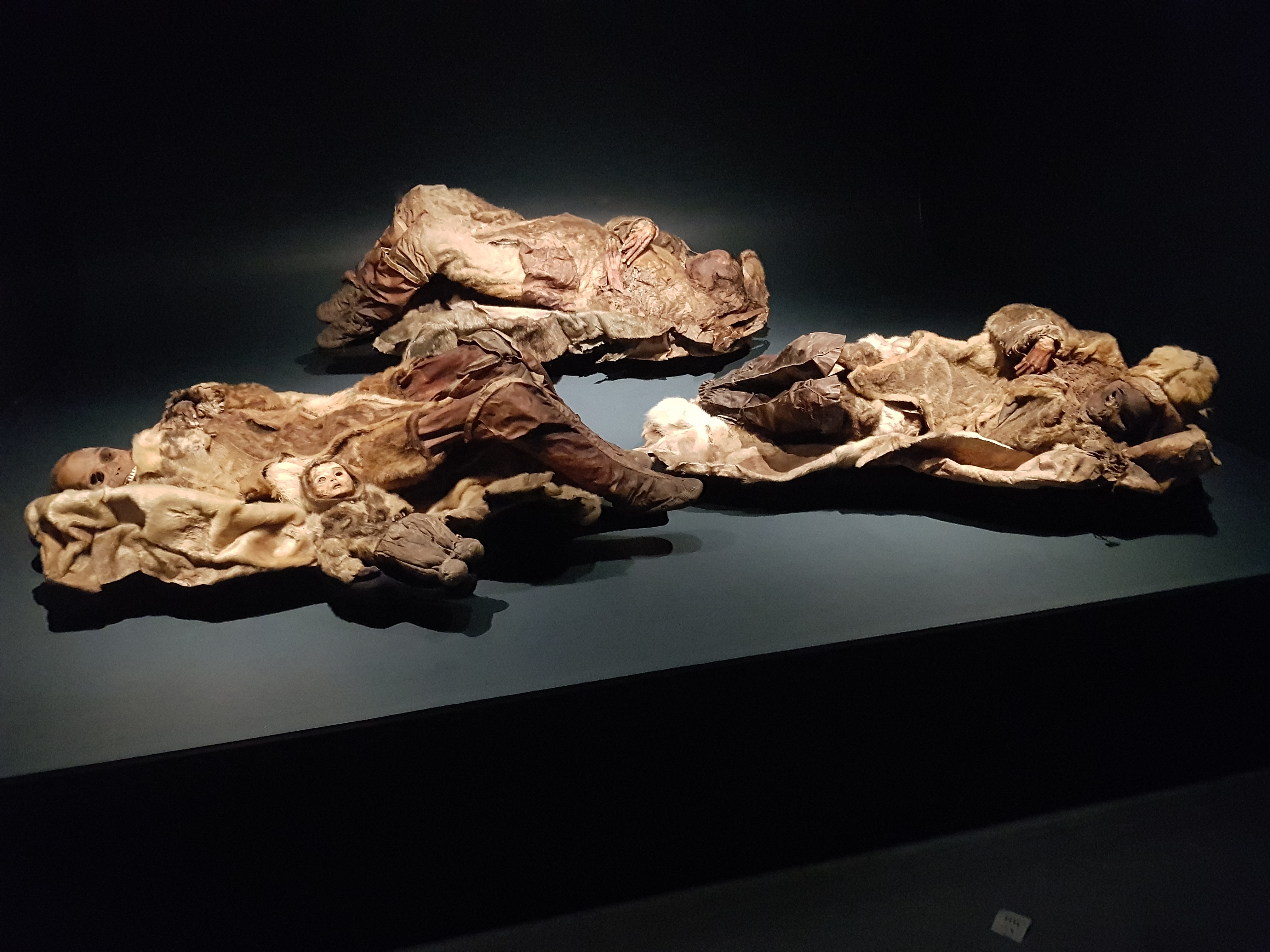
Eight 500-year-old Inuit mummies frozen in Greenland ice. Clothes, tattoos, and even their last meals preserved, revealing how people thrived in the harshest climate on Earth.
Kenny McFly, CC BY-SA 4.0
A chance discovery under a rock
In 1972, two brothers, Hans and Jokum Grønvold, were hunting near the abandoned Inuit settlement of Qilakitsoq when they found a gravesite protected by a rock overhang. Inside were the bodies of six women and two children, stacked between layers of animal skins. Radiocarbon dating places their deaths around 1475 CE. These were not mummified bodies in the Egyptian sense; instead, the sub-zero temperatures and dry, dehydrating winds of the arctic winter naturally freeze-dried their remains.
The eight individuals were arranged in two separate graves about a meter apart. One grave held three women, a four-year-old boy, and a six-month-old infant. The other contained three women. DNA analysis confirmed familial relationships among some of the individuals, suggesting a small family unit composed of sisters and their children. The infant, a boy, is the best-preserved of the group, likely due to his small body size allowing for faster freezing. It is believed he was buried alive or suffocated after his mother's death, a traditional practice to prevent a slow death from starvation when no one could care for the child. The four-year-old boy had signs of a congenital hip disorder and may have had Down syndrome.
An intimate look at Thule life
The preservation of the Qilakitsoq mummies shows the lives of the Thule people 500 years ago. Their clothing, a collection of 78 individual garments, is evidence of their survival skills. They wore layered outfits, including inner parkas made from bird skins with the feathers turned inward for insulation and outer parkas of sealskin for water resistance. Their boots, called kamiks, were made of depilated sealskin.
Five of the six women had facial tattoos. These markings, made by pulling soot-dipped sinew through the skin, were not visible to the naked eye on the darkened skin but were revealed using infrared photography. The patterns consist of dark blue or black lines arching over the eyebrows, on the cheeks, and below the chin. The one untattooed adult woman may have been unmarried.
Analysis of the bodies reveals details about their health and diet. Isotopic analysis shows a diet composed of about 75% marine life. Soot in their lungs was common, a consequence of using seal-oil lamps inside their homes. One older woman suffered from a malignant tumor that likely affected her sight and hearing and had a poorly healed collarbone. Many of the older women showed significant tooth wear, likely from using their teeth to soften animal hides for clothing.
💡Fun Facts
The six-month-old boy was so small and well-preserved that his discoverers initially thought he was a doll.
The four-year-old boy suffered from Calvé-Perthes disease, a condition that affected his thighbone and would have prevented him from walking.
In addition to seal and caribou, their clothing included materials from at least five different bird species.
One woman had a kidney stone, while another may have died from a bowel obstruction.
The Greenland National Museum's hours vary by season. From April 15 to September 15, it is open daily from 10:00 AM to 5:00 PM. From September 15 to April 15, hours are 12:00 PM to 4:00 PM daily. The museum is closed on major holidays like Christmas and New Year's Day.
Admission
Admission is 100 DKK for adults. Entry is free for students and children.
Accessibility
The original gravesite is in a remote, inaccessible wilderness location. The four best-preserved mummies are on permanent display in Nuuk at the Greenland National Museum, which is accessible.