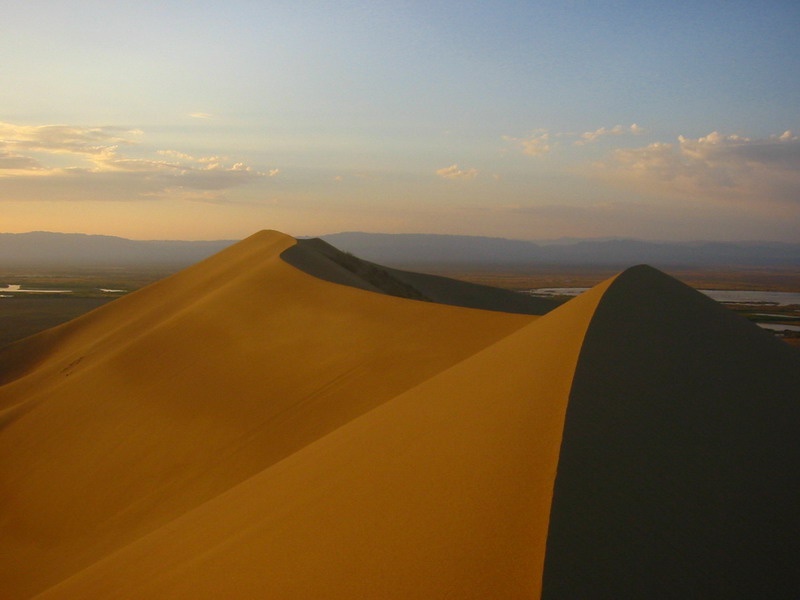
The Physics of a Singing Dune
The Altyn-Emel Singing Dune is a barchan, or crescent-shaped dune, approximately 3 kilometers long and reaching a height of 150 meters. The sound it produces is not caused by wind, but by the movement of sand itself. When sand on the steep leeward face of the dune avalanches—either naturally from wind deposition or triggered by a person sliding down—it emits a powerful, low-frequency hum. This sound can reach up to 105 decibels, comparable to a loud car horn, and can be heard for several kilometers.
The acoustic phenomenon depends on a precise set of physical conditions. First, the sand must be completely dry; any moisture will silence the dune. Second, the sand grains must be remarkably uniform in size, typically between 0.1 and 0.5 millimeters in diameter. These grains are mostly spherical and composed of quartz sand with a silica coating.
During an avalanche, this collection of uniform grains shears and slides in a synchronized manner. The friction between the countless grains creates a vibration. This synchronized motion causes the entire sliding sand layer to vibrate as a single sheet, acting as the diaphragm of a massive natural loudspeaker. The vibration produces a sound with a fundamental frequency between 75 and 105 Hz, which gives it the organ-like quality.
A Stationary Giant
The Singing Dune is located in Altyn-Emel National Park, on the right bank of the Ili River. It formed over millennia as strong winds carried sand from the river's shoals inland. Its location between the Greater and Lesser Kalkan mountain ranges is significant. These mountains create a wind corridor that deposits the sand but also prevents the dune from migrating across the steppe, a behavior typical of most barchan dunes. As a result, the Singing Dune has remained in a relatively fixed position for thousands of years.
The dune is actually a complex of two main structures, a larger Southern Dune and a smaller Northern Dune, covering a total area of 240 hectares. The sound is most prominent from the Southern Dune. The constant action of the wind blows sand up the gentler slope to the crest. When the angle of repose—typically around 32-35 degrees—is exceeded, the sand avalanches down the steep slip face, generating its characteristic song. This geological oddity is one of only about 35 large-scale singing sand dunes known worldwide.