Deep-sea bone devourers
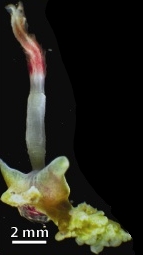
In February 2002, researchers from the Monterey Bay Aquarium Research Institute (MBARI) were exploring the Monterey Canyon with a remotely operated vehicle. At a depth of 2,893 meters (9,491 feet), they encountered the carcass of a gray whale. The skeleton was covered in a strange, shaggy red carpet, which turned out to be a previously unknown type of worm. Officially named Osedax, Latin for "bone-devourer," these creatures have a bizarre anatomy. The visible parts of the worms are all females, possessing colorful, feathery plumes that act as gills to absorb oxygen from the water. They have no mouth, stomach, or anus.
The main body of the female worm is a muscular trunk that can retract into a transparent tube for protection. Below the trunk, hidden inside the bone, is the most unusual feature: a branching, greenish root system that houses an egg sac. These roots anchor the worm; they are important for its survival. The worms secrete acid through these root tissues to dissolve the hard calcium phosphate of the bone. This grants them access to the lipids and collagen locked inside, which are then digested by symbiotic bacteria living within the roots. The two species first discovered at this site were named Osedax rubiplumus and Osedax frankpressi. Since this initial finding, over 30 species have been identified worldwide.
An outsourced digestive system
The Osedax worm's root system is a biological partnership. The worms themselves cannot digest bone. Instead, the roots are packed with symbiotic bacteria from the order Oceanospirillales. The worm secretes acid, likely using a proton pump like to the mechanism in human kidneys, to demineralize the bone. Once the bone matrix is dissolved, the bacteria take over, using specialized enzymes to break down the remaining proteins and fats. The worm then absorbs these nutrients through its roots. It has effectively outsourced its entire digestive process to its bacterial partners.
Reproduction in Osedax is equally strange. The visible, bone-eating worms are exclusively female. Males are microscopic, paedomorphic organisms that never develop beyond a larval stage. Dozens, sometimes hundreds, of these dwarf males live inside the gelatinous tube that surrounds a single female. Their only function is to produce sperm, which they generate using yolk reserves from their own egg stage. Females spawn continuously, releasing hundreds of fertilized eggs each day. The larvae drift through the water column for up to two weeks before, if they are lucky, settling on a new skeleton. A larva that lands on bone develops into a female, while a larva that lands on an existing female becomes a resident dwarf male. The symbiotic bacteria are not passed down from the mother; each new female worm must acquire them from the environment.