A Discovery in the Abyss
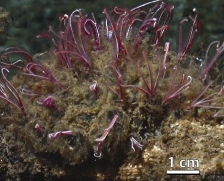
In February 2002, scientists from the Monterey Bay Aquarium Research Institute (MBARI) were exploring the Monterey Canyon with the remotely operated vehicle (ROV) Tiburon. At a depth of 2,893 meters (9,491 feet), they came across the skeleton of a gray whale on the seafloor. The bones were covered in what looked like a strange, red shag carpet. Upon collecting samples, researchers realized this was not a plant, but a new genus of bizarre worms. They named it Osedax, Latin for "bone-devourer."
These creatures, commonly called bone-eating worms or zombie worms, have no eyes, mouth, or stomach. The visible part of the animal is the female, which has a trunk ending in reddish feathery plumes that act as gills, absorbing oxygen from the water. The rest of the female's body—a greenish root-like structure—is hidden from view, bored deep inside the bone itself. Since the initial finding, researchers have identified 32 species of Osedax worldwide, with 18 of those found in Monterey Bay alone.
The Biology of a Bone-Devourer
Osedax worms do not mechanically drill into bone. Instead, their root tissues secrete acid to dissolve the bone's mineral components. This chemical boring is accomplished using enzymes, including a proton pump, which are highly concentrated in the root system. Once the bone matrix is dissolved, the worms can access the lipids and collagen trapped within.
Digestion is handled by symbiotic bacteria of the order Oceanospirillales, which live inside the worm's roots. These bacteria break down the complex organic compounds from the bone into simpler nutrients that the worm can absorb. The worm gets nutrition, and the bacteria get a safe place to live with direct access to food. The worms acquire these bacteria from the environment after settling on a bone, as they are not present in the eggs.
The reproductive strategy of Osedax is extreme. The visible, bone-boring worms are all females. Males are microscopic, paedomorphic dwarves that never develop beyond a larval stage. Dozens or even hundreds of these males live inside the gelatinous tube that surrounds the female's trunk, producing sperm. A single female can accumulate a "harem" of more than 600 males. This arrangement likely evolved because finding mates in the vast, food-scarce deep sea is difficult, and it prevents males and females from competing for the limited resource of a bone.